Quick Links
Micron Drops 13%: Sector-Wide AI Chip Unwind — Leverage Impact, Key Levels & Cross-Market Fallout
Data Snapshot
Key Takeaways
- •MU fell ~13% (currently -11.85% at $856.90) on sector-wide AI chip de-risking, NOT a company-specific fundamental deterioration.
- •Leverage risk is extreme: a 100x long MU CFD entered above ~$873 would have faced full liquidation intraday — position sizing must account for this volatility range.
- •The drop occurred AFTER Micron secured Nvidia memory-chip approval — a textbook 'sell the news' / crowded-positioning unwind.
- •Cross-market contagion: NVDA, AMD, TSM, and the NASDAQ 100 Index all face correlated downside pressure while semiconductor sentiment remains negative.
- •The structural HBM/AI demand thesis is intact; medium-term dip buyers should wait for SOXX/SMH volume exhaustion as the confirmation trigger before adding exposure.
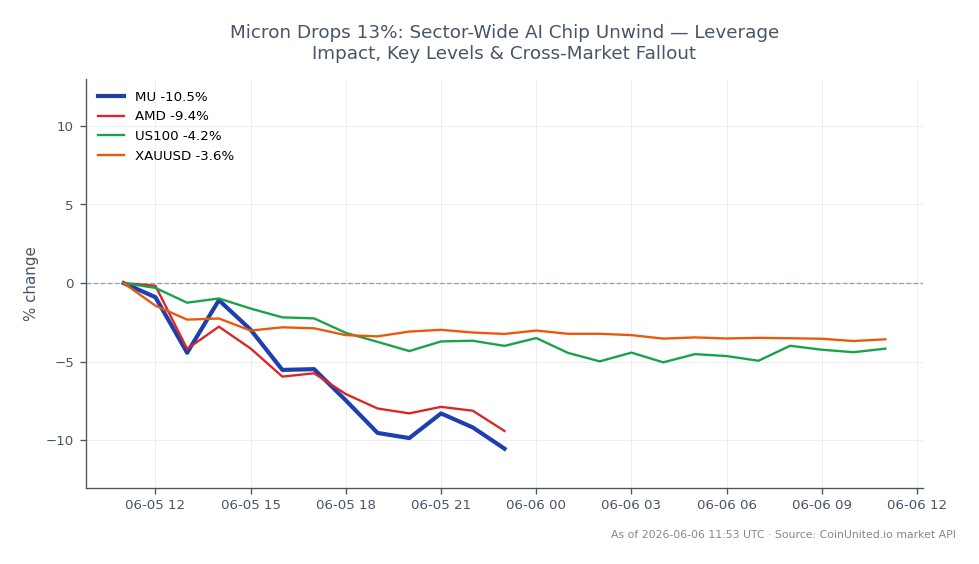
Micron Technology (MU) plunged approximately 13% in a single session as part of a sweeping semiconductor selloff that erased roughly $1.3 trillion in chip-sector market cap, according to coverage aggr
Event Summary
Micron Technology (MU) plunged approximately 13% in a single session as part of a sweeping semiconductor selloff that erased roughly $1.3 trillion in chip-sector market cap, according to coverage aggregated by Perplexity Finance. Notably, the move occurred *despite* Micron securing memory-chip approval from Nvidia — a fundamentally positive development — underscoring a classic "sell the news" dynamic in an over-extended sector. Current live data shows MU trading at $856.90 (session range: $851.67–$884.09), down 11.85% on the day, with volume running well above daily averages per Perplexity's market data.
There was no company-specific negative catalyst — no guidance cut, no earnings miss, no litigation. This is a positioning shock: richly valued AI/memory names unwound simultaneously, driven by institutional de-risking, ETF basket selling, and quant factor rotation. The earnings miss revenue shock framing is secondary here; the primary driver is crowded positioning in the AI revenue monetization and chip demand surge theme hitting a sentiment ceiling.
Leverage Impact Analysis
For leveraged traders on CoinUnited.io's stock CFDs (up to 2000x leverage), a 13% single-session move is an extreme stress event.
Worked example — Long MU CFD: A trader entering a 50x long MU CFD at $970 (pre-drop level) would face a ~65% drawdown on margin at the $856.90 current price — well past typical liquidation thresholds. At 100x leverage, a move of just 1% triggers a 100% margin wipe; a 13% move would have liquidated long positions opened anywhere above approximately $873 with 100x leverage.
Worked example — Short MU CFD: Conversely, a 30x short entered at $970 would show a gain of roughly 390% on initial margin at current prices — but faces violent snap-back risk if the sector stabilizes. Short squeeze dynamics in semiconductor names can be rapid.
Key risk: Since this is a *sector-wide* positioning flush rather than a fundamental break, volatility is likely to remain elevated in both directions. Position sizing should reflect the possibility of sharp intraday reversals — institutions absorbing supply at volume exhaustion points are a real near-term risk for short holders. Monitor open interest and funding rates on CoinUnited.io for directional confirmation before sizing into momentum trades.
Cross-Market Impact
The ripple effects extend well beyond MU itself. NVIDIA Corporation and Advanced Micro Devices, Inc. trade as part of the same AI-chip complex and faced correlated selling pressure — any sustained weakness in memory pricing expectations feeds directly into GPU and accelerator demand narratives. Taiwan Semiconductor Manufacturing Company Ltd. is similarly exposed as the foundry underpinning most AI silicon.
At the index level, the NASDAQ 100 Index carries meaningful semiconductor weighting; a $1.3T chip-sector draw-down creates measurable drag on the index. Traders holding US100 CFD longs should treat semiconductor momentum as a leading indicator.
Gold / US Dollar benefits marginally from risk-off rotation — a broad tech unwind historically nudges capital toward safe-haven assets, though this is a sentiment flow rather than a macro-data-driven move. FX impact is limited but KRW and TWD face mild pressure given semiconductor export exposure.
For a deeper framework on how sector-level crypto and tech earnings miss repricing propagates across asset classes, see our dedicated theme analysis.
Trading Considerations
The $851.67 intraday low represents the immediate support level to watch — a decisive break below opens further downside toward prior consolidation zones. Resistance sits at the $884.09 session high; reclaiming this level with volume would signal institutional absorption. The critical signal to monitor is whether SOXX/SMH semiconductor ETFs show volume exhaustion on down days — a tapering of sell volume would precede any credible mean-reversion bounce in MU and peers.
Given that the structural AI/HBM demand thesis remains intact (Nvidia memory-chip approval is still a net positive), medium-term traders may find asymmetric setups emerging — but momentum remains negative and systematic sellers are likely still active. Staggered entries with defined risk levels outperform single-entry bets in this environment. For those exploring how to trade earnings misses in semiconductor names, sector ETF stabilization is the prerequisite confirmation signal.
Trade Micron Technology, Inc. on CoinUnited.io
Frequently Asked Questions
At 100x leverage, a 1% adverse move wipes 100% of margin — MU's 13% drop would have liquidated any long position opened above approximately $873 with 100x leverage. Traders using 50x leverage from near $970 levels faced roughly 65% margin drawdown, underscoring the critical importance of stop-loss placement in high-beta semiconductor names.
Continue Exploring
Disclaimer: This brief is for educational purposes only and is not investment advice.