Quick Links
FINRA Scraps $25K PDT Rule: Broker Stocks Surge as Day-Trading Barrier Falls
Data Snapshot
Key Takeaways
- •The SEC has fully eliminated the Pattern Day Trader rule and its $25,000 minimum equity requirement, replacing it with a real-time risk-based intraday margin system effective 45 days post-adoption.
- •Robinhood (HOOD) surged ~7.6% and Webull proxies jumped >9% on the news — a 50x long HOOD CFD captured a ~380% margin return on the initial move alone.
- •The structural beneficiaries extend beyond HOOD to exchanges (CBOE, Nasdaq) via higher volume and fee income, and options market makers via increased 0DTE/short-dated activity.
- •Cross-market spillover is limited at the index level (S&P 500, NASDAQ 100) but material for small-cap equities and retail-favorite options — watch for meme-stock volatility resurgence.
- •Phase 2 risk: leveraged broker positions should be sized with the 45-day implementation gap in mind — DARTs and active account data at next earnings are the key confirmation or deflation triggers.
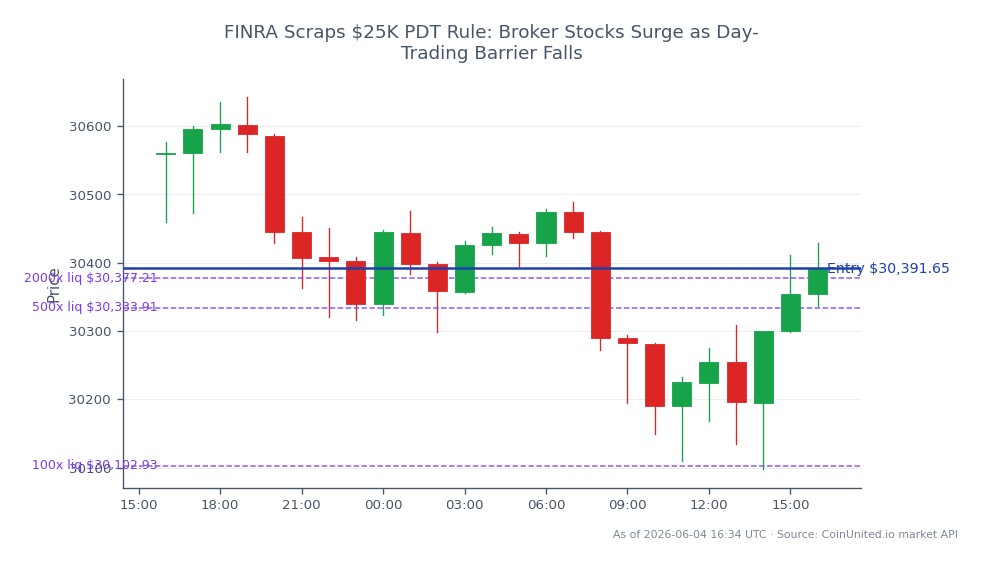
The U.S. Securities and Exchange Commission has approved the elimination of the Pattern Day Trader (PDT) rule, including its $25,000 minimum equity requirement that restricted frequent day traders for
Event Summary
The U.S. Securities and Exchange Commission has approved the elimination of the Pattern Day Trader (PDT) rule, including its $25,000 minimum equity requirement that restricted frequent day traders for decades. According to reporting from HeyGoTrade and Moomoo, the formal PDT classification is fully abolished — not merely adjusted — and replaced by a real-time, risk-based intraday margin system applicable to all accounts regardless of size. The new framework takes effect 45 days after the rule's effective date.
Market reaction was immediate. Robinhood Markets (HOOD) surged approximately 7.6% on the news, while Webull and related platform proxies jumped over 9%, signaling clear institutional repricing of retail brokerage business models.
Leverage Impact Analysis
This regulatory shift is a structural catalyst for broker CFD traders, not a short-term noise event. Consider a trader holding a 50x long HOOD CFD position before the announcement: a 7.6% move in HOOD generates a 380% return on margin — but the same leverage also means a 2% adverse move triggers a 100% margin loss. With the news already priced into the initial spike, leveraged longs now face elevated reversal risk if volume data disappoints post-implementation.
The more nuanced leverage play is the two-phase repricing window: Phase 1 (now through effective date) rewards momentum longs on broker CFDs as markets reprice addressable volume upside. Phase 2 (post-implementation) will be data-driven — Daily Average Revenue Trades (DARTs), active accounts, and margin balances will either confirm or deflate the thesis. Traders running high-leverage broker positions should treat Phase 2 catalysts (quarterly earnings, DARTs disclosures) as key exit or re-entry signals. Monitor funding rates on CoinUnited.io for positioning extremes in related CFDs.
Cross-Market Impact
The primary impact concentrates in retail-facing broker and exchange stocks — HOOD, Interactive Brokers Group, Charles Schwab, and CBOE Global Markets as a volume/fee beneficiary. The S&P 500 Index and NASDAQ 100 Index face only second-order effects: incremental retail turnover boosts index liquidity but won't drive index-level price discovery given large-cap concentration.
The more actionable cross-market read is in options markets and small-cap equities. Sub-$25k accounts can now freely execute intraday option round-trips, including 0DTE contracts, amplifying gamma-driven intraday swings in retail-favorite names. This structurally lifts CBOE volumes and could reignite meme-stock dynamics. Crypto-adjacent broker platforms like Robinhood — which offer both equities and crypto — stand to benefit as a larger, more active user base drives dual-market volume growth. For broader stocks market outlook context, this regulatory pivot fits within the SEC's current access-expansion posture.
Forex and commodities show no direct linkage. The macro read is a mild risk-on signal: lower retail trading barriers = increased speculative activity = marginal positive for risk assets.
Trading Considerations
Key levels to watch on HOOD: the initial 7.6% spike sets a near-term resistance reference; a consolidation and retest of pre-announcement levels would represent a higher-quality entry for traders seeking Phase 2 exposure. The 45-day implementation window creates a defined catalyst timeline — DARTs and account-growth disclosures at the next earnings cycle are the primary confirmation signals.
Risk factors include regulatory reversal risk if retail loss rates spike post-implementation, broker credit stress from expanded intraday margin exposure, and volatility clustering in low-liquidity small-caps that could trigger political pushback. Position sizing should account for the event already being partially priced.
Start Trading on CoinUnited.io
Create Your Free Account → — Trade crypto, stocks, forex, indices, and commodities with up to 2000x leverage and zero fees.
Frequently Asked Questions
The initial 7.6% HOOD spike is already priced in — high-leverage longs (e.g., 50x) now carry significant reversal risk on any volume disappointment. The cleaner leverage opportunity is the Phase 2 catalyst: DARTs and account data at the next earnings cycle will confirm or deflate the volume thesis.
Continue Exploring
Disclaimer: This brief is for educational purposes only and is not investment advice.