Quick Links
Quantinuum IPO Raises Up to $1.68B at $14B+ Valuation — What Leveraged Traders Need to Know
Data Snapshot
Key Takeaways
- •Quantinuum priced at $53–$55/share (26.5M shares) implying a $14.3B+ market cap; Reuters' $1.68B figure likely includes full greenshoe exercise — treat $1.4–1.7B as the confirmed capital raise range.
- •Leverage risk is extreme: at 50x long QNT CFD, a 10% intraday fade (entirely normal for frontier tech IPOs) is a full margin wipeout — position sizing below 5x is advisable until a post-IPO trading range is established.
- •Honeywell (HON) offers a lower-volatility CFD expression of the Quantinuum thesis, with potential sum-of-the-parts re-rating as QNT's $14B+ valuation crystallizes on HON's balance sheet.
- •NASDAQ 100 Index CFD traders should note QNT's eventual index inclusion as a passive flow tailwind — watch reconstitution announcements for timing.
- •The U.S. Commerce Department's tentative $100M funding agreement positions QNT as a policy-aligned strategic tech asset, similar to the premium seen in leading AI semiconductor names — this supports narrative durability but not near-term fundamental cash flows.
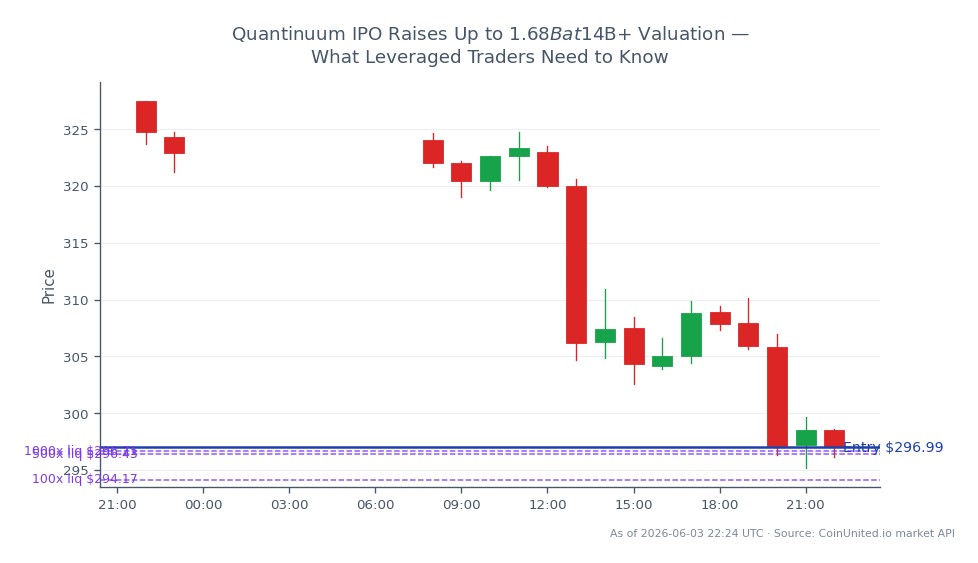
As reported by Reuters and confirmed by Renaissance Capital and The Quantum Insider, Quantinuum — a quantum computing company carved out of Honeywell — has priced its Nasdaq IPO under ticker QNT. The
Event Summary
As reported by Reuters and confirmed by Renaissance Capital and The Quantum Insider, Quantinuum — a quantum computing company carved out of Honeywell — has priced its Nasdaq IPO under ticker QNT. The deal was upsized to 26.5 million shares at a $53–$55 price range, implying gross proceeds of approximately $1.40–$1.46 billion before any overallotment exercise. Reuters' cited $1.68 billion figure likely reflects final pricing plus full exercise of the 15% greenshoe, consistent with standard large-cap tech IPO mechanics. The implied market cap exceeds $14.3 billion, a dramatic step-up from a prior $5 billion pre-money valuation on a $300 million equity raise by Honeywell. The IPO was filed on May 8, 2026, with trading expected to begin on the Nasdaq Global Market in early June 2026.
Strategic context matters here: The Quantum Insider notes the upsized deal follows a tentative $100 million U.S. Commerce Department funding agreement supporting Quantinuum's trapped-ion quantum systems, positioning QNT firmly within the quantum computing investment surge alongside policy-backed deep-tech peers. This is part of a broader IPO wave & capital markets revival playing out in 2026.
Leverage Impact Analysis
QNT is a high-volatility IPO name with no direct trading history and limited public comps. For leveraged traders on CoinUnited.io (stock CFDs with up to 2000x leverage), position sizing discipline is paramount.
Worked example — Long QNT CFD at $55 (top of range):
- -At 50x leverage, a $1,000 margin controls $50,000 notional (~909 shares). A 10% post-IPO pop to $60.50 returns $5,000 (+500% on margin). A 10% fade to $49.50 wipes the position entirely — a realistic scenario for a newly listed, high-narrative stock.
- -At 20x leverage, the same $1,000 margin controls $20,000 notional (~364 shares). The 10% fade leaves ~$2,000 remaining — painful but survivable with a stop.
Key risk: IPO-day volatility on frontier tech names regularly exceeds ±15–25% intraday. Upsized deals reduce the scarcity premium that drives "IPO pops", meaning fade risk is elevated. Traders should monitor whether QNT opens above or below the $55 offer price — a below-offer open signals institutional demand was softer than headlines suggest.
HON CFD angle: Honeywell retains a significant equity stake in QNT post-IPO. A QNT pop crystallizes sum-of-the-parts value for Honeywell, offering a lower-volatility leveraged expression. At 50x long HON, a 3–5% sympathy re-rating is more contained than direct QNT exposure.
Cross-Market Impact
The primary spillover is within tech equities and thematic indices. The NASDAQ 100 Index will eventually feel passive flow pressure once QNT's $14B+ market cap qualifies for index inclusion — watch for reconstitution announcements. Near-term, the successful upsizing signals robust risk appetite for long-duration growth names, which is broadly supportive for AI infrastructure and semiconductor stocks.
International Business Machines Corporation carries quantum computing exposure via its own IBM Quantum program and competes directly with Quantinuum's commercial roadmap — a successful, oversubscribed QNT IPO validates the sector TAM and could trigger re-rating discussions for IBM's quantum division. Traders tracking quantum computing stocks should note that QNT's government-aligned positioning mirrors the policy premium seen in leading semiconductor and AI compute names.
Crypto linkage is indirect but real: a well-funded, high-profile quantum computing company entering public markets reinforces narratives around post-quantum cryptographic threats to Bitcoin and Ethereum. This is a slow-burn sentiment driver, not an immediate catalyst.
Forex and commodities see no direct near-term impact from this event.
Trading Considerations
Key levels to watch: the $53 floor (bottom of IPO range) acts as the first structural support — a break below this on Day 1 would signal a failed IPO and likely trigger sharp selling. The $55 offer price is the key reference for the pop/fade decision. Given the upsized deal size, the greenshoe underwriters will defend the offer price in the aftermarket, providing a technical floor in the near term.
Risk factors: QNT has high rate sensitivity given its long-duration cash flow profile — any hawkish Fed repricing could compress the valuation multiple rapidly. Monitor open interest and funding rates on related AI/tech CFDs for broader sentiment confirmation.
Start Trading on CoinUnited.io
Create Your Free Account → — Trade crypto, stocks, forex, indices, and commodities with up to 2000x leverage and zero fees.
Frequently Asked Questions
Given that frontier tech IPOs routinely see ±15–25% intraday swings, leverage above 10x carries significant liquidation risk on a $55 entry. Most experienced leveraged traders treat new IPO names as 5x-or-below until a stable trading range emerges over the first 5–10 sessions.
Continue Exploring
Disclaimer: This brief is for educational purposes only and is not investment advice.