Quick Links
Canada Q1 Productivity Falls 0.5%: CAD/USD Bears Eye Structural Weakness, Leverage Traders Watch Unit Labour Cost Fallout
Data Snapshot
Key Takeaways
- •Statistics Canada confirmed Q1 service-sector labour productivity fell 0.5%, reversing a +1.3% Q4 rebound and extending a multi-year structural decline.
- •Leverage risk is two-sided: USD/CAD longs face a potential squeeze if inflation fears push front-end Canadian yields higher, temporarily supporting CAD — high-leverage positions (>100x) need tight stops.
- •The BoC-Fed policy divergence remains the structural macro driver; Canada's productivity at 71% of U.S. levels underpins a persistent bearish CAD bias.
- •Cross-market: TSX industrials, construction, and transportation sectors face margin pressure; global allocators may continue underweighting Canadian equities versus U.S. benchmarks.
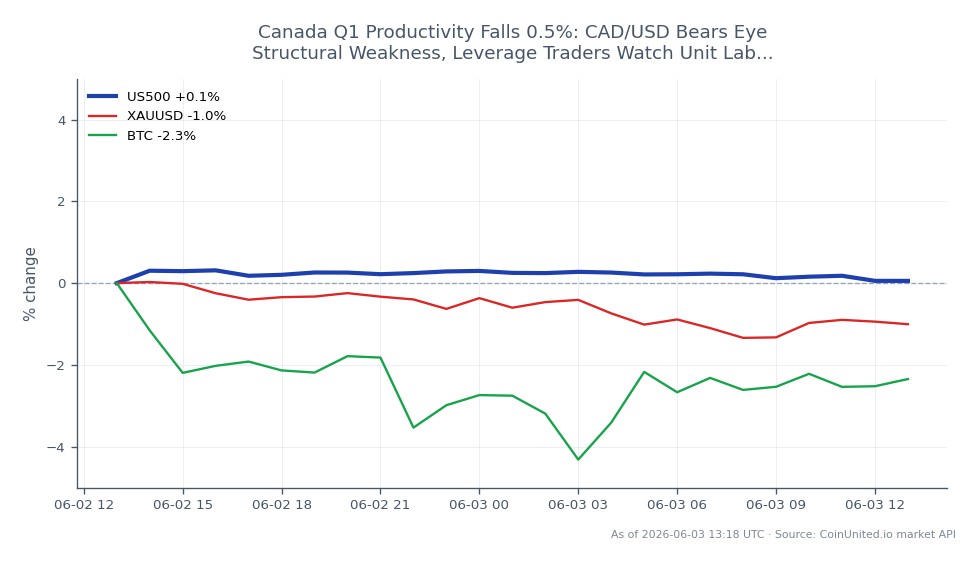
- •Gold and Bitcoin see only indirect, second-order impact — this is primarily a CAD/rates story with limited immediate spillover to commodities or crypto.
According to Statistics Canada's official Labour Productivity, Hourly Compensation and Unit Labour Cost release, labour productivity in Canadian service-producing businesses declined 0.5% in Q1, rever
Event Summary
According to Statistics Canada's official Labour Productivity, Hourly Compensation and Unit Labour Cost release, labour productivity in Canadian service-producing businesses declined 0.5% in Q1, reversing a strong +1.3% rebound in Q4. The broader backdrop reinforces a structural problem: Canadian business-sector productivity fell 0.6% in level terms between 2019 Q1 and 2024 Q2, as hours worked (+6.0%) outpaced output (+5.4%). The Bank of Canada has flagged that by 2022, Canadian productivity had fallen to just 71% of the U.S. level, a gap that continues to widen.
The OECD Economic Survey for Canada notes average labour-productivity growth of approximately 0.5% since 2019 — materially below historical norms and peer economies. Sectoral concentration is key: transportation and warehousing, construction, and manufacturing account for roughly two-thirds of the overall productivity decline, per University of Calgary research.
Leverage Impact Analysis
The primary leverage-trading angle is USD/CAD. This data point alone rarely moves spot materially, but it feeds a well-established bearish structural narrative for CAD that leveraged traders can exploit on momentum or BoC commentary.
Worked example — Long USD/CAD at 1.3650:
- -At 50x leverage on CoinUnited.io, a 0.5% adverse move (CAD strengthening to ~1.3582) wipes 25% of margin.
- -At 200x leverage, the same 0.5% move triggers near-liquidation — position sizing must account for the two-sided risk (inflation fears could temporarily support CAD via front-end yield repricing).
The critical transmission mechanism: falling productivity + stable wages = higher unit labour costs → embedded core inflation pressure → BoC faces a stagflationary dilemma. If BoC commentary leans hawkish on unit labour costs, short-term CAD support is possible, creating a counter-trend squeeze for high-leverage short-CAD positions. Conversely, if growth concerns dominate (unemployment rose from 5.6% to 6.6% year-on-year per Statistics Canada), CAD weakness resumes.
For traders following the Fed Macro Policy Crossroads theme, the BoC–Fed policy divergence is the key lever: weaker Canadian productivity reinforces the case for a wider BoC-Fed rate differential, structurally pressuring CAD.
Cross-Market Impact
Forex: USD/CAD is the primary expression. EUR/CAD and CAD/JPY offer relative-value alternatives. The 2026 Forex Market Outlook context supports a structurally bearish CAD bias given the persistent growth gap versus the U.S.
Equities / Indices: The S&P/TSX Composite faces a lower long-run earnings growth assumption versus the S&P 500 Index. TSX Industrials, construction, and transportation names face margin compression risk as unit labour costs rise. Global allocators may continue tilting toward U.S. equities on relative-productivity grounds.
Commodities: Canada's energy and mining sectors are capital-intensive. Structural productivity weakness raises project costs and delays timelines for resource developments. Gold benefits indirectly if weak Canadian data amplifies broader risk-off or macro inflation concerns via the macro inflation pressure theme.
Crypto: The link to Bitcoin is second-order — CAD weakness may marginally encourage Canadian investors to seek non-domestic stores of value, but this is not a primary crypto catalyst.
Trading Considerations
Key level to watch: USD/CAD — a sustained break above recent range highs would confirm the structural bearish CAD thesis. The two-sided risk is real: front-end Canadian yields could spike modestly if unit labour cost data confirms inflation pressure, providing short-term CAD support and creating a squeeze for over-leveraged USD/CAD longs. Traders should monitor the Statistics Canada unit labour cost figure released alongside this productivity print, and watch upcoming BoC communications for their interpretation of the supply-side inflation risk.
Position sizing discipline is critical here — this is a slow-burn structural trade, not a sharp catalyst. High leverage (>100x) on USD/CAD requires tight stops given the two-sided interpretation risk.
Start Trading on CoinUnited.io
Create Your Free Account → — Trade crypto, stocks, forex, indices, and commodities with up to 2000x leverage and zero fees.
Frequently Asked Questions
The data reinforces the structural bearish CAD thesis, but the immediate directional move depends on whether markets focus on inflation (unit labour costs rising = short-term CAD support from yield repricing) or growth (weak output = CAD weakness). At 100x leverage on USD/CAD, a 0.5% adverse swing erodes 50% of margin — position sizing and stop placement are critical.
Continue Exploring
Disclaimer: This brief is for educational purposes only and is not investment advice.