Quick Links
Zama's cUSDC Freeze Lifted: What a $12.5M Court Order Reveals About Stablecoin Censorship Risk in DeFi
Data Snapshot
Key Takeaways
- •U.S. court lifted the cUSDC freeze; Zama confirms all systems operational — acute liquidity risk is resolved.
- •The freeze mechanism (full contract blacklist due to one dominant hacker deposit) sets a new legal precedent for shared-liquidity DeFi contracts.
- •KYT tools failed to flag the hacker address at deposit time, exposing gaps in current on-chain compliance screening.
- •Zama is doubling down on a 'compliance and confidentiality' model — favoring regulatory cooperation over anonymity, which may attract institutional DeFi users.
- •USDC censorship at the contract level (not just wallet level) is now a demonstrated risk factor for any DeFi protocol relying on USDC pools or wrappers.
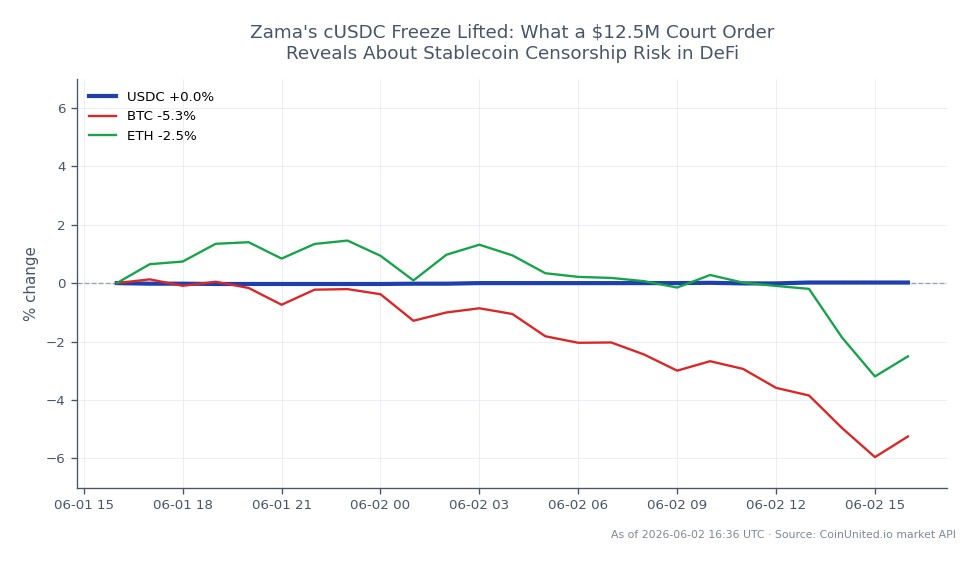
As reported by multiple sources including Phemex and Intellectia AI, a U.S. court has lifted the temporary restraining order that froze Zama's confidential USDC (cUSDC) smart contract, with Zama found
Event Analysis
As reported by multiple sources including Phemex and Intellectia AI, a U.S. court has lifted the temporary restraining order that froze Zama's confidential USDC (cUSDC) smart contract, with Zama founder Rand confirming that "all systems are back to normal." The freeze originated when a hacker address linked to the Overnight Finance exploit deposited funds into Zama's cUSDC wrapper — and because that address represented over 99% of the contract's holdings (~$12.5–$12.6M USDC), the entire contract was frozen via court order. Circle then blacklisted the smart contract address, as confirmed by The Defiant and CCN.
What makes this incident structurally significant is the *mechanism* of enforcement. This was not a targeted wallet freeze — it was a full contract-level blacklist affecting all users of a shared liquidity pool because one tainted depositor dominated the balance. As detailed in our earlier coverage of the Circle contract-level censorship precedent, this reframes how DeFi protocols must think about pool contamination risk. Critically, Zama noted the hacker address was not flagged by KYT (Know Your Transaction) tools at the time of deposit — meaning standard compliance screening failed to prevent the event.
Zama's response has been a deliberate pivot toward what the protocol calls a "compliance and confidentiality" stance — pausing cUSDC, cUSDT, and cWETH, commissioning a post-incident analysis, and publicly committing to handle future court requests cooperatively. This positions Zama within a growing class of privacy protocols navigating the stablecoin institutional buildout era by emphasizing regulatory cooperation over censorship resistance. This approach may differentiate it favorably from fully anonymous privacy designs as regulators tighten AML/KYC frameworks.
What This Means for Traders
The resolution is net neutral-to-mildly positive for the immediate DeFi sentiment around Zama. The freeze is lifted and operations have resumed, removing the acute liquidity risk. However, the structural lesson persists: any shared-liquidity contract — pools, wrappers, L2 bridges, privacy vaults — where a single depositor can dominate balances now carries demonstrable legal freeze risk. Traders and LPs in USDC-heavy DeFi protocols should treat this as a real stress-test data point when assessing stablecoin payment rails and counterparty risk.
For the broader stablecoin market, the event reinforces the SEC reg crypto and stablecoin reckoning narrative: USDC is legally and operationally censorable at the contract level, not just at individual wallet addresses. Traders monitoring stablecoin market share shifts should watch on-chain flows between USDC, USDT, DAI, and decentralized alternatives — renewed censorship debate can drive rotations, particularly in DeFi protocols that use USDC as primary collateral. The crypto enforcement accountability wave continues to reshape risk premiums across privacy-adjacent projects.
Trade USDC on CoinUnited.io
Trade USDC with up to 2000xx leverage → | Create Free Account
Frequently Asked Questions
Yes — USDC trades 24/7 on CoinUnited.io and was never directly impacted at the exchange level, as the freeze was specific to Zama's cUSDC smart contract on-chain.
Continue Exploring
Disclaimer: This brief is for educational purposes only and is not investment advice.