Quick Links
Gnosis Pay Zodiac Delay Module Exploit: GNO Downside Risk and Safe Wallet Contagion for Leveraged Traders
Data Snapshot
Key Takeaways
- •Exploit confirmed by Gnosis co-founder Martin Köppelmann and PeckShield — this is not a rumor; bridge validators have been asked to halt activity.
- •Total losses remain unquantified, creating maximum uncertainty for leveraged GNO positions — high-leverage longs (50x+) face liquidation from even modest price moves.
- •ETH at $1,967.10 is under independent pressure (-2.59% on the day); the $1,954.70 intraday low is the key support level for leveraged ETH traders.
- •Cross-market impact is crypto-specific: COIN equity may see sentiment drag, EURe faces liquidity stress, and DeFi protocols using Zodiac modules face governance pressure.
- •A confirmed small-loss + patch announcement could trigger a GNO relief rally — monitor on-chain treasury activity and official remediation updates as the key catalyst.
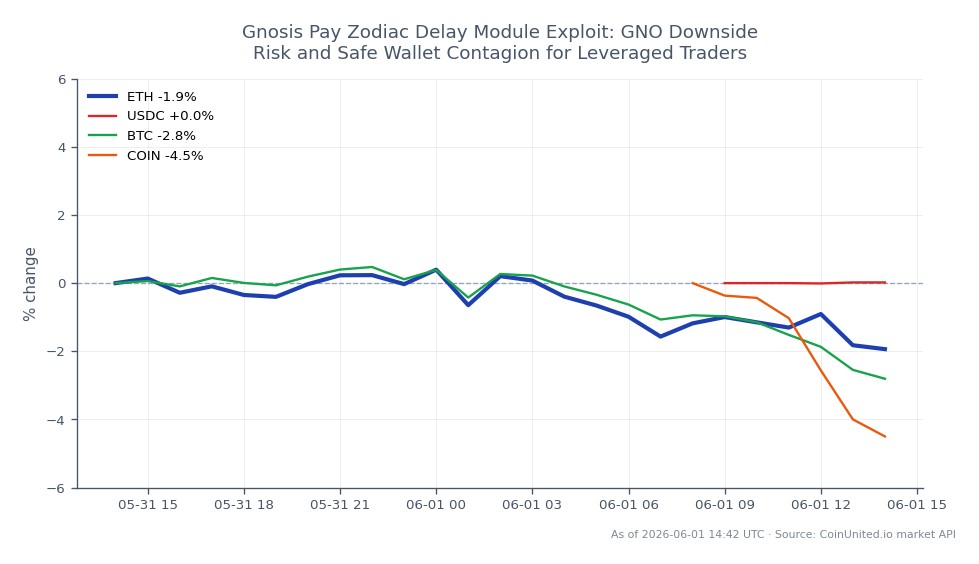
Gnosis Pay publicly disclosed an active security exploit tied to a vulnerability in its Zodiac Delay Module, a component used with Safe smart-contract wallets to add a short delay to outgoing transact
Event Summary
Gnosis Pay publicly disclosed an active security exploit tied to a vulnerability in its Zodiac Delay Module, a component used with Safe smart-contract wallets to add a short delay to outgoing transactions as a protective layer. According to Bloomingbit, Gnosis co-founder Martin Köppelmann confirmed the incident and announced emergency containment measures, including requesting bridge validators to halt related bridging activity. Blockchain security firm PeckShield flagged the exploit in real time, urging users to immediately withdraw EURe and GNO from affected setups.
The Gnosis team has committed to compensating affected users, but the total loss remains unquantified as the investigation is ongoing. This is a team-confirmed, on-chain exploit — not a rumor — with mitigation still in progress.
Leverage Impact Analysis
With ETH currently trading at $1,967.10 (down 2.59% on the day, per live market data), the broader crypto sentiment is already risk-off. The Gnosis Pay exploit compounds this, particularly for GNO perpetual traders.
The core leverage risk here is asymmetric downside uncertainty: total losses are unconfirmed, bridge activity is halted, and users are actively withdrawing card balances — creating run-like selling pressure. For leveraged GNO longs, this is a multi-vector threat: security narrative damage, potential treasury drawdown for compensation, and liquidity fragmentation from bridge halts.
Scenario — High-leverage GNO long: A trader holding a 50x long GNO perpetual position opened before the disclosure now faces both fundamental downside (compensation burden on the Gnosis treasury) and liquidity risk (wider spreads due to halted bridges). Even a modest 5–10% spot price decline would represent a 250–500% move against a 50x position, triggering liquidation well before a recovery can materialize. The DeFi Structural Reset theme reinforces that protocol-level exploits compress leverage multiples quickly.
Funding rates on GNO should be monitored closely — a negative funding shift would signal increasing short pressure. Check live funding rates on CoinUnited.io before sizing any position.
For ETH at $1,967.10: while not directly exploited, ETH faces secondary pressure as the base layer for Safe infrastructure. A 100x ETH long opened near today's high of $2,022.26 would face liquidation if ETH drops a further ~1% from current levels — margin for error is thin in this environment.
Cross-Market Impact
This is a crypto-specific event with limited direct macro spillover, but secondary read-throughs exist across several asset classes.
Crypto proxies: Coinbase Global, Inc. (COIN) may see modest sentiment drag as crypto security incidents elevate perceived risk across the sector. However, the impact is indirect.
ETH ecosystem: The exploit targets Safe wallets and Zodiac modules built on Ethereum, raising questions about module audit standards in the broader self-custody and cross-chain infrastructure stack. DAOs and DeFi protocols using similar Zodiac module configurations face governance pressure to audit or rotate modules — a headwind for DeFi TVL.
Stablecoins: EURe (Gnosis Pay's euro stablecoin) faces spread-widening and potential liquidity stress in Gnosis Chain DeFi pools. USDC and other stablecoins are unaffected directly, but the incident adds marginal regulatory ammunition for stablecoin oversight frameworks. See our institutional stablecoins guide for the policy context.
Bridge infrastructure: Halted bridging activity creates cross-venue pricing dislocations for GNO between Gnosis Chain and Ethereum mainnet — a short-term arbitrage opportunity but also an execution risk for traders relying on cross-chain liquidity. This fits the DeFi bridge exploit contagion pattern.
Trading Considerations
The key risk factor is unquantified loss size — the market cannot fully price the downside until the total compensation burden is disclosed. Watch for on-chain treasury movements from Gnosis, any governance proposals, and official patch/remediation announcements. A confirmed small-loss + full patch could catalyze a sharp relief rally in GNO; a large loss disclosure would accelerate selling.
For ETH, the $1,954.70 intraday low (per live data) is the immediate support level to watch. A break below that level on elevated volume would signal broader risk-off crypto positioning beyond this single incident. Our Ethereum trading guide and DeFi exploit resolution guide provide additional framework for navigating protocol-level risk events.
Trade Ethereum on CoinUnited.io
Trade ETH with up to 2000xx leverage → | Create Free Account
Frequently Asked Questions
Leveraged GNO longs face downside from security-driven sell pressure, bridge-halt liquidity fragmentation, and potential Gnosis treasury drawdown for user compensation — a 50x long can be liquidated on a 2% adverse move. Monitor funding rates and avoid adding leverage until total losses are confirmed.
Continue Exploring
Disclaimer: This brief is for educational purposes only and is not investment advice.