Quick Links
JGB Yields Surge on Bridging Bond Fears — Yen Softens at 159.59, Leveraged JPY Positions at Risk
Data Snapshot
Key Takeaways
- •10-year JGB yields rose ~26 bps to ~2.33% YTD; 30-year yields peaked near 3.2%, ~90 bps above year-end (DWS).
- •USD/JPY at 159.59 — leveraged long positions are profitable but a 200–300 pip MoF intervention snap remains the primary tail risk near 160.00.
- •Yen weakness is paradoxically driven by sovereign risk, not orthodox tightening — limiting BoJ's ability to normalize aggressively given JPY 1,287 trillion in debt (Morningstar).
- •Gold can diverge positively from the usual yield-headwind dynamic when the yield driver is fiscal stress rather than growth.
- •Cross-market contagion to global bonds remains limited for now (DWS), but the Japan setup is increasingly watched as an early test case for high-debt DM fiscal sustainability.
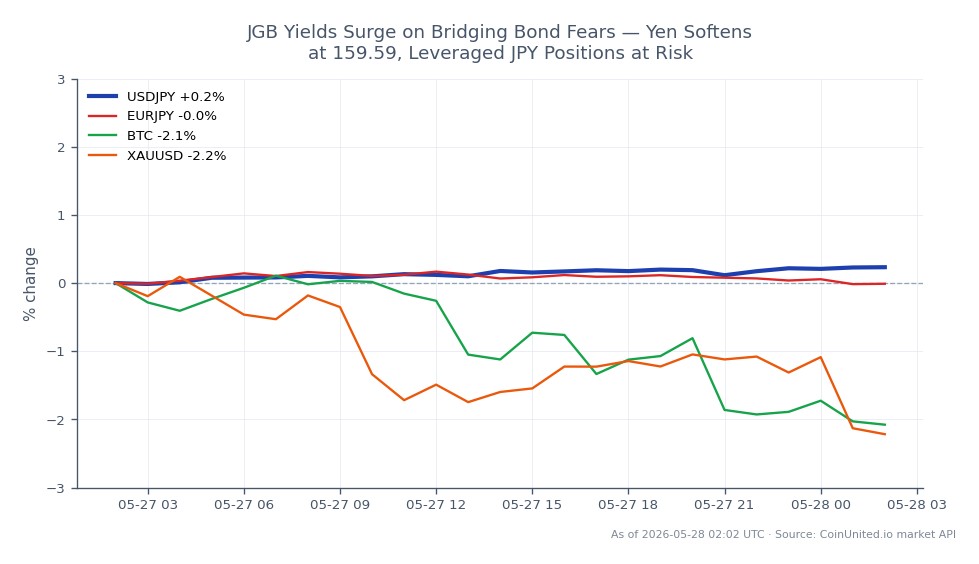
Japanese government bond (JGB) yields have risen sharply following market concern over Japan's new fiscal "bridging bond" initiative — additional debt issuance to fund spending increases and tax cuts.
Event Summary
Japanese government bond (JGB) yields have risen sharply following market concern over Japan's new fiscal "bridging bond" initiative — additional debt issuance to fund spending increases and tax cuts. According to Morningstar, the 10-year JGB yield jumped approximately 26 basis points to around 2.33% year-to-date through January 20, while DWS reports 30-year JGB yields peaked near 3.2%, roughly 90 basis points above year-end levels. The backdrop is Japan's sovereign debt pile of approximately JPY 1,287 trillion — any rise in average funding costs materially erodes fiscal space as this debt is rolled over.
As reported by J.P. Morgan, the structural tension is acute: allowing yields to rise toward fundamentals risks triggering debt-sustainability concerns, while suppressing them sustains fiscal dominance fears. The yen paradoxically softens despite rising domestic yields because markets interpret the move as reflecting sovereign risk rather than orthodox monetary tightening. Live market data shows USD/JPY trading at 159.59, just off the 24-hour high of 159.60.
Leverage Impact Analysis
With USD/JPY at 159.59, leveraged long positions are in a structurally favorable spot — but intervention risk is the critical tail. Consider a 100x long USD/JPY CFD opened at 158.50: the 109-pip gain to current levels represents an 18.2% return on margin, or roughly $1,820 on a $10,000 notional. At 200x leverage, that same move delivers ~36% on margin — illustrating why this yen-softness trend has been a high-reward carry for aggressive traders.
However, the Japanese yen intervention risk is real and asymmetric. The Ministry of Finance intervened previously near similar levels. A 200–300 pip snap reversal — well within intervention precedent — would wipe a 200x long USD/JPY position opened at current prices. Traders should monitor the 160.00 psychological level as a likely intervention trigger zone. For EUR/JPY longs, the same fiscal-driven yen softness applies, but with additional EUR volatility layered on top — compounding leverage risk in both directions. Position sizing at extreme leverage (500x–2000x) should account for at least a 150–200 pip adverse move as a minimum stress scenario.
Cross-Market Impact
The macro inflation pressure from Japan's fiscal expansion ripples across asset classes in nuanced ways. For Japanese equities (JPN225), the Morningstar Japan TME Index had gained ~7.9% YTD before pulling back ~3.6% on JGB volatility — exporters benefit from yen weakness, but rate-sensitive sectors (REITs, utilities, domestic defensives) face higher discount rates. Net, the JPN225 impact is mixed and sector-dependent.
Gold presents an interesting divergence: while rising real yields typically suppress gold, fiscal-driven yield spikes can support it as a sovereign-risk hedge. This aligns with the inflation hedge asset rotation thesis. For Bitcoin, the linkage is second-order — growing narratives around DM debt sustainability occasionally channel flows into hard assets, but this is not a direct price catalyst. DWS notes the JGB move remains largely domestic and is not yet a systemic global bond shock, limiting contagion to US Treasuries and European sovereigns for now. The CPI shock and central bank repricing theme remains the dominant macro lens across markets.
Trading Considerations
Key levels to monitor: USD/JPY 160.00 as the primary intervention trigger, with 158.00–158.50 as near-term structural support. The 30Y JGB yield at ~3.2% is an important ceiling — a sustained break higher would signal accelerating fiscal risk premium. Watch BoJ communications closely; any signal of slower tightening or renewed yield management would be yen-negative but JGB-supportive. The macro inflation trading strategy guide offers additional framework for positioning in this environment.
For risk management, traders should treat MoF verbal warnings as early indicators of imminent intervention, and note that CoinUnited's 24/7 forex trading means any Asia-session or off-hours intervention can be acted on immediately — unlike traditional brokers constrained by session hours.
Trade US Dollar / Japanese Yen on CoinUnited.io
Trade USDJPY with up to 2000xx leverage → | Create Free Account
Frequently Asked Questions
The 160.00 level is widely watched as a psychological intervention trigger — prior MoF actions occurred in similar ranges. A 200–300 pip reversal from that zone would liquidate any long USD/JPY position using more than ~150x leverage if opened near current prices.
Continue Exploring
Disclaimer: This brief is for educational purposes only and is not investment advice.