Quick Links
Jamie Dimon Eyes $20 Billion in Acquisitions: What JPMorgan's Hunting Season Means for Markets
Data Snapshot
Key Takeaways
- •Dimon confirmed on-the-record that JPMorgan could invest up to $20B in acquisitions and equity deals, with payments, fintech, and financial infrastructure as likely focus areas.
- •No specific target has been named — the signal is about capacity and intent, not an imminent deal, making this a multi-year theme rather than an immediate catalyst.
- •A competing regulatory proposal could require JPMorgan to hold an additional $20B in capital, directly constraining the same budget Dimon wants to deploy into deals.
- •Mid-cap fintech, payments processors, and banking SaaS names gain M&A optionality premium from this announcement and warrant monitoring for idiosyncratic spikes.
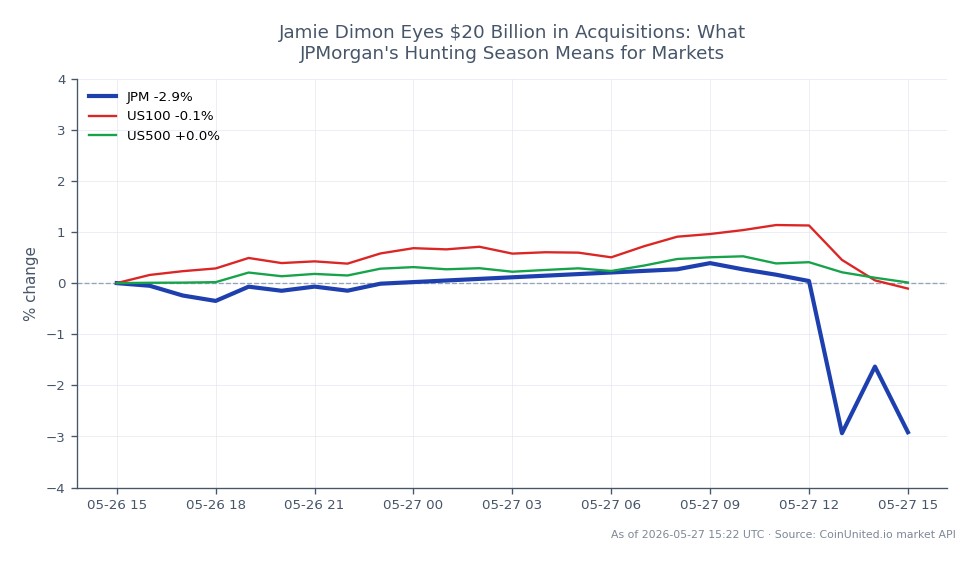
- •JPM stock trades at $297.48, down 3.07% on the day — near session lows — with the regulatory/valuation tension likely to keep near-term price action choppy.
JPMorgan Chase CEO Jamie Dimon has publicly confirmed that the bank is actively pursuing acquisitions and equity investments at a scale of up to $20 billion, according to a Payments Dive interview. Di
Event Analysis
JPMorgan Chase CEO Jamie Dimon has publicly confirmed that the bank is actively pursuing acquisitions and equity investments at a scale of up to $20 billion, according to a Payments Dive interview. Dimon stated that while JPMorgan already has a framework for direct equity and venture capital investments of up to $10 billion, "we could do $20 billion," adding that the firm is "on the lookout" for opportunities. This is on-the-record strategic guidance from the CEO of the world's largest bank by market cap — not rumor or speculation.
What makes this significant is the breadth of the mandate. Dimon's comments were framed against competitive pressure in payments, fintech, and technology-driven financial services, alongside JPMorgan's multi-billion-dollar security and resiliency initiative. The likely hunting grounds — payments processors, merchant acquiring, banking SaaS, compliance tech, and embedded finance platforms — span a wide swathe of the global acquisition and consolidation wave currently reshaping financial infrastructure. This isn't a one-off deal signal; it represents a sustained multi-year deployment posture that lifts M&A optionality premiums across these verticals.
Critically, Dimon simultaneously flagged concerns about high asset prices and drew parallels to pre-2008 credit cycle dynamics. This creates a tension: JPMorgan wants to deploy capital aggressively into deals, but a separate regulatory proposal could require the bank to hold an additional $20 billion in capital — effectively locking up the same dollar amount management wants to spend. That regulatory overhang is a key variable traders should monitor alongside any deal announcements. For a deeper read on how acquisitions at this scale move markets, see our guide to M&A wave trading and merger cycles.
What This Means for Traders
For JPMorgan Chase stock specifically, the signal is mixed in the near term. Markets currently price JPM at $297.48, down 3.07% on the day, with today's range between $295.81 and $308.46. The selloff likely reflects broader macro pressure rather than deal skepticism, but the gap between high-valuation acquisition targets (a risk Dimon himself acknowledged) and the regulatory capital constraint introduces genuine uncertainty about capital allocation efficiency. If investors fear overpayment in a late-cycle environment, large deal announcements could initially weigh on JPM shares.
The more actionable angle may be in the cross-sector acquisition repricing of potential targets. Mid-cap payments processors, fintech platforms, and financial infrastructure SaaS companies become thematic longs on M&A speculation — particularly names with strategic assets, moderate valuations, and regulatory compatibility with a SIFI acquirer. Traders should watch for sell-side research linking specific names to JPMorgan's mandate, as idiosyncratic spikes in those names can be sharp and fast. The M&A acquisition wave theme broadly benefits consolidators like Goldman Sachs and Citigroup as well, as JPMorgan's posture raises competitive pressure on peers to respond in kind.
At the index level, JPMorgan's significant weighting in the S&P 500 and NASDAQ 100 means any material re-rating of JPM feeds directly into index performance. Volatility outlook for JPM CFDs is elevated given the wide intraday range and the forward uncertainty around deal timing and regulatory capital resolution.
Trade JP Morgan Chase & Co. on CoinUnited.io
Frequently Asked Questions
This is strategic signaling — Dimon confirmed capacity and intent, but no specific target, sector, or timeline has been identified. Traders should treat it as a multi-year thematic catalyst rather than an imminent deal.
Continue Exploring
Disclaimer: This brief is for educational purposes only and is not investment advice.