Quick Links
StablR $2.8M Exploit: Euro & USD Stablecoins Depeg — Liquidation Risks for Leveraged DeFi Positions
Data Snapshot
Key Takeaways
- •STBL is trading at $0.0316 (−2.44%), with the exploit vector reportedly still active — avoid new leveraged exposure until containment is confirmed.
- •Leveraged traders using StablR stablecoins as collateral face a double hit: depegged margin value AND volatile underlying asset prices compressing liquidation buffers simultaneously.
- •At $2.8M, systemic risk to USDC, ETH, or BTC is limited — but DeFi lending protocols holding StablR assets as collateral face localised bad-debt and forced-liquidation risk.
- •Capital rotation from smaller experimental stablecoins toward audited, MiCA-compliant euro stablecoins and regulated USD stablecoins is the structural trade this event accelerates.
- •The mint/redeem status of StablR is the single most important binary to watch — a halt removes peg arbitrage and makes recovery dependent on recapitalisation alone.
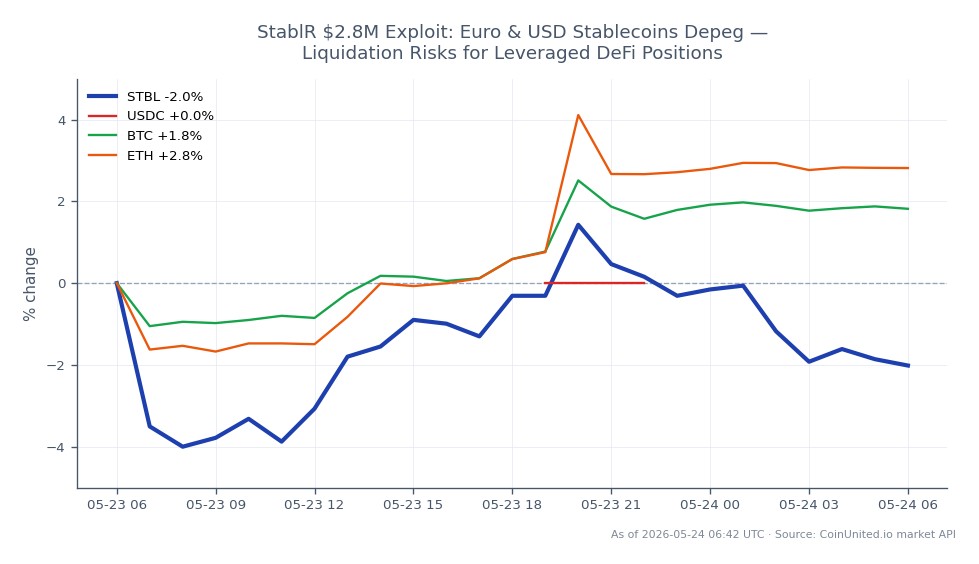
A live security exploit targeting StablR — a protocol issuing euro and USD-pegged stablecoins — has drained approximately $2.8M, triggering a depeg in both its euro and USD stablecoin products. Accord
Event Summary
A live security exploit targeting StablR — a protocol issuing euro and USD-pegged stablecoins — has drained approximately $2.8M, triggering a depeg in both its euro and USD stablecoin products. According to on-chain security monitors and crypto news signals, the attack vector remains partially active, with StablR's official response and remediation steps still pending confirmation at time of writing. STBL is trading at $0.0316, down 2.44% over 24 hours (24h range: $0.0315–$0.0325), reflecting elevated selling pressure.
For a smaller issuer, $2.8M can represent a material share of total protocol reserves. The depeg signals a confidence shock rather than a purely mechanical failure — holders are exiting faster than arbitrageurs can restore the peg. This event sits squarely within the broader DeFi Structural Reset theme, where under-audited or under-capitalised protocols face disproportionate damage from even modest exploits.
Leverage Impact Analysis
For leveraged traders, the primary danger is positions collateralised with or denominated in the impacted stablecoins. Consider a trader using 50x leverage on an ETH perpetual, with margin posted in a StablR USD stablecoin now trading at $0.94: their effective collateral value drops ~6%, compressing their liquidation buffer significantly. At 50x, a 2% adverse price move already represents 100% of margin — a simultaneous collateral haircut accelerates liquidation risk.
For traders attempting to play a mean-reversion back to peg: STBL's 24h low of $0.0315 vs. high of $0.0325 shows a compressed range, but the downside tail is open if the exploit is not contained. The risk/reward on a discount-to-par recovery trade is highly asymmetric — if reserves are materially impaired, recovery may never come. Check live funding rates and open interest on CoinUnited.io before sizing any position. Refer to our DeFi Protocol Exploits: How Bad Debt Is Resolved guide for how these incidents typically resolve.
Cross-Market Impact
At $2.8M, systemic contagion to USDC or Bitcoin is limited. However, DeFi protocols that accepted StablR assets as collateral face immediate bad-debt risk — lending markets may see forced liquidations of positions backed by the depegged tokens. Ethereum gas fees could spike if mass on-chain exits from affected pools trigger high-volume DEX activity.
The euro-stablecoin angle adds a regulatory dimension: under MiCA, incidents involving EUR-pegged assets attract EU supervisory attention. This is a negative sentiment signal for the stablecoin institutional buildout narrative, reinforcing capital rotation toward regulated, audited issuers. Our Institutional Stablecoins 2026 guide outlines which alternatives attract flows in a flight-to-quality scenario. No meaningful spillover to equities, forex, or commodities is expected at this exploit size.
Trading Considerations
Key levels to monitor: STBL 24h low of $0.0315 is the immediate support — a break below with volume expansion signals further confidence deterioration. Whether StablR pauses mint/redeem functions is the most critical binary: a mint/redeem halt removes the arbitrage mechanism that normally restores a peg, making recovery dependent entirely on recapitalisation. Watch DEX pool imbalances (Curve, Uniswap) for the impacted pairs as a real-time sentiment gauge.
Until the exploit vector is publicly confirmed as closed and reserves are transparently disclosed, treat any recovery bounce as a dead-cat risk. Traders monitoring the broader DeFi exploit contagion theme should note that repeated small incidents historically accelerate capital rotation toward on-chain T-bill and RWA products.
Trade STBL on CoinUnited.io
Trade STBL with up to 2000xx leverage → | Create Free Account
Frequently Asked Questions
If your margin is denominated in or collateralised by StablR stablecoins, the depeg effectively reduces your collateral value, tightening your liquidation threshold — at 50x leverage, even a 2% collateral haircut can be critical. Positions in unrelated assets (BTC, ETH) using major stablecoins as margin are not directly affected.
Continue Exploring
Disclaimer: This brief is for educational purposes only and is not investment advice.