Quick Links
Kazakhstan's $1.4B Gazprom Ruling: Energy Enforcement Risk Hits Russian Energy Assets
Data Snapshot
Key Takeaways
- •A $1.4B enforcement award against Gazprom by a Kazakhstani court is one of the largest cross-border rulings against a Russian state energy company by a Central Asian jurisdiction.
- •Leveraged WTI CFD traders face two-sided risk: supply disruption risk on the upside, demand-concern repricing on the downside — avoid high-leverage directional bets before market confirmation.
- •USD/RUB is the most direct cross-market expression; ruble weakness is the path of least resistance under continued legal attrition on Gazprom.
- •USD/KZT is a nuanced play — watch for Russian retaliatory pipeline moves vs. Kazakhstani institutional credibility gains.
- •This event fits the global regulatory enforcement wave theme, where emerging-market courts are increasingly willing to enforce against state-linked Russian entities.
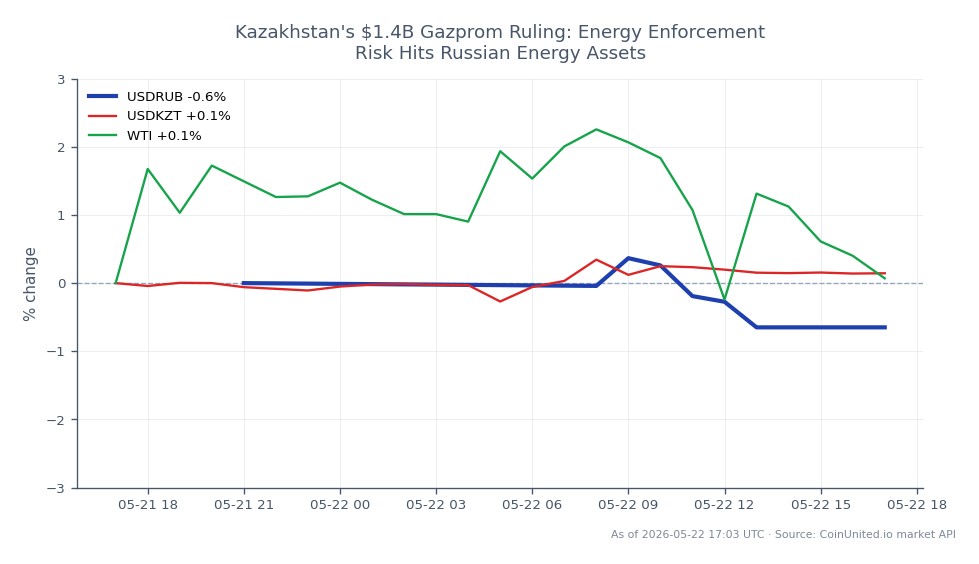
A Kazakhstani court has upheld a $1.4 billion arbitration award against Gazprom, Russia's state-controlled natural gas giant, in a dispute related to energy transit or contractual obligations across t
Event Summary
A Kazakhstani court has upheld a $1.4 billion arbitration award against Gazprom, Russia's state-controlled natural gas giant, in a dispute related to energy transit or contractual obligations across the two nations. The ruling represents one of the largest cross-border enforcement actions against a Russian state energy company by a Central Asian jurisdiction, underscoring a broader trend of post-Soviet courts asserting legal independence over Russian energy majors. The full enforcement mechanism and asset seizure timeline remain subject to diplomatic and legal developments.
This verdict falls squarely within the cross-border enforcement repricing theme — where judicial rulings in emerging-market jurisdictions force sudden reassessment of counterparty risk in energy supply chains. It also amplifies the global regulatory enforcement wave narrative that has been pressuring state-linked energy assets throughout 2025–2026.
Leverage Impact Analysis
For leveraged WTI and commodity CFD traders, this event introduces asymmetric tail risk. The ruling does not directly disrupt physical supply volumes today, but it raises counterparty and transit risk premiums on Russian-routed energy flows through Central Asia — particularly the Caspian Pipeline Consortium (CPC) route, which handles significant Kazakhstani crude exports.
A trader holding a 50x long WTI Light Crude Oil CFD faces amplified exposure if the ruling triggers retaliatory flow disruptions or a broader reassessment of CPC route reliability. Conversely, a 50x short WTI position risks a sharp squeeze if the market interprets enforcement action as supply-chain destabilization — a classic volatile, two-directional setup. Given the `requires_immediate_market_confirmation` flag on this event, traders should avoid initiating high-leverage directional positions until WTI price reaction confirms the dominant narrative. Monitor open interest and funding rates on CoinUnited.io for directional confirmation.
Cross-Market Impact
USD/RUB: The US Dollar / Russian Ruble faces upward pressure (RUB weakening) as large enforcement awards against Gazprom signal continued legal and financial attrition on Russian state enterprises. This compounds existing sanctions-driven ruble stress.
USD/KZT: The US Dollar / Kazakhstani Tenge is a nuanced play. A successful enforcement win signals Kazakhstani institutional strengthening — modestly KZT-supportive long-term — but near-term energy revenue uncertainty (if Russia retaliates via pipeline leverage) could weaken the tenge, which remains heavily tied to oil export revenues.
Energy Commodities: Brent and WTI could see short-term volatility spikes if CPC transit risk is repriced. For a deeper framework on sanctions-driven energy market dislocations, see the Cross-Border Sanctions & Oil Markets guide.
Gold: Risk-off spillover from geopolitical escalation between Kazakhstan and Russia would modestly support gold as an inflation hedge and safe-haven play.
Trading Considerations
The key risk to watch is whether Russia responds through pipeline flow reductions — approximately 1.2–1.5 million barrels per day transit through CPC — which would be a hard supply shock for global crude markets. Until that escalation is confirmed or denied, this event is a volatility trigger rather than a clean directional catalyst.
For forex traders, USD/RUB is the most direct expression of enforcement risk. USD/KZT requires patience: watch for any Kazakh government statements on enforcement timelines before sizing into tenge positions at high leverage.
Start Trading on CoinUnited.io
Create Your Free Account → — Trade crypto, stocks, forex, indices, and commodities with up to 2000x leverage and zero fees.
Frequently Asked Questions
It introduces pipeline transit uncertainty via the CPC route, creating spike risk in both directions — confirm WTI price reaction before entering leveraged positions, and use tighter stops given the binary escalation/de-escalation path.
Continue Exploring
Disclaimer: This brief is for educational purposes only and is not investment advice.