Quick Links
Hamilton ETFs Files for Leveraged Bitcoin Income ETF in Canada — Leverage Map at $75,891
Data Snapshot
Key Takeaways
- •Hamilton ETFs has filed for a leveraged Bitcoin income ETF in Canada, expanding regulated institutional BTC access and creating potential long-term spot buy pressure.
- •BTC at $75,891 (-2.26%) means 50x long positions opened near yesterday's $77,000 mid-range have lost approximately 72% of margin — immediate liquidation risk for undercapitalized longs.
- •The $75,620 session low is the critical support level; a break below exposes a liquidity void with no clear technical floor until the mid-$74,000s.
- •MSTR and COIN are the primary cross-market beneficiaries — each new ETF filing structurally validates the Bitcoin treasury and custody business models.
- •ETF approval timelines in Canada typically span 30–90 days post-filing, making this a medium-term catalyst rather than an immediate price trigger.
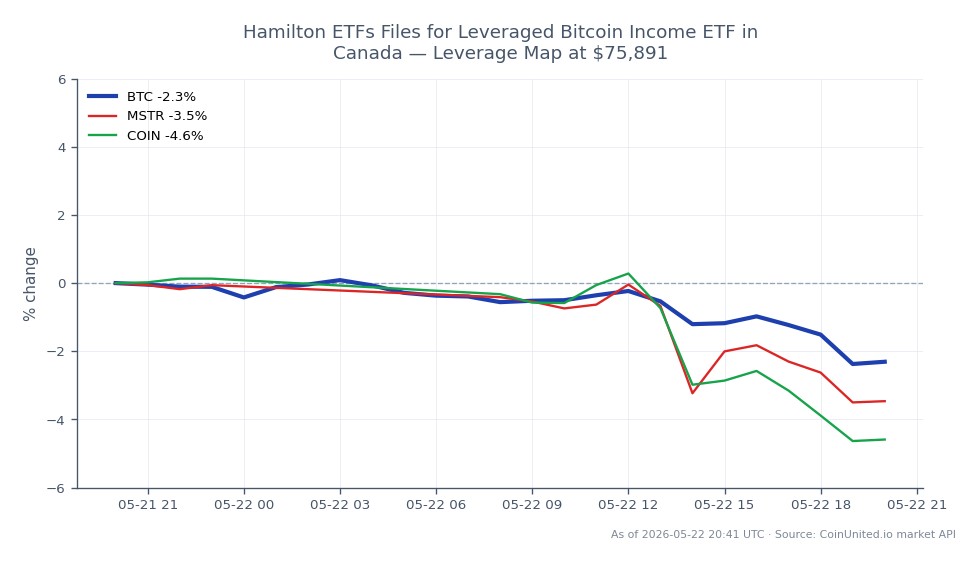
Hamilton ETFs has filed for a leveraged Bitcoin income ETF in Canada, adding to a growing wave of bitcoin municipal and institutional adoption that is expanding regulated BTC exposure across North Ame
Event Summary
Hamilton ETFs has filed for a leveraged Bitcoin income ETF in Canada, adding to a growing wave of bitcoin municipal and institutional adoption that is expanding regulated BTC exposure across North America. While full prospectus details are not yet confirmed, the filing follows a pattern of Canadian asset managers structuring yield-generating, leveraged BTC products for retail and institutional investors seeking regulated access. Canada has been a consistent first-mover in crypto ETF approvals, having launched spot Bitcoin ETFs before the United States.
The filing aligns with the broader crypto corporate treasury and exchange listings theme, as institutional vehicles that embed Bitcoin exposure into traditional fund structures continue to accelerate. BTC is currently trading at $75,891, down 2.26% over the past 24 hours, with a session range of $75,620–$77,862.
Leverage Impact Analysis
This filing is a structural bullish signal — not an immediate price catalyst — but it matters for leveraged traders because ETF inflows mechanically require spot BTC purchases, creating sustained buy-side pressure over time.
At current prices, the leverage math is unforgiving given the 24h drawdown context:
- -50x long BTC perpetual at $77,000 entry (yesterday's mid-range): At $75,891, that position is down ~1.44% on underlying — representing a 72% loss of margin at 50x. Liquidation territory for positions opened near $77,000 with thin margin buffers.
- -100x long at $76,500 entry: The move to $75,891 represents a ~79% margin erosion — most 100x positions opened intraday are already at or past liquidation.
- -20x long at $76,000: Down ~0.14% on margin — still viable, but the $75,620 session low represents a critical test. A wick to $75,500 would wipe a 20x position opened at $76,100.
The session low of $75,620 is the key liquidation cluster floor to monitor. Check funding rates on CoinUnited.io — negative funding (shorts paying longs) would confirm capitulation and reduce flush risk for long-side re-entries.
Cross-Market Impact
The Hamilton filing reinforces the corporate crypto treasury and exchange listings playbook. Crypto-proxy equities are the primary cross-market read:
- -MicroStrategy (MSTR) trades at a premium to NAV and is highly sensitive to BTC ETF filing momentum — each new institutional vehicle validates MSTR's treasury model. See the MSTR NAV gap trading guide for structured entry levels.
- -Coinbase (COIN) benefits indirectly: more ETF AUM means more institutional custody demand, which flows through Coinbase's institutional services revenue.
- -Gold and DXY: Limited direct impact. This is a crypto-structure event with minimal macro spillover unless BTC ETF inflows accelerate enough to register as risk-on rotation.
For broader context on how Bitcoin is evolving as an institutional asset, see the 2026 Crypto Market Outlook.
Trading Considerations
BTC's immediate structure shows the $75,620 session low as the first support and $77,862 (24h high) as near-term resistance. A reclaim above $77,000 would neutralize the current bearish momentum triggered by the macro overhang. The Hamilton filing is a medium-term bullish catalyst — ETF approval timelines in Canada typically run 30–90 days post-filing — so position sizing should reflect a longer event horizon rather than an immediate breakout setup.
Monitor open interest on BTC perpetuals for confirmation: rising OI with price recovery above $77,000 would signal fresh long entries rather than short covering.
Trade Bitcoin on CoinUnited.io
Trade BTC with up to 2000xx leverage → | Create Free Account
Frequently Asked Questions
ETF filings signal future spot BTC purchases by fund managers, which is structurally bullish over a 30–90 day horizon — but they don't prevent short-term drawdowns. Leveraged longs should size positions to survive volatility at the $75,620 support level before any ETF-driven rally materializes.
Continue Exploring
Disclaimer: This brief is for educational purposes only and is not investment advice.