Quick Links
Indonesia Tightens Commodity Export Controls — Coal, Gold & Rupiah in Focus for Leveraged Traders
Data Snapshot
Key Takeaways
- •Gold (XAU/USD) is trading at $4,492.75 with a 24h range of $4,453–$4,509; Indonesian supply restrictions add a marginal bullish catalyst but Fed policy remains dominant.
- •Leveraged traders: a 50x Gold CFD faces full liquidation within an ~$89 adverse move from entry — position sizing discipline is critical in this policy-uncertainty environment.
- •USD/IDR faces downside pressure on Rupiah as export controls historically reduce Indonesian FX earnings — monitor for IDR weakness as a confirmation signal.
- •EV-linked stocks including Tesla and BYD face indirect bearish pressure if nickel is included in Indonesia's export tightening, given their battery supply chain dependencies.
- •This event requires immediate market confirmation — do not size into large leveraged positions until official Indonesian policy details are published and commodity futures volumes confirm the move.
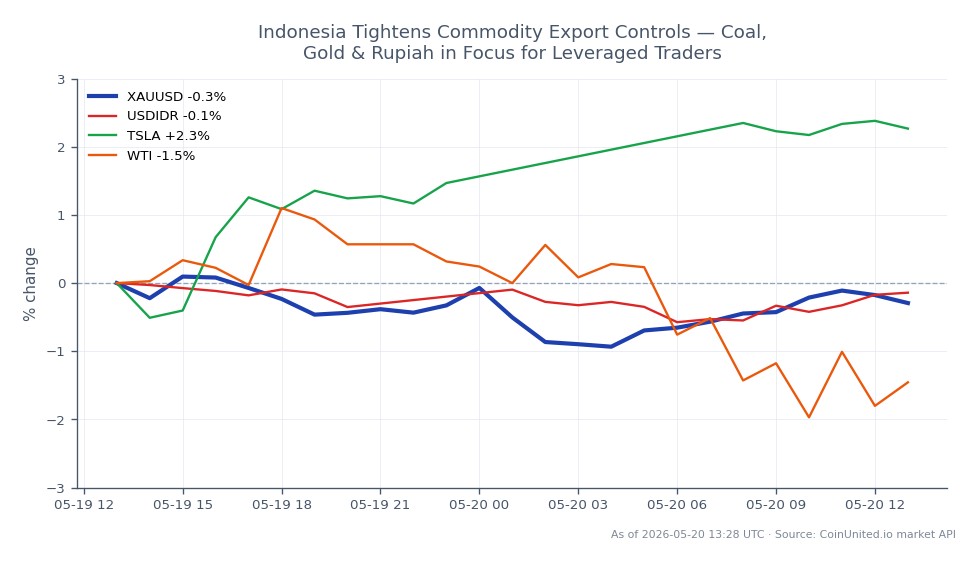
Indonesia, one of the world's largest exporters of thermal coal and a significant producer of nickel, tin, and other raw materials, is reported to be implementing tighter controls on key commodity exp
Event Summary
Indonesia, one of the world's largest exporters of thermal coal and a significant producer of nickel, tin, and other raw materials, is reported to be implementing tighter controls on key commodity exports. While full research data is pending confirmation, Indonesia has a well-documented history of using export policy as a strategic lever — most notably its 2022 palm oil export ban and the phased nickel ore export ban that reshaped global supply chains. A new regulatory tightening cycle would follow this playbook, restricting outflows to capture more domestic value-add and shore up foreign-exchange reserves.
The move carries direct implications for the Indonesian Rupiah (USD/IDR), global coal supply, and — critically — gold markets, where Indonesia ranks as a notable producer. According to live market data, Gold (XAU/USD) is currently trading at $4,492.75, with a 24-hour range of $4,453.62–$4,508.95, up +0.19% on the session.
Leverage Impact Analysis
For leveraged commodity CFD traders, an Indonesian export restriction scenario creates an asymmetric risk environment — bullish pressure on constrained commodities, bearish pressure on Indonesian-linked FX.
Gold CFD scenario: With XAU/USD at $4,492.75, a trader holding a 50x long Gold CFD entered at today's open near $4,453.62 currently sits on approximately +$39.13/oz of unrealized gain — representing roughly +87.5% return on margin at 50x. However, the 24-hour range of $55.33 means a 50x position could face a margin call within a $89 adverse move from entry. Traders should monitor the $4,453 support level closely; a break below risks cascading liquidations given recent leveraged long accumulation in gold.
Coal CFD volatility: Export restriction news typically generates 3–8% intraday moves in coal futures. At 100x leverage on a coal CFD, a 3% adverse move would fully liquidate a position — reinforcing the need for tight stop placement and reduced position sizing during policy uncertainty windows.
Monitor open interest and funding rates on CoinUnited.io for real-time confirmation signals before sizing into directional positions.
Cross-Market Impact
USD/IDR: Export controls historically pressure the Rupiah by reducing export earnings and signaling policy unpredictability — watch for IDR weakness in the near term. The APAC currency stress theme is directly relevant here.
Gold (XAU/USD): Supply-side restriction from a producing nation adds a marginal bullish input to gold's already elevated price. The inflation hedge asset rotation thesis gains incremental support, though Fed rate policy remains the dominant driver at current levels above $4,490.
WTI Crude Oil: Indonesia is a net energy importer, so coal export restrictions could indirectly shift regional energy demand toward WTI Light Crude Oil and LNG substitutes — a secondary bullish signal for energy.
Tesla & BYD (EV stocks): Indonesia controls significant nickel reserves critical to EV battery supply chains. If nickel is included in tightening measures, Tesla and BYD face input cost pressure — a bearish read for EV manufacturers dependent on Indonesian supply.
Trading Considerations
For gold, the key levels are $4,453 (24h low / near-term support) and $4,508 (24h high / resistance). A sustained break above $4,509 on elevated volume could signal a continuation move toward prior highs. The 2026 Commodities Market Outlook notes that supply-side geopolitical shocks have been the primary upside catalyst for industrial and precious metals this year.
Requires immediate market confirmation — watch for official Indonesian government announcements, coal and nickel futures volume spikes, and IDR moves beyond 2% as confirmation triggers before committing to directional leverage.
Trade Gold / US Dollar on CoinUnited.io
Trade XAUUSD with up to 2000xx leverage → | Create Free Account
Frequently Asked Questions
It adds a marginal supply-side bullish input to gold, but the $4,453–$4,509 range is the critical zone — a 50x long opened near the day's low is up ~87% on margin, but a reversal below $4,453 could trigger rapid liquidation.
Continue Exploring
Disclaimer: This brief is for educational purposes only and is not investment advice.