Quick Links
SEC Tokenized Stock Approval: What Leveraged Crypto & Equity Traders Must Know Now
Key Takeaways
- •The SEC's January 2026 Statement on Tokenized Securities confirms the policy direction, but the specific Nasdaq approval remains report-driven — treat as medium-confidence until verified.
- •Leveraged ETH perpetual traders face amplified volatility risk: a 50x long can be liquidated on a ~2% reversal if the 'sell the news' dynamic kicks in post-confirmation.
- •Ethereum and RWA-adjacent tokens are the primary crypto beneficiaries as preferred blockchain rails for tokenized equity settlement.
- •USDC and stablecoin payment infrastructure stand to benefit if tokenized securities require blockchain-native cash settlement legs.
- •Cross-market impact is concentrated in crypto and market infrastructure equities — forex and commodities show no material direct exposure.
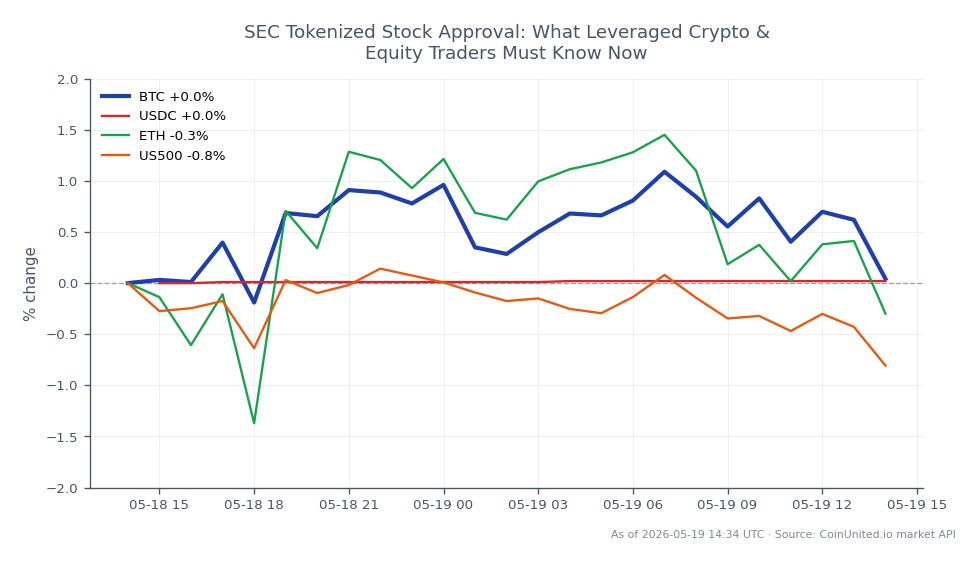
According to reports citing SEC materials and an IndexBox analysis, the U.S. Securities and Exchange Commission is preparing to open the door to tokenized stock trading on Nasdaq, with initial scope c
Event Summary
According to reports citing SEC materials and an IndexBox analysis, the U.S. Securities and Exchange Commission is preparing to open the door to tokenized stock trading on Nasdaq, with initial scope covering Russell 1000 stocks and select index ETFs. The SEC's Division of Corporation Finance issued a formal Statement on Tokenized Securities on January 28, 2026, recognizing tokenized securities as securities subject to existing federal law — providing regulatory clarity that underpins the proposal.
Under the reported settlement model, brokers would designate tokenized settlement at order entry, with Nasdaq routing that instruction to the Depository Trust Company (DTC). Trades that cannot process via tokenized rails would revert to conventional settlement. According to the research, tokenized shares must mirror traditional shares in shareholder rights, trading symbol, and exchange priority. A DTCC roll-out target of H2 2026 has been cited for related services. Confidence on the specific approval mechanics remains medium pending an independently verified SEC/Nasdaq filing.
Leverage Impact Analysis
This event is a narrative catalyst, not a hard fundamental shift — making leverage management critical. Crypto perpetual traders should note that the tokenization/RWA sentiment trade can produce sharp, short-lived spikes followed by mean reversion if primary-source confirmation is delayed.
For example, an Ethereum perpetual long opened at current prices with 50x leverage would see liquidation triggered by a pullback of roughly 2%. Given that ETH is the primary blockchain infrastructure associated with tokenized securities settlement, sentiment-driven pumps can reverse quickly on "sell the news" mechanics. Traders using CoinUnited's up to 2000x crypto leverage should size positions conservatively — a 10x ETH position gives approximately 10% buffer before liquidation, more suitable for a headline-driven event with unconfirmed specifics.
For NASDAQ 100 Index CFD traders, market infrastructure names embedded in the index (exchange operators, fintech) could see outperformance. A 20x long US100 CFD faces liquidation on a ~5% drawdown — manageable if confirmation arrives, but headline risk cuts both ways if the approval is walked back.
Cross-Market Impact
The primary beneficiaries sit across two markets simultaneously. In crypto, Ethereum and RWA-adjacent tokens receive a structural tailwind as the preferred settlement layer for tokenized equities — reinforcing the crypto-banking institutional integration thesis. The USDC ecosystem and stablecoin payment rails also stand to benefit if tokenized securities require blockchain-native cash legs, as detailed in CoinUnited's institutional stablecoins guide.
In U.S. equities, the S&P 500 impact is diffuse, but market infrastructure and fintech sub-sectors could re-rate. Crypto-proxy stocks like Coinbase may catch indirect flows as tokenized securities legitimize onchain financial infrastructure. This development is a meaningful data point within the evolving crypto securities regulation framework and aligns with the broader crypto clarity act regulatory pivot traders have been positioning around.
Forex and commodities show no direct linkage. This is an equity/crypto structural story with negligible near-term macro spillover.
Trading Considerations
The unverified status of the specific Nasdaq approval order is the primary risk factor — a clarification or retraction could sharply reverse any sentiment-driven moves in ETH and RWA tokens. Key levels to watch: ETH support at prior consolidation zones and Coinbase (COIN) stock relative to recent highs as a proxy for institutional crypto sentiment.
Monitor open interest and funding rates on CoinUnited.io for confirmation that leveraged longs are accumulating — elevated positive funding on ETH perpetuals would signal overcrowding risk. The H2 2026 DTCC roll-out timeline means this is a medium-term structural story; short-term traders should treat unconfirmed headlines with reduced position sizing.
Start Trading on CoinUnited.io
Create Your Free Account → — Trade crypto, stocks, forex, indices, and commodities with up to 2000x leverage and zero fees.
Frequently Asked Questions
ETH is the primary beneficiary as a tokenization settlement layer, but headline-driven pumps can reverse sharply if official confirmation is delayed. Keep leverage below 20x and monitor funding rates for crowding signals.
Continue Exploring
Disclaimer: This brief is for educational purposes only and is not investment advice.