Quick Links
ECB's Kocher: June Rate Hike 'Unavoidable' If Hormuz Stays Shut — EUR/USD Leveraged Traders Face Hawkish Squeeze
Data Snapshot
Key Takeaways
- •EUR/USD is at $1.1600 (24h low) — leveraged traders face liquidation risk within 12 pips at 100x leverage, requiring tight stop-loss discipline before the Hormuz situation clarifies.
- •The Hormuz → crude oil → euro-area inflation → ECB hawkish pivot chain is the core transmission; watch Brent price action as the upstream leading indicator.
- •USD/JPY and Gold are the key cross-market proxies: JPY safe-haven flows and Gold's inflation hedge demand both activate if this scenario firms.
- •The exact Kocher quote is unverified from primary sources — position sizing should reflect this uncertainty until Reuters or Bloomberg confirmation.
- •S&P 500 faces dual headwinds: higher energy input costs for transport/airlines and tighter global financial conditions if ECB rate-hike probability rises.
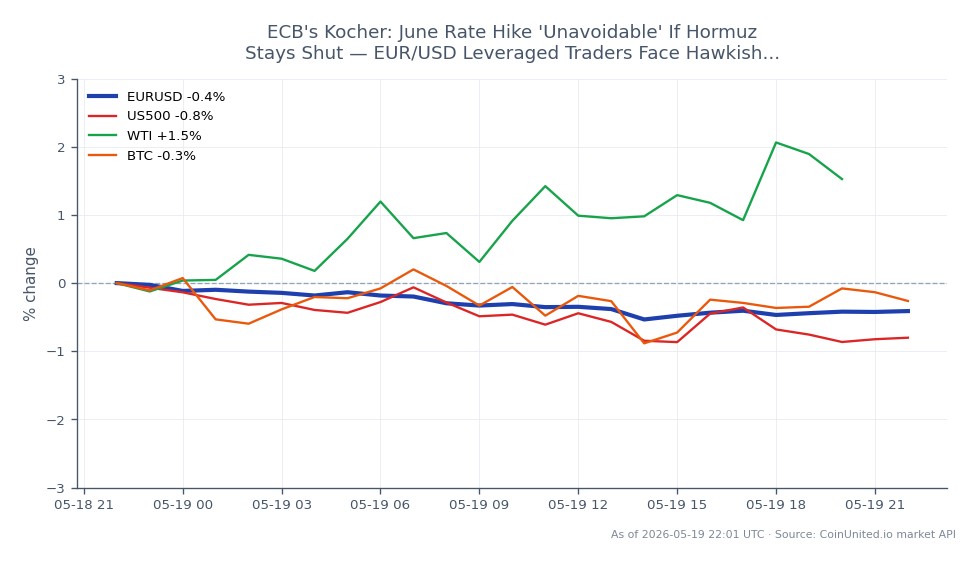
ECB Governing Council member Kocher has signaled that a June rate hike could become unavoidable if the Strait of Hormuz remains closed, according to available market commentary. While the exact quote
Event Summary
ECB Governing Council member Kocher has signaled that a June rate hike could become unavoidable if the Strait of Hormuz remains closed, according to available market commentary. While the exact quote remains unverified from a primary Reuters or Bloomberg source, the transmission mechanism is well-established: a sustained Hormuz disruption drives Brent and WTI crude sharply higher, re-accelerating euro-area inflation and eliminating the ECB's room to ease. Notably, prior ECB communications confirm Kocher stated a June hike is not the baseline — meaning any shift toward inevitability represents a meaningful hawkish pivot.
This scenario sits squarely within the Hormuz Strait Energy Supply Shock and stagflation risk themes actively tracked by CoinUnited Research. The crude oil → inflation expectations → ECB repricing chain has clear precedent, and markets are already pricing elevated uncertainty given Germany's wholesale prices surging 4.1% in recent data.
Leverage Impact Analysis
EUR/USD is currently trading at $1.1600, down 0.48% on the day (24h high: $1.1700, low: $1.1600). The pair is pressing against the lower bound of its recent range — a hawkish ECB repricing could produce a sharp directional move in either direction depending on whether energy-import deterioration or rate-hike expectations dominate.
Long EUR/USD scenario (hawkish ECB repricing dominant): A trader with 100x long EUR/USD opened at $1.1600 controls a $116,000 notional position with $1,160 margin. A 50-pip rally to $1.1650 generates a $500 gain — a 43% return on margin. However, a 12-pip adverse move triggers a margin call, underlining the extreme sensitivity at high leverage.
Short EUR/USD scenario (energy-import deterioration dominant): If elevated energy costs worsen Europe's trade balance faster than ECB hawkishness can support the euro, a move toward $1.1550 yields $500 on a 100x short — but a 12-pip reversal wipes the position. Traders should monitor CoinUnited.io funding rates and open interest for directional confirmation before sizing in.
The macro inflation pressure context means volatility is asymmetric: headline-driven spikes can be swift and large, making tight stop-loss discipline essential at leverage above 50x.
Cross-Market Impact
WTI Crude & Gold: A confirmed Hormuz closure directly supports WTI crude oil and Brent — these are the primary transmission assets. Gold benefits as a geopolitical hedge and inflation store, consistent with the inflation hedge asset rotation theme.
USD/JPY: Safe-haven flows into the yen would pressure USD/JPY lower. The yen's dual role as a safe-haven and energy-import-cost-sensitive currency creates a complex setup — monitor the pair for confirmation of broader risk-off positioning.
S&P 500: The S&P 500 faces headwinds from higher energy input costs hitting airlines, transport, and consumer discretionary, while tighter global financial conditions weigh on rate-sensitive growth names. The Fed & ECB oil-driven rate patience theme may deteriorate rapidly if this scenario firms.
Bitcoin: Near-term risk-off pressure is the base case for BTC if broader risk sentiment deteriorates. Longer-term, persistent inflation can support hard-asset narratives, but short-term liquidity dynamics tend to dominate.
Trading Considerations
EUR/USD key levels: $1.1600 is current support (24h low); $1.1700 is immediate resistance (24h high). A confirmed break below $1.1600 on sustained Hormuz closure headlines opens a move toward $1.1550. Watch ECB overnight index swap repricing and Euribor futures for rate-hike probability shifts as the primary leading indicator. Brent crude price action is the upstream signal — sustained elevation above recent highs would be the trigger for ECB policy repricing to accelerate. This event requires immediate market confirmation before high-conviction positioning.
Trade Euro / US Dollar on CoinUnited.io
Trade EURUSD with up to 2000xx leverage → | Create Free Account
Frequently Asked Questions
At 100x leverage, a 12-pip adverse move against your EUR/USD position triggers a margin call — the pair's current range ($1.1600–$1.1700) means volatility can cover that distance rapidly on a headline. Size positions to withstand at least a 50-pip swing before any Hormuz/ECB confirmation emerges.
Continue Exploring
Disclaimer: This brief is for educational purposes only and is not investment advice.