Quick Links
CMB.Tech Q1 Earnings Surge 250% as Hormuz Closure Supercharges Freight Rates — Leverage Playbook
Key Takeaways
- •CMB.Tech reported 250% YoY Q1 earnings growth, directly attributable to elevated tanker freight rates caused by Hormuz Strait disruption.
- •Leveraged CMBT CFD traders at 50x face liquidation on a ~2% adverse move — position sizing and stop placement are critical in this event-driven, headline-sensitive setup.
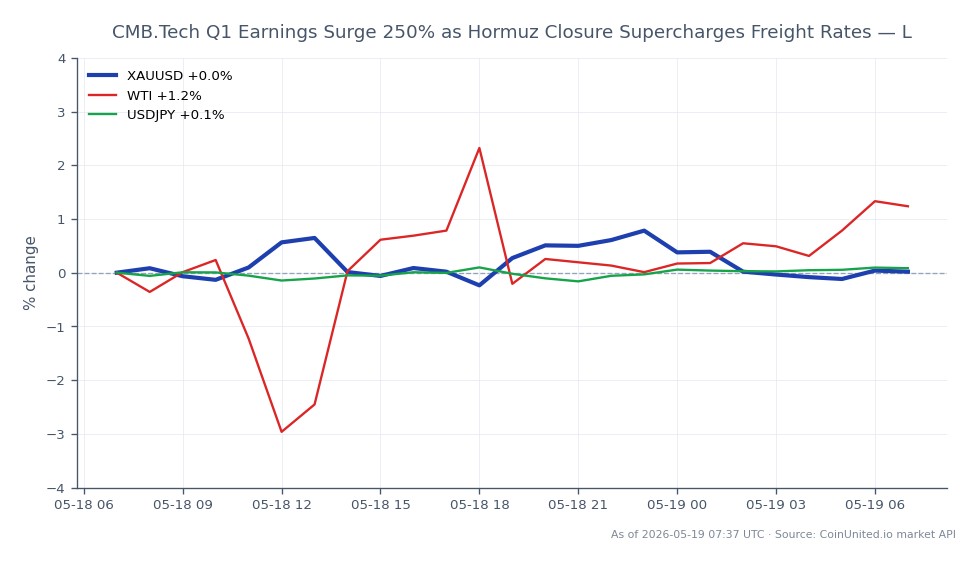
- •WTI crude oil is the most direct cross-market beneficiary; sustained Hormuz disruption supports the crude price floor and energy inflation narrative.
- •Gold catches a secondary bid via inflation hedge rotation as Hormuz disruption feeds energy price pressures globally.
- •The primary risk to the entire Hormuz trade complex is a sudden diplomatic de-escalation — monitor geopolitical headlines for Iran/Gulf developments as the key reversal trigger.
CMB.Tech (CMBT) reported a dramatic 250% year-over-year earnings surge in Q1, driven by elevated tanker freight rates tied to the ongoing Hormuz Strait Energy Supply Shock. The Strait of Hormuz — thro
Event Summary
CMB.Tech (CMBT) reported a dramatic 250% year-over-year earnings surge in Q1, driven by elevated tanker freight rates tied to the ongoing Hormuz Strait Energy Supply Shock. The Strait of Hormuz — through which roughly 20% of global oil trade flows — has experienced significant disruption, forcing tanker operators onto longer alternative routes and compressing available vessel supply. This supply-demand squeeze pushed time-charter equivalent (TCE) rates sharply higher, directly inflating CMB.Tech's revenue base. The result is one of the standout Q1 earnings beats in the shipping sector this cycle.
CMB.Tech is a diversified shipping company operating across tankers and dry bulk, with exposure to both crude and chemical freight markets. The 250% earnings jump reflects not just rate tailwinds but also the operational leverage inherent in shipping — once fixed costs are covered, incremental rate increases flow almost entirely to the bottom line.
Leverage Impact Analysis
For leveraged stock CFD traders on CoinUnited.io (up to 2000x leverage, zero fees), CMBT's earnings beat presents a high-volatility, event-driven setup. The 250% earnings surge is a strong fundamental catalyst, but the critical variable is whether elevated freight rates persist — making this a *confirmation-dependent* trade.
Worked example: A trader opening a 50x long CMBT CFD position post-earnings announcement at a hypothetical $15 entry (verify live price on CoinUnited.io) controls $750 in notional exposure per $15 margin. A 5% post-earnings rally would return $37.50 — a 250% gain on margin. However, a 2% adverse reversal triggers a $15 drawdown, wiping the entire position. At 100x leverage, that liquidation threshold compresses to just a 1% move against the position.
Given the earnings beat trading dynamics at play, post-announcement volatility is elevated. Traders should monitor whether management provides forward guidance on freight rate visibility — a lack of guidance upgrades could see an initial pop fade quickly. Position sizing at high multiples (>100x) carries acute gap-risk if geopolitical headlines shift overnight.
Cross-Market Impact
The Hormuz disruption creating CMBT's earnings windfall has direct read-throughs across multiple asset classes. WTI crude oil is the most direct beneficiary of prolonged Hormuz uncertainty — tighter shipping capacity raises effective delivered costs for Asian importers, supporting the crude price floor. Traders watching oil markets through a sanctions lens should note that freight rate spikes historically precede crude spot price divergences between regions.
Gold (XAU/USD) catches a secondary bid under the inflation hedge asset rotation thesis — sustained Hormuz disruption feeds into energy-driven inflation expectations, reinforcing safe-haven demand. Meanwhile, USD/JPY faces competing pressures: risk-off Hormuz headlines support JPY safe-haven buying, but higher energy import costs are structurally negative for Japan's trade balance, a JPY headwind. Our USD/JPY trading guide covers these competing dynamics in depth.
On equities, other shipping and energy logistics names (tanker operators, port operators) should see sympathy moves. Broader indices face modest stagflationary drag if Hormuz disruption prolongs — higher energy costs compress margins across industrials and consumer sectors.
Trading Considerations
The key confirmation signal for CMBT bulls is freight rate sustainability. Baltic Dirty Tanker Index (BDTI) levels and spot charter rates for VLCCs are the metrics to track — if rates plateau or roll over, the earnings beat becomes backward-looking. Watch for any diplomatic developments around the Hormuz Strait that could rapidly deflate the freight rate premium.
For cross-market positions, Iran de-escalation headlines represent the primary tail risk — a ceasefire or reopening agreement would reprice CMBT, crude, and the entire Hormuz-exposed trade complex simultaneously.
Start Trading on CoinUnited.io
Create Your Free Account → — Trade crypto, stocks, forex, indices, and commodities with up to 2000x leverage and zero fees.
Frequently Asked Questions
The earnings beat is a strong catalyst, but at 50x leverage even a 2% post-announcement pullback can wipe a position — always confirm live price levels on CoinUnited.io and size accordingly. The event-driven volatility spike cuts both ways.
Continue Exploring
Disclaimer: This brief is for educational purposes only and is not investment advice.