Hızlı Bağlantılar
Lucid Denies Bankruptcy but Hits Record Low: Leverage Risk Map for LCID and EV Peers
Veri Anlık Görüntüsü
Ana Çıkarımlar
- •LCID hit a new record low (~$0.89 post-split) despite management denying bankruptcy; a quantitative model assigns ~60% distress probability over 24 months.
- •Leveraged long LCID CFD traders face liquidation on moves as small as 2% at 50x — position sizing must reflect binary event risk, not trend conviction.
- •PIF support extends runway into H1 2027 but a future dilutive capital raise is explicitly acknowledged by management, capping long-term equity upside.
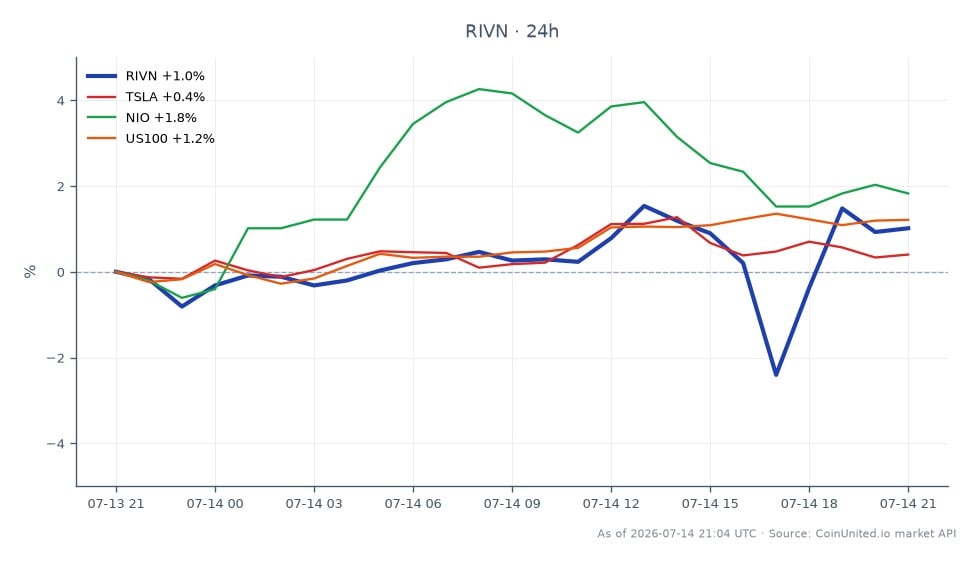
- •Cross-market read-across is bearish for Rivian and NIO as EV startup consolidation fears intensify; Tesla benefits as the perceived survivor.
- •Battery metals (nickel) see no direct demand impact from LCID alone, but persistent EV startup failures incrementally soften near-term demand forecasts.
Lucid Group's stock hit a new record low near $0.89 (post-split equivalent) following its largest quarterly operating loss on record, even as the company's VP of Communications Nick Twork explicitly d
Event Summary
Lucid Group's stock hit a new record low near $0.89 (post-split equivalent) following its largest quarterly operating loss on record, even as the company's VP of Communications Nick Twork explicitly dismissed bankruptcy fears. According to the research report, Lucid management cited $4.6–$5.5 billion in liquidity and confirmed Saudi Arabia's Public Investment Fund (PIF) backing extends the runway into the first half of 2027. CFO Taoufiq Boussaid acknowledged publicly that "there will be another fundraise" before profitability is reached.
Despite official denial, a quantitative distress model places Lucid's probability of bankruptcy at approximately 60% over the next 24 months. The stock has shed roughly 99% from its peak and ~85% over the past two years. Multiple rounds of layoffs — including one cutting approximately 18% of staff — are expected to deliver $158 million in annualized cost savings while generating $32 million in severance charges.
Leverage Impact Analysis
LCID at record lows is a high-volatility, sentiment-driven instrument — and for leveraged traders on CoinUnited.io, that cuts both ways sharply.
Long scenario: A trader opening a 50x long LCID CFD at $0.89 needs only a 2% adverse move ($0.018) to face a margin call. Given the 60% modeled distress probability and ongoing dilution risk from future PIF-linked capital raises, long positions require extremely tight position sizing. Even a modest negative headline — a creditor report, a delayed capital raise, or a weaker delivery print — can gap the stock further.
Short scenario: LCID at record lows is also a prime short-squeeze candidate. Any confirmatory PIF backstop announcement, strategic partnership deal, or positive production update could trigger a violent relief rally. A 20x short opened at $0.89 faces liquidation on roughly a 5% upward move ($0.044). Given how thin the float is at these levels, short squeezes can be abrupt.
Key leverage consideration: Elevated implied volatility in LCID options reflects the binary nature of the outcome — survival-with-dilution vs. restructuring. Leveraged CFD traders should treat LCID as an event-driven position with defined risk, not a directional trend trade. Monitor open interest and funding conditions on CoinUnited.io before sizing in.
Cross-Market Impact
Lucid's distress reinforces the broader EV consolidation narrative. Rivian Automotive and NIO Inc. face similar read-across pressure — investors are increasingly discriminating between cash-generative EV leaders and capital-dependent challengers. Tesla, Inc. benefits from the narrative as the perceived consolidation winner in luxury EVs.
For the NASDAQ 100 Index, LCID's weight is negligible, but the story feeds into the broader theme of tighter capital allocation to unprofitable growth names — a headwind for high-duration tech and EV-thematic ETFs. Nickel and other battery metals see no direct demand impact from LCID alone, but ongoing EV startup failures marginally soften near-term battery materials demand forecasts.
The Saudi PIF angle adds a geopolitical dimension: any shift in PIF's posture toward Lucid could affect perception of state-backed industrial investments more broadly, though macro FX impact on USD/SAR remains negligible.
Trading Considerations
Key levels to watch: LCID has no meaningful technical support below current record lows — price discovery is sentiment-driven. The next material catalysts are PIF capital injection announcements, quarterly delivery/production data, and any regulatory filings signaling restructuring advisors. Management's explicit acknowledgment of a future fundraise means dilution is a near-certainty; the question is timing and terms.
For earnings miss traders, LCID represents a textbook distressed equity setup: high headline risk, binary outcomes around capital events, and a stock that could double or halve on a single announcement. Position sizing should reflect the asymmetric volatility rather than a trend conviction.
Start Trading on CoinUnited.io
Create Your Free Account → — Trade crypto, stocks, forex, indices, and commodities with up to 2000x leverage and zero fees.
Sıkça Sorulan Sorular
At record-low prices with a 60% modeled distress probability, even moderate leverage (20–50x) carries liquidation risk on single-digit percentage moves. Treat LCID as an event-driven position with strict stop-losses rather than a trend trade.
Keşfetmeye Devam Et
Feragatname: Bu özet yalnızca eğitim amaçlıdır ve yatırım tavsiyesi değildir.