Быстрые ссылки
Maersk 2026 Guidance: Strong Demand Signal, But Oversupply Caps the Upside
Снимок данных
Основные выводы
- •Maersk maintains 2026 EBITDA guidance of USD 4.5–7.0bn, citing solid volume growth — but the wide range reflects geopolitical uncertainty around Red Sea and Hormuz route normalization.
- •Approximately USD 700m of EBIT support in 2026 comes from an accounting change (vessel life extension), not pure operating improvement — traders should isolate this when assessing earnings quality.
- •Structural container shipping overcapacity (~5% capacity addition from new vessels) caps freight rate upside even if demand stays firm, limiting the magnitude of any sector re-rating.
- •Maersk's demand commentary is a positive read-through for European cyclicals, STOXX 600 industrials/logistics names, and port/terminal operators globally.
- •Free cash flow guidance of up to USD -3bn paired with USD 10–11bn capex signals a capital-intensive transition phase; dividend and buyback sustainability is a key watch item for equity positioning.
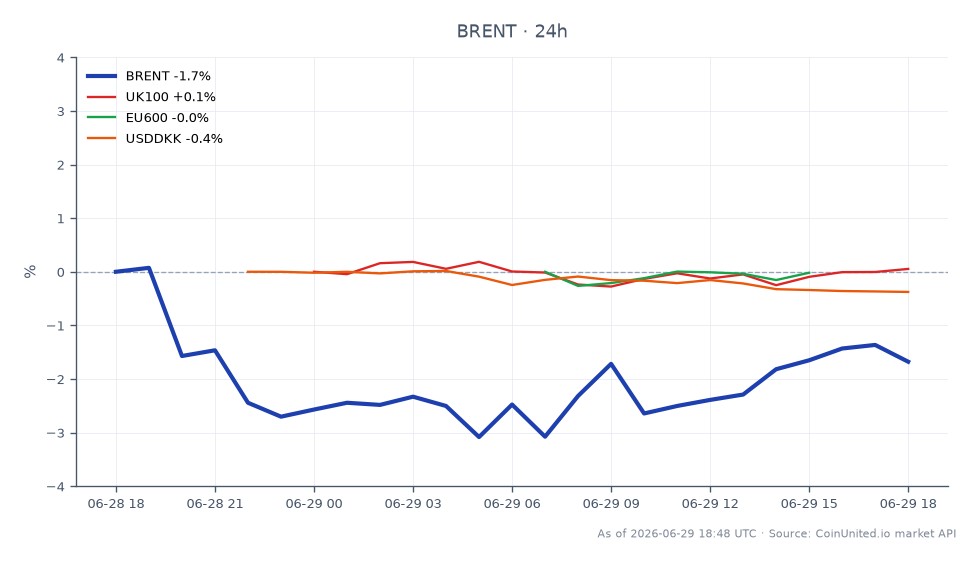
A.P. Moller-Maersk's 2026 financial guidance has attracted renewed market attention following Q1 2026 results and updated investor communications. According to Maersk's Q1 2026 interim report, the com
Event Analysis
A.P. Moller-Maersk's 2026 financial guidance has attracted renewed market attention following Q1 2026 results and updated investor communications. According to Maersk's Q1 2026 interim report, the company maintains its full-year 2026 guidance of underlying EBITDA of USD 4.5–7.0bn, underlying EBIT of USD -1.5bn to +1.0bn, and free cash flow of USD -3bn or higher, with capex of USD 10–11bn across 2025–2026. Management cited solid volume growth and strong performance in Terminals and Logistics & Services divisions as demand drivers, with global container volume growth forecast at 2–4% for 2026.
The wide guidance range is deliberately constructed around two distinct geopolitical scenarios: a prolonged Red Sea and Strait of Hormuz disruption (supporting elevated freight rates via longer sailing distances) versus a normalization of those routes (adding effective capacity and compressing rates). As reported by Reuters and Investing.com, when the current guidance band was first communicated, Maersk shares fell roughly 4–5%, as markets interpreted the midpoint as below the company's annualized run-rate EBITDA from Q4. One technical detail worth flagging: Maersk extended vessel useful lives from 20 to 25 years effective January 2026, reducing depreciation by approximately USD 700m and mechanically supporting the EBIT range — meaning not all of the EBIT improvement reflects pure operating strength.
What makes this guidance cycle distinct from prior Maersk announcements is the intersection of structural capacity overhang with genuine demand resilience. Unlike the 2021–2022 supercycle driven by supply-chain disruptions and constrained capacity, the current backdrop features new vessel deliveries increasing industry capacity by roughly 5%, even as Maersk simultaneously plans to expand terminal throughput from 3m to 4m TEU. The 2026 Global Indices Outlook and broader macro context matter here: Maersk explicitly flags global recession risk as a downside scenario, and the 2–4% volume growth forecast for 2026 is a deceleration from the approximately 5% expected in 2025.
For traders following macro inflation and trading dynamics, Maersk's guidance carries a secondary signal: overcapacity and normalized freight rates are disinflationary for goods prices, potentially softening the transport cost component of CPI in major import-reliant economies.
What This Means for Traders
Maersk is widely regarded as a bellwether for global goods trade, and any credible demand-strength narrative from the company carries read-through for European cyclicals broadly. The STOXX Europe 600 Index has material exposure to industrials and logistics names that track Maersk's demand commentary. Similarly, the FTSE 100 Index contains port, logistics, and shipping-adjacent names that can see sentiment lift when a bellwether like Maersk signals volume resilience. Hapag-Lloyd and COSCO Shipping peers would likely see sympathetic moves on confirmed demand upgrades.
The US Dollar / Danish Krone pair has a direct but second-order link: Maersk is one of the largest Danish large-caps and a dominant driver of the OMX Copenhagen index. A significant re-rating in Maersk equity could influence DKK-denominated capital flows, though the effect on USD/DKK is typically modest and diffused. Traders focused on earnings beats across sectors should note the critical distinction here: the EBIT support is partly accounting-driven (depreciation change), not purely operational — that distinction matters for how durable any guidance-driven re-rating proves to be.
Volatility is likely to remain elevated around any follow-up freight rate data or Red Sea/Hormuz developments, given how explicitly Maersk has tied its guidance range to those geopolitical scenarios. The asymmetric range (EBITDA 4.5–7.0bn) signals management's own uncertainty, which means news flow around route normalization or escalation carries binary repricing risk for shipping-sector positions.
Start Trading on CoinUnited.io
Create Your Free Account → — Trade crypto, stocks, forex, indices, and commodities with up to 2000x leverage and zero fees.
Часто задаваемые вопросы
Per Maersk's Q1 2026 interim report, the company explicitly states it 'maintains its full-year 2026 financial guidance' — the characterization as an upgrade is not directly confirmed in current filings. The guidance band (EBITDA USD 4.5–7.0bn) has been consistent since earlier 2026 communications.
Продолжить исследование
Отказ от ответственности: Этот бриф предназначен только для образовательных целей и не является инвестиционной рекомендацией.