Hurtiglenker
Levi Strauss Q1 FY2026: Double Beat, Raised Guidance, and a Dividend Hike Signal Brand Resilience
Datasnapshot
Viktige punkter
- •Levi beat Q1 EPS ($0.42 vs. $0.37 consensus) and revenue (~$1.74B vs. ~$1.65B), with 14% YoY net revenue growth.
- •DTC surpassed 50% of net revenues for the first time, with e-commerce up 17% and ~70% of new U.S. online orders from Gen Z/Millennials.
- •FY2026 adjusted EPS guidance raised to $1.42–$1.48; quarterly dividend increased ~8% to $0.14/share with $214M returned to shareholders last quarter.
- •Tariff-driven gross margin pressure (~61.9%) is being actively offset through pricing — a live signal of branded apparel's pricing power.
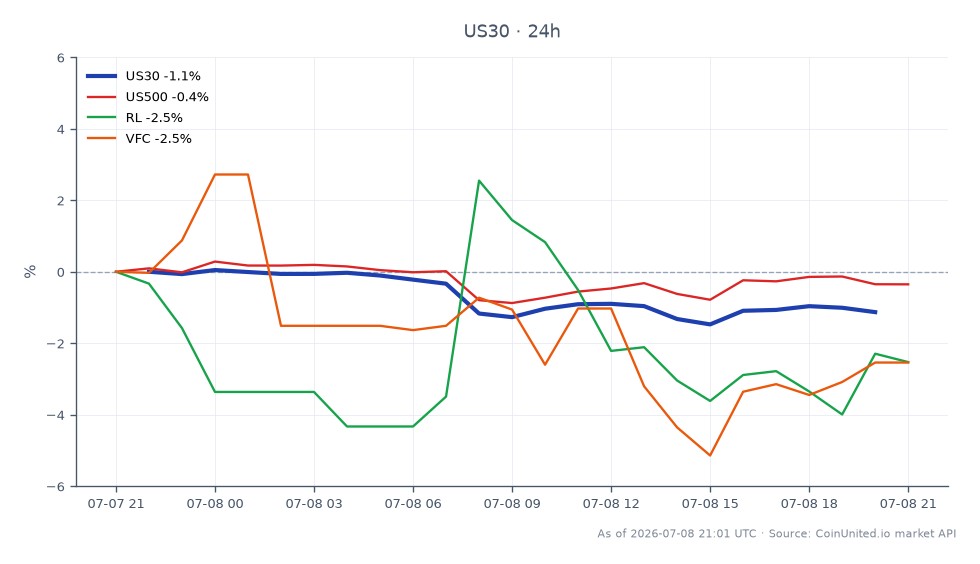
- •Peers including Gap, Ralph Lauren, and VF Corp may see sentiment lift, though each carries distinct risk profiles relative to Levi's cleaner balance sheet story.
Levi Strauss & Co. delivered a decisive Q1 FY2026 earnings beat, reporting adjusted EPS of $0.42 versus the $0.37 consensus and revenue of approximately $1.74B against expectations of $1.65B, accordin
Event Analysis
Levi Strauss & Co. delivered a decisive Q1 FY2026 earnings beat, reporting adjusted EPS of $0.42 versus the $0.37 consensus and revenue of approximately $1.74B against expectations of $1.65B, according to CNBC and MarketBeat. Net revenues grew roughly 14% year-over-year, a notable acceleration for a heritage apparel brand navigating a cautious U.S. consumer environment. The company simultaneously raised FY2026 adjusted EPS guidance to $1.42–$1.48 (from $1.40–$1.46) and bumped its quarterly dividend approximately 8% to $0.14/share, with roughly $214M returned to shareholders via dividends and buybacks last quarter alone.
What makes this result strategically significant is the structural story beneath the headline numbers. As reported by Investing.com, Direct-to-Consumer (DTC) now comprises ~52% of total net revenues — the first time it has crossed the majority threshold — after 16 consecutive quarters of DTC growth. E-commerce rose 17%, with approximately 70% of new U.S. online orders coming from Gen Z and Millennials, validating Levi's repositioning as a lifestyle brand rather than a legacy denim label. International markets drove ~75% of total growth, and China has returned to positive territory after prolonged weakness.
The tariff picture is a genuine test of pricing power. As Reuters noted, gross margin compressed to approximately 61.9% due to import tariffs, yet management is actively passing these costs through to consumers and expects to fully offset tariff impacts over the full year. This is a live case study in branded apparel's ability to sustain pricing — directly relevant to macro inflation trading frameworks watching goods-price stickiness. The guidance caveat — assuming "no significant worsening of macro conditions" — is an honest acknowledgment that the bullish case has a macro dependency.
This report fits squarely within the broader Q1 earnings beat and outlook upgrade wave, where select consumer names are demonstrating that brand equity and DTC infrastructure can offset macro headwinds others cannot.
What This Means for Traders
For equity traders, LEVI is the primary event-driven instrument. CNBC reported shares "popping" on the announcement, with one data point showing an approximately +11% move around the earnings release — consistent with the magnitude of the surprise (EPS beat of ~13–14%). Traders monitoring how to trade earnings beats should note that post-gap mean-reversion is a common pattern after outsized initial reactions; the sustainability of the move depends on whether macro conditions hold into H2.
The sector read-through is meaningful for The Gap, Inc., Ralph Lauren Corporation, and V.F. Corporation — all mid-to-premium apparel names where Levi's DTC success and demand resilience may lift sentiment. However, each has a different exposure profile: VF Corp carries significant debt load, while Gap's turnaround story is less advanced. The broader S&P 500 Index consumer discretionary component gets a marginal positive signal from evidence that branded spending is holding up despite tariffs and U.S. consumer pressure.
Volatility on LEVI is likely to compress post-earnings as the event risk clears, shifting the setup toward a momentum or mean-reversion trade depending on entry. The dividend increase and buyback acceleration add a fundamental floor for medium-term holders, supporting the quality/yield factor angle.
Start Trading on CoinUnited.io
Create Your Free Account → — Trade crypto, stocks, forex, indices, and commodities with up to 2000x leverage and zero fees.
Ofte stilte spørsmål
The EPS beat was ~13–14% above consensus ($0.42 vs. $0.37), and CNBC reported shares popped approximately +11% on the news. Post-earnings gaps of this size often see partial mean-reversion within days — monitor volume and price action at the gap level for confirmation.
Fortsett Utforskningen
Ansvarsfraskrivelse: Denne briefen er kun for utdanningsformål og er ikke investeringsråd.