Quick Links
Oxford Industries Drops ~7% on Revenue Miss and Soft Forward Guidance
Data Snapshot
Key Takeaways
- •OXM Q2 revenue of $403.1M missed the $406.1M consensus and fell 4% YoY, while adjusted EPS of $1.26 beat the $1.18 estimate.
- •Next-quarter revenue guidance of $302.5M was 2.1% below analyst expectations, implying continued top-line pressure.
- •Full-year revenue guidance was reaffirmed at ~$1.50B midpoint, limiting the structural bear case but not resolving near-term demand concerns.
- •The EPS beat signals margin discipline, not demand recovery — a pattern markets typically discount in discretionary stocks.
- •Broader index and macro impact is minimal; this remains a single-name and sector-sentiment event.
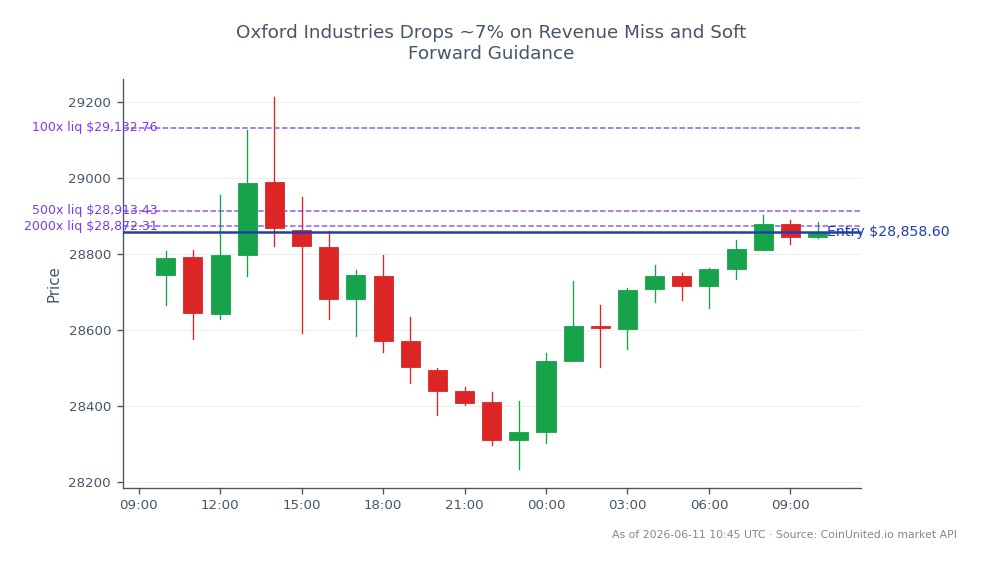
Oxford Industries (NYSE: OXM), the Atlanta-based fashion conglomerate behind Tommy Bahama and Lilly Pulitzer, reported a mixed Q2 result that ultimately sent shares lower by approximately 7%. Accordin
Event Analysis
Oxford Industries (NYSE: OXM), the Atlanta-based fashion conglomerate behind Tommy Bahama and Lilly Pulitzer, reported a mixed Q2 result that ultimately sent shares lower by approximately 7%. According to StockStory, Q2 revenue came in at $403.1 million, down 4% year-over-year and marginally below the analyst consensus of $406.1 million. Adjusted EPS of $1.26 beat estimates of $1.18, providing some bottom-line cushion — but the market's focus shifted quickly to the forward picture.
The real pressure point was next-quarter revenue guidance of $302.5 million, sitting 2.1% below analyst expectations and implying a further 1.8% year-over-year sales decline. That near-term softness overshadowed the full-year revenue reaffirmation of approximately $1.50 billion at the midpoint. This pattern — beating on EPS while missing on revenue and guiding conservatively — is a classic signal of margin management under demand stress, not fundamental recovery. Management appears to be controlling costs rather than growing the top line, which markets typically penalize in discretionary names.
What distinguishes this result from a routine earnings wobble is the sequential demand narrative. A 4% revenue decline in branded lifestyle apparel points to the consumer trading down or deferring discretionary purchases — a micro-signal consistent with the broader pressure on mid-to-premium branded retail. Oxford's result reinforces caution across the earnings miss revenue shock theme, particularly for brands reliant on aspirational lifestyle spending.
What This Means for Traders
For OXM specifically, the setup now fits the profile covered in how to trade earnings misses: sector strategies & setups: a revenue miss plus soft near-term guidance with a full-year reaffirmation creates a "wait and see" dynamic where sentiment stays cautious but the stock isn't in freefall. The EPS beat may limit downside from here, but any near-term bounce would likely face resistance until demand signals improve. Traders should monitor whether the ~7% move fully prices the guidance cut, or whether further selling emerges if peers report similarly.
The broader sector read-through is modest but worth noting. Comparable branded apparel and consumer discretionary names may see mild sympathy pressure, as Oxford's results add another data point to softening mid-tier consumer spending. However, this is a single-name story — the impact on the S&P 500 Index or NASDAQ 100 Index is negligible. Sector-level ETF exposure in consumer discretionary could see marginal sentiment drag if additional apparel names confirm similar trends this earnings cycle.
Volatility on OXM itself may persist for a session or two as analyst price target revisions land. The mixed earnings structure (EPS beat, revenue miss, soft near-term guide, full-year reiteration) tends to generate disagreement among analysts, keeping the stock choppy rather than trending cleanly in either direction.
Start Trading on CoinUnited.io
Create Your Free Account → — Trade crypto, stocks, forex, indices, and commodities with up to 2000x leverage and zero fees.
Frequently Asked Questions
Markets weight revenue and forward guidance more heavily than EPS beats in discretionary names. The soft next-quarter guidance of $302.5M — 2.1% below estimates — signaled demand weakness that overshadowed the bottom-line beat.
Continue Exploring
Disclaimer: This brief is for educational purposes only and is not investment advice.