Quick Links
Risk-On Macro Regime: Lower Oil, Yields, and Dollar Drive Multi-Asset Rally — Leverage Impact Across Forex, Equities & Commodities
Data Snapshot
Key Takeaways
- •At 100x leverage on GBP/USD, the 100-pip session range ($1.3300–$1.3400) produces a ±37% margin swing — position sizing is critical in this volatile cross-asset regime.
- •The macro setup — lower oil, yields, and dollar — is structurally bullish for EUR/USD, AUD/USD, gold, and equities simultaneously, but the entire thesis reverses if oil weakness is demand-driven.
- •USD/CAD is a conflicted trade: CAD benefits from dollar weakness but is hurt by lower oil — avoid treating it as a pure dollar-short vehicle.
- •Gold and silver are dual beneficiaries: weaker DXY and lower inflation expectations both support metals CFD long positions.
- •Crypto (BTC, ETH) aligns with the risk-on bid and softer dollar but typically lags equities in the initial leg — watch for equity confirmation before sizing up leveraged perpetual positions.
As reported by Investing.com, markets are pricing a classic "peace dividend" macro regime: oil prices falling, U.S. Treasury yields declining, the U.S. dollar softening, and equities rallying in tande
Event Summary
As reported by Investing.com, markets are pricing a classic "peace dividend" macro regime: oil prices falling, U.S. Treasury yields declining, the U.S. dollar softening, and equities rallying in tandem. This is not a single catalyst event but a converging multi-asset pattern where lower oil eases macro inflation pressure, pulling yields lower and improving equity valuations through reduced discount rates. The setup directly feeds into Fed macro policy crossroads pricing — if softer oil sustainably reduces headline CPI, the market can justify earlier or deeper rate cuts, amplifying the risk-on move.
The critical open question, per the research, is whether oil weakness reflects easing geopolitical risk (bullish for equities) or deteriorating demand (bearish for growth assets). These two drivers produce identical oil price moves but opposite implications for stocks and yields.
Leverage Impact Analysis
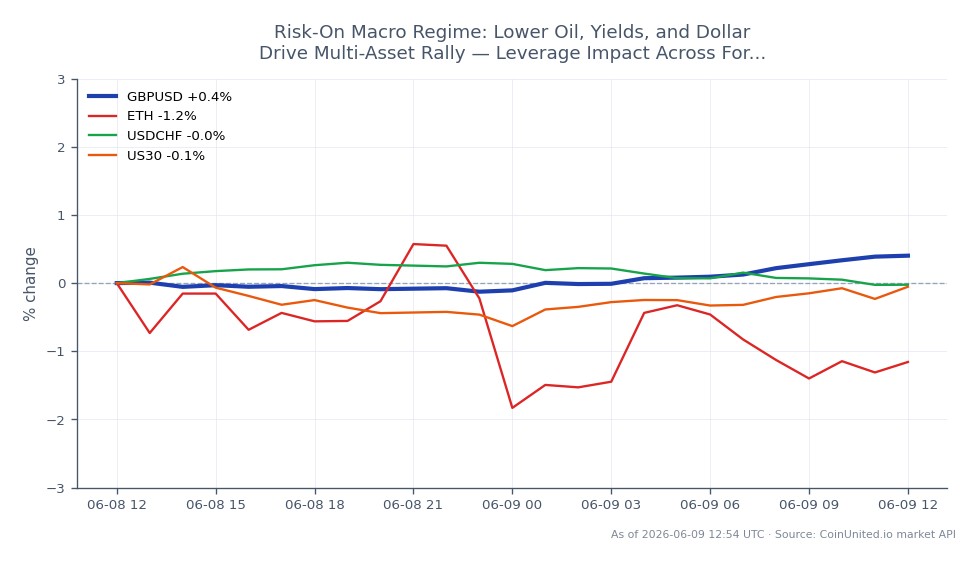
GBP/USD is trading at $1.3400 (+0.49% on the session, 24h low $1.3300) — a 100-pip range. For a trader running a 100x long GBP/USD position entered at $1.3350, the current $1.3400 print represents a +0.37% move, translating to a +37% gain on leveraged margin — but a retracement to the session low at $1.3300 would mean a -37% drawdown on that same position. At 500x leverage, that same 100-pip range represents the entire margin.
On EUR/USD and USD/JPY, dollar softness is the common thread. Long EUR/USD and short USD/JPY positions are structurally aligned with this regime. However, leverage traders must watch for regime reversal risk: if oil's decline is demand-driven, a risk-off pivot would rapidly reverse dollar weakness, squeezing short-USD positions. Monitor funding rates on CoinUnited.io for crowding signals — heavily one-sided positioning in dollar-short pairs increases liquidation cascade risk.
USD/CHF short positions also align with the softer dollar theme, though CHF's safe-haven properties mean a sudden risk-off flip could produce a violent squeeze for leveraged shorts.
Cross-Market Impact
Equities: Lower yields reduce discount rates for long-duration growth stocks, benefiting the S&P 500 and Nasdaq. Airlines, logistics, and consumer discretionary stocks are direct beneficiaries of lower oil — as detailed in our United Airlines stock guide. Energy producers and E&P names face margin headwinds.
Commodities: Lower oil directly pressures WTI CFDs. However, the gold vs. U.S. dollar inverse relationship means a weaker DXY is structurally supportive for gold — XAU/USD long positions are tactically aligned with this regime, and silver typically follows with amplified beta.
Crypto: BTC and ETH benefit from risk-on sentiment and a weaker dollar reducing the relative opportunity cost of non-yielding assets. Monitor whether equity gains are sustained — crypto tends to lag the initial risk-on move but accelerates on confirmation.
Commodity-linked FX: AUD/USD and NZD/USD are dual beneficiaries of both dollar weakness and commodity price support (ex-oil). USD/CAD is a conflicted pair — CAD benefits from dollar weakness but is hurt by lower oil.
Trading Considerations
Key levels: GBP/USD 24h range $1.3300–$1.3400 defines near-term support/resistance. A break above $1.3400 on volume would confirm bullish continuation; a failure back below $1.3350 signals range re-entry. For the broader dollar-weakness thesis, watch DXY for confirmation — a sustained move lower validates long EUR/USD, long AUD/USD, and long gold setups simultaneously.
The primary risk factor is oil's demand signal. If crude weakness accelerates on growth concerns rather than supply normalization, equities will reprice lower and the dollar could rally as a safe haven, unwinding the entire cross-asset setup rapidly. Position sizing at high leverage should account for this binary outcome.
Trade British Pound / US Dollar on CoinUnited.io
Trade GBPUSD with up to 2000xx leverage → | Create Free Account
Frequently Asked Questions
At 100x leverage, a 100-pip move from $1.3300 to $1.3400 represents approximately a 37% gain or loss on margin — at 500x, the same range can eliminate an entire position, so stops must be placed within the range, not beyond it.
Continue Exploring
Disclaimer: This brief is for educational purposes only and is not investment advice.