Quick Links
Pentagon's 1260H List Flash-Addition: BABA, BIDU, BYD Hit — Leverage Impact for China ADR CFD Traders
Data Snapshot
Key Takeaways
- •The Pentagon's 1260H list addition was real as a market event but was withdrawn minutes later — final regulatory status remains unresolved, creating binary headline risk.
- •BIDU is trading at $119.06 (-2.06%), with a 24h low of $118.13 — leveraged long CFD traders who entered above $121 face significant margin erosion at 50x leverage.
- •High-leverage directional positions (long or short) on BIDU, BABA, and BYD CFDs carry elevated whipsaw risk; a formal retraction or re-addition could trigger 3–5% counter-moves.
- •Cross-market spillover is most direct into the Hang Seng Index and China ADR ETFs; TSM and NVIDIA face secondary sentiment pressure via the semiconductor supply chain geopolitics theme.
- •Gold is a natural beneficiary if U.S.-China tensions escalate further; Copper faces demand-side headwinds from any formal investment restriction escalation.
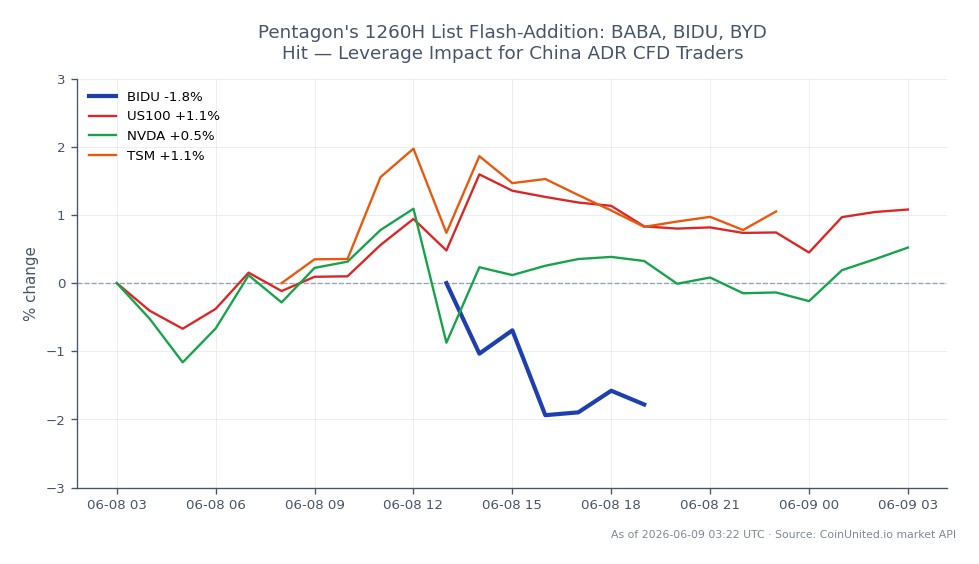
According to reports from Kharon and ROIC.ai, the U.S. Department of Defense briefly added Alibaba, Baidu, BYD, COSCO, Huawei, and NIO to its Section 1260H list — a Pentagon register identifying compa
Event Summary
According to reports from Kharon and ROIC.ai, the U.S. Department of Defense briefly added Alibaba, Baidu, BYD, COSCO, Huawei, and NIO to its Section 1260H list — a Pentagon register identifying companies believed to support China's military — before withdrawing the update minutes later without explanation. The event is confirmed as a real market incident even though the final designation remains unpublished. As reported by Kharon, inclusion on the 1260H list does not currently impose direct sanctions but signals potential future procurement bans and investment restrictions. The initial print showed Alibaba down over 3% and Baidu down over 2% on the headline.
The withdrawal creates an ambiguous regulatory environment: the list update was real enough to move markets, but its retraction means traders cannot treat these firms as formally designated. The key risk, as sources note, is whether this becomes a precursor to wider cross-border enforcement repricing — including investment restrictions or procurement bans — as part of a broader global regulatory enforcement wave.
Leverage Impact Analysis
With Baidu (BIDU) currently trading at $119.06 (down 2.06% on the day, 24h low: $118.13), leveraged CFD traders face amplified drawdown risk from further headline escalation.
Worked example — leveraged long: A trader holding a 50x long BIDU CFD entered at $121.00 (pre-news) now faces an unrealized loss of approximately $1.94 per share, representing a ~8% margin erosion at 50x leverage. A further 2% decline to ~$116.70 would approach liquidation territory for positions sized at maximum exposure.
Short-side risk: Traders who shorted BIDU on the initial headline now face squeeze risk if the Pentagon formally retracts the update or issues a clarification. A relief rally of 3–4% — reversing the initial drop — would erase leveraged short gains rapidly. Monitor for official Pentagon statements as the key trigger.
For BABA and BYD CFDs, the same logic applies: headline-driven gaps create sharp but potentially short-lived dislocations. Given the event's ambiguity (added, then withdrawn), high-leverage directional positions carry elevated whipsaw risk on any official clarification.
Cross-Market Impact
The semiconductor supply chain geopolitics angle creates spillover into chip names. Taiwan Semiconductor Manufacturing (TSM) and NVIDIA face indirect sentiment pressure as any escalation in U.S.-China tech restrictions tightens the demand outlook for advanced chips shipped to Chinese buyers.
The NASDAQ 100 carries indirect exposure through its weighting in U.S.-listed China ADRs and semiconductor names. Broad risk-off from U.S.-China tension historically supports Gold as a safe-haven, and Copper faces demand-side headwinds if China's industrial outlook deteriorates on further restrictions. The Hang Seng Index — tracked via our Hang Seng trader's guide — is the most direct index vehicle for this event.
Forex markets reflect the tension via USD/CNY; any formal re-listing would likely pressure the yuan and weigh on AUD (a China-demand proxy commodity currency).
Trading Considerations
BIDU's 24h range of $118.13–$122.45 defines near-term support and resistance. The $118 level is the immediate downside trigger; a confirmed break opens a retest of recent swing lows. Resistance sits at $122.45. The event's ambiguity — list added, then withdrawn — means binary outcome risk is elevated: a formal Pentagon confirmation re-introduces the 3%+ downside seen on the initial print, while an official retraction could spark a sharp mean-reversion rally.
Watch for: (1) official Pentagon statement on the 1260H update; (2) follow-on Congressional or OFAC commentary; (3) Hong Kong-listed shares of BABA/BYD as a real-time sentiment gauge before U.S. market open. Given the semicon geopolitical supply repricing backdrop, any escalation carries tail risk well beyond the initial 2–3% moves observed.
Trade Baidu, Inc. on CoinUnited.io
Trade BIDU with up to 500xx leverage → | Create Free Account
Frequently Asked Questions
The designation itself imposes no direct sanctions, but it reprices geopolitical risk premium — BIDU dropped over 2% on the initial headline. At 50x leverage, a 2% adverse move erodes approximately 100% of the initial margin on that increment, so position sizing must account for potential re-escalation if the list is formally re-published.
Continue Exploring
Disclaimer: This brief is for educational purposes only and is not investment advice.