Quick Links
BoC Stagflation Preview: How Macklem's Rate Dilemma Creates a High-Stakes USD/CAD Setup
Data Snapshot
Key Takeaways
- •USD/CAD is trading at $1.4000 — leveraged positions face liquidation within 50 pips at 200x+, making pre-announcement position sizing critical
- •BoC's stagflation bind (tariffs = higher prices + weaker growth) limits Macklem's room to cut, keeping CAD rate differentials in focus
- •Gold benefits from a constrained-BoC narrative as a stagflation hedge — watch XAU/USD for confirmation of risk-off spillover
- •WTI crude faces bearish pressure if BoC reinforces a slower global growth outlook via trade war damage assessment
- •The June Canada jobs beat (+87.8K) complicates the dovish case — markets are not fully priced for either outcome, amplifying volatility risk
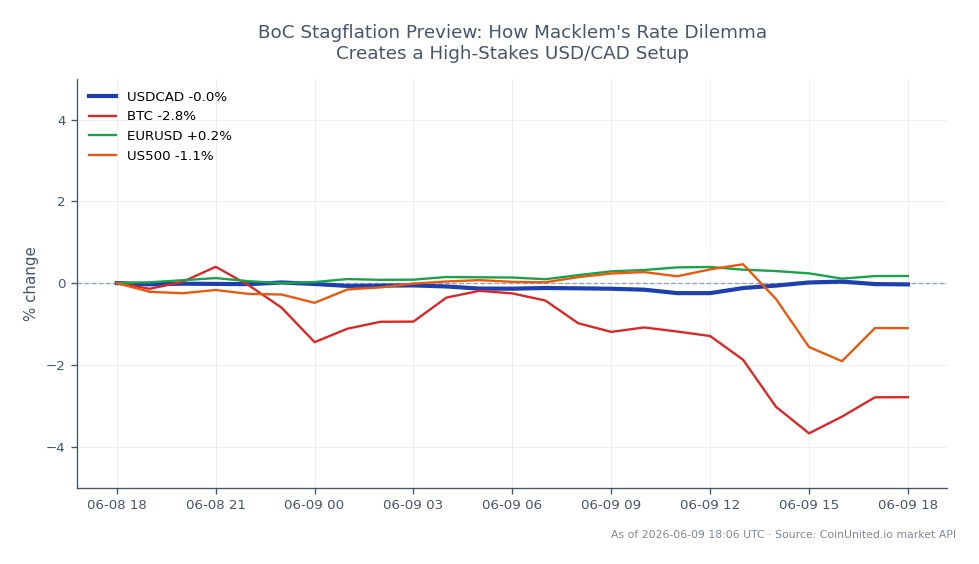
Bank of Canada Governor Tiff Macklem faces a classic stagflationary bind ahead of the next policy communication: US tariffs and trade conflict are simultaneously raising consumer prices (inflationary)
Event Summary
Bank of Canada Governor Tiff Macklem faces a classic stagflationary bind ahead of the next policy communication: US tariffs and trade conflict are simultaneously raising consumer prices (inflationary) and suppressing growth and employment (disinflationary). According to BoC speeches and Monetary Policy Reports, Macklem has explicitly acknowledged that monetary policy is "somewhat limited" when shocks are structural in nature — it cannot target specific tariff-hit sectors or undo supply-side cost increases.
Live market data shows USD/CAD trading at $1.4000 (24h range: $1.39–$1.40, -0.01%), reflecting cautious positioning ahead of the decision. Following the Canada jobs shock of +87.8K in June — which briefly collapsed BoC cut bets — markets are now re-evaluating how much room Macklem actually has to ease. This is a textbook stagflation risk & geopolitical inflation shock scenario.
Leverage Impact Analysis
With USD/CAD at $1.4000, the event carries asymmetric leverage risk. A hawkish surprise (BoC holds, emphasizes inflation persistence) could push USD/CAD back toward $1.39 support, while a dovish tilt (prioritizing growth weakness) could see a move toward $1.41–$1.42.
Worked example — Long USD/CAD at 100x leverage:
- -Position size: $14,000 notional (100 units at $1.4000)
- -A 50-pip adverse move to $1.3950 = $500 loss on $140 margin — a 357% margin wipeout
- -At 500x leverage, the same 50-pip move liquidates the position entirely
Key risk: The BoC statement lands as scheduled macro news — not a surprise leak — meaning volatility will be concentrated in a narrow window. Traders holding positions through the announcement face spread widening and slippage at extreme leverage levels. Monitor funding rates on CoinUnited.io for CAD pairs pre-event. The macro inflation risk-off repricing theme adds tail risk if Macklem's tone turns unexpectedly hawkish on trade war escalation scenarios.
Cross-Market Impact
The BoC stagflation narrative creates ripple effects across five asset classes:
- -EUR/USD: A dovish BoC reinforces global central bank constraint narrative, mildly supportive of USD broadly, pressuring EUR/USD
- -Gold: Stagflation historically supports gold as a policy-mistake hedge. If Macklem signals limited toolkit, the gold vs. USD inverse relationship thesis strengthens
- -WTI Crude: BoC emphasizing slower Canadian/global growth weighs on energy demand expectations — bearish short-term signal for oil, compounding existing supply uncertainty
- -S&P 500: Broader "higher-for-longer" repricing spillover could pressure rate-sensitive sectors; Canadian bank stocks face dual headwinds of credit risk + compressed margins
- -BTC: Neutral-to-mildly negative via tighter global liquidity if stagflation fears accelerate risk-off sentiment; limited direct CAD-crypto channel
For traders using the macro inflation trading strategy framework, this BoC event is a live test case of how commodity-linked currencies behave under constrained central bank optionality.
Trading Considerations
USD/CAD key levels: $1.3900 is immediate support (24h low), with $1.4050–$1.4100 as near-term resistance if CAD weakens on a dovish BoC. A hold with hawkish inflation language would likely see CAD strength test $1.39 again. Watch the forward guidance language — any shift from "balanced risks" to "skewed toward inflation" is the hawkish signal; emphasis on trade-war growth damage is the dovish trigger.
Position sizing is critical here. Given the macro inflation risk-off repricing backdrop and requires_immediate_market_confirmation status, traders should treat this as a volatility event and size accordingly — not a directional trade with high confidence.
Trade US Dollar / Canadian Dollar on CoinUnited.io
Trade USDCAD with up to 2000xx leverage → | Create Free Account
Frequently Asked Questions
Central bank surprises on CAD pairs can trigger 80–150 pip moves within minutes. At 100x leverage, a 100-pip adverse move on USD/CAD represents a 714% loss relative to margin — pre-event, reduce leverage to 10x–20x or wait for the dust to settle before entering.
Continue Exploring
Disclaimer: This brief is for educational purposes only and is not investment advice.