Quick Links
Citi Reiterates 25bp RBA August Hike — AUD/USD Leverage Scenarios at $0.7157
Data Snapshot
Key Takeaways
- •Citi reiterates a 25bp RBA hike at the August meeting, underpinned by inflation overshoot risk, tight labour markets, and housing strength — consistent with calls from Deutsche, Morgan Stanley, and Rabobank in prior analogous setups.
- •AUD/USD is trading at $0.7157 (24h range $0.7153–$0.7168), suggesting the market has not yet fully repriced the Citi call — Q2 CPI is the key binary trigger for a move higher.
- •Leveraged AUD/USD longs at 100x face liquidation on a ~72-pip adverse move; at 200x, a 30-pip reversal erases 60%+ of margin — position sizing around upcoming CPI data is critical.
- •Cross-market: AUD/JPY upside is the cleanest relative-rate expression; Gold (USD-priced) is more Fed-driven, but the macro inflation backdrop remains supportive.
- •The broader APAC hawkish pivot theme is intact — if Q2 CPI surprises to the upside, AUD could rally across the board; a miss would pressure AUD back toward $0.7124 support.
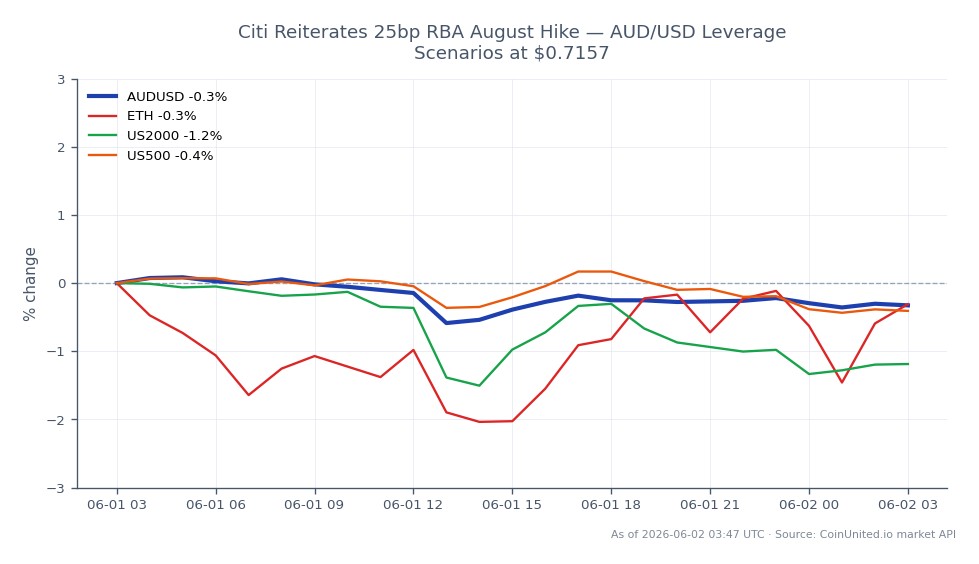
Citi has reiterated its forecast for a 25 basis point rate hike by the Reserve Bank of Australia (RBA) at the Bank's August meeting — the next realistic policy inflection point given the RBA does not
Event Summary
Citi has reiterated its forecast for a 25 basis point rate hike by the Reserve Bank of Australia (RBA) at the Bank's August meeting — the next realistic policy inflection point given the RBA does not meet in July. According to research compiled from institutional commentary and prior Citi RBA frameworks, the call is underpinned by inflation overshoot risk, a tight labour market, and unexpected strength in household consumption and housing demand. Other major houses including Morgan Stanley, Deutsche Bank, Judo Bank, Rabobank, and UBS have previously held similar August hike expectations, with market-implied probabilities near 40% in analogous setups. This reiteration adds weight to the hawkish side of the August debate. The Q2 CPI print remains the critical trigger: as Morgan Stanley has noted, an upside surprise in Q2 CPI is the threshold that makes an August move actionable.
AUD/USD is trading at $0.7157 (24h range: $0.7153–$0.7168, -0.05%) per live market data, suggesting the market has not yet aggressively repriced the Citi call into spot.
Leverage Impact Analysis
For leveraged AUD/USD traders, a hawkish RBA reiteration from a major bank can generate sharp intraday moves, particularly around upcoming CPI and labour data releases that will validate or invalidate the August hike thesis.
Long AUD/USD scenario (bullish RBA repricing): A trader opening a 100x long AUD/USD position at $0.7157 controls $71,570 notional per standard lot. A 30-pip move to $0.7187 generates approximately $300 profit on a $716 margin — a 42% return on margin. However, a 10-pip adverse move to $0.7147 represents a ~14% drawdown on margin, and a 72-pip reversal to $0.7085 triggers liquidation. Given AUD's dual sensitivity to RBA hawkishness AND global risk sentiment (especially Fed/China), volatility spikes around data events are a primary liquidation risk.
Short squeeze risk: If Q2 CPI beats to the upside and confirms the Citi call, traders short AUD from recent lows near $0.7124 (per prior pulse data) face significant squeeze pressure. At 200x leverage, a 30-pip move represents 60%+ of margin — position sizing discipline is critical. Monitor open interest and funding rates on CoinUnited.io for real-time confirmation signals before sizing up.
The APAC hawkish pivot & inflation surge theme is directly in play here — this is not an isolated RBA event but part of a broader regional repricing cycle.
Cross-Market Impact
The primary transmission channels beyond AUD/USD extend to:
- -AUD/JPY and AUD/NZD: A widening RBA-vs-BOJ rate differential supports AUD/JPY upside. NZD/USD also faces relative pressure if RBNZ is perceived closer to cuts than the RBA.
- -Gold (XAU/USD): A stronger AUD driven by hawkish RBA repricing is a modest headwind for AUD-denominated gold returns for Australian producers, though USD-priced Gold is more directly driven by the Fed/DXY complex. The macro inflation pressure backdrop remains broadly supportive of gold as a hedge.
- -S&P 500 / Russell 2000: RBA hawkishness is second-order for US indices, but fits the broader macro inflation risk-off repricing narrative. If global rate expectations shift higher, rate-sensitive growth sectors face headwinds.
- -BTC/ETH: Crypto impact is third-order — an RBA hike alone won't move Bitcoin materially, but a sustained hawkish pivot across APAC central banks tightening global liquidity remains a marginal headwind for risk assets.
For a deeper framework on how CPI prints and rate decisions cascade across asset classes, see our macro inflation trading strategy guide.
Trading Considerations
AUD/USD spot at $0.7157 sits near the tight 24h range of $0.7153–$0.7168, suggesting consolidation ahead of a data catalyst. The key level to watch on the upside is $0.7168 (24h high); a break above with volume would confirm hawkish repricing is gaining traction. On the downside, $0.7124 (recent unemployment shock low per prior pulse) serves as near-term support — a break below that level on softer-than-expected CPI would invalidate the August hike thesis entirely.
The critical upcoming catalyst is the Q2 CPI release. Traders should review our AUD/USD trading guide for structural level context, and monitor whether other houses converge on Citi's August call in the weeks ahead — institutional consensus shift is the primary AUD upside catalyst.
Trade Australian Dollar / US Dollar on CoinUnited.io
Trade AUDUSD with up to 2000xx leverage → | Create Free Account
Frequently Asked Questions
AUD/USD at $0.7157 is range-bound near 24h highs of $0.7168 — the Citi reiteration is directionally bullish AUD but requires Q2 CPI confirmation to drive a sustained breakout. At 100x leverage, a 30-pip rally to $0.7187 yields ~42% return on margin, but a 72-pip reversal triggers liquidation, so sizing conservatively ahead of the CPI print is essential.
Continue Exploring
Disclaimer: This brief is for educational purposes only and is not investment advice.