Quick Links
SEC Sues Privvy Founder Over $12.3M Fake AI Trading Bot Scheme — What It Signals for Crypto Markets
Key Takeaways
- •The SEC confirmed Nathan Fuller raised ~$12.3M from ~150 investors via fake AI arbitrage bots, misappropriating at least $6.2M for personal use and recycling $5.5M as Ponzi payments.
- •This case explicitly targets AI branding as a fraud vector in crypto — a new and important regulatory signal for any platform marketing AI-driven yield or arbitrage products to U.S. retail.
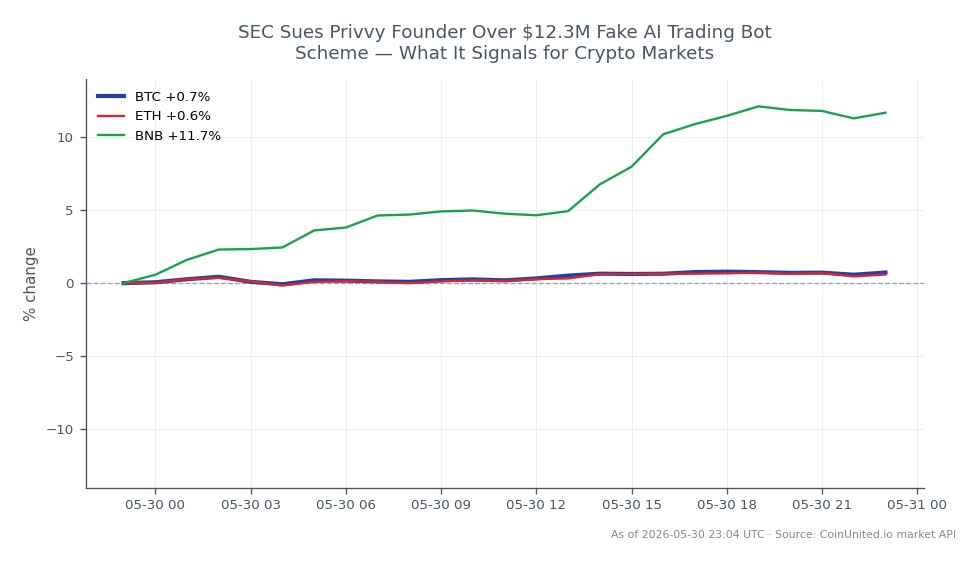
- •No direct price shock expected for BTC, ETH, or major tokens; the impact is incremental pressure on the regulatory-risk premium for U.S.-exposed crypto platforms.
- •Claims of 'FDIC insurance' and 'surety bonds' on speculative crypto strategies are firmly in the SEC's crosshairs — a compliance red flag for any firm using similar marketing language.
- •The enforcement narrative is accumulating: this case reinforces that SEC action intensity is not easing, supporting caution on regulatory-overhang risk for crypto-exposed equities.
According to the U.S. Securities and Exchange Commission's official litigation release (May 28, 2026), the SEC filed suit against Nathan Fuller of Cypress, Texas, in the Southern District of Texas (*N
Event Analysis
According to the U.S. Securities and Exchange Commission's official litigation release (May 28, 2026), the SEC filed suit against Nathan Fuller of Cypress, Texas, in the Southern District of Texas (*No. 4:26-cv-04237*). Fuller allegedly raised approximately $12.3 million from around 150 investors between October 2022 and mid-2024 through Privvy Investments, LLC — also operating as Gateway Digital Investments. The scheme promised returns of 40–50% within 30–45 days and "guaranteed" profits exceeding 100% in as little as 21 days, marketed as income from proprietary AI-based high-frequency arbitrage bots. Those bots, the SEC alleges, did not function as described.
The reality was far grimmer: at least $6.2 million was misappropriated for personal expenses, while roughly $5.5 million was recycled as Ponzi-like payments to earlier investors. Fake account statements and fabricated correspondence from phony entities were used to keep investors in the dark. Fuller is charged with violating Sections 5(a), 5(c), and 17(a) of the Securities Act of 1933, and Section 10(b) of the Securities Exchange Act of 1934. This case sits squarely in the fraud/unregistered securities bucket — not the gray-area token classification debates — making it a clean enforcement signal.
What distinguishes this case from prior retail crypto fraud actions is the explicit targeting of AI branding as a vector for misrepresentation. The SEC is on record alleging that Fuller weaponized "proprietary AI" and "FDIC-insured" language to lend false credibility to an unregistered investment scheme. This is part of the broader crypto industry enforcement and accountability wave and signals that regulators are now specifically scrutinizing the intersection of AI marketing with crypto yield products — a combination that has proliferated across Telegram groups, Discord servers, and boutique fund structures. Traders should read our crypto enforcement & accountability guide for deeper context on how these actions accumulate into policy trajectory.
What This Means for Traders
This case is too small and idiosyncratic to generate direct price impact on Bitcoin, Ethereum, or Binance Coin. No major exchange, public company, or widely-held token is named in the complaint. However, as part of the global regulatory enforcement wave, it adds an incremental layer of regulatory-risk premium to U.S.-exposed crypto platforms and any firm marketing AI-driven yield or arbitrage strategies to retail investors. Publicly listed brokerages and exchanges may tighten third-party strategy listings and copy-trading product approvals to preempt similar scrutiny.
For traders already positioned in U.S. crypto-exposed equities, this is a marginal bearish signal on the regulatory-overhang axis — not a catalyst for immediate repositioning, but a reinforcement of the thesis that enforcement intensity is not easing. The cross-border enforcement repricing theme remains active: boutique funds and signal-seller platforms using joint-venture wrappers for retail crypto offerings face elevated structural risk. Retail sentiment may also cool slightly toward off-exchange "signal sellers" and unregistered fund managers, potentially concentrating volume at larger, more compliant venues over time.
Start Trading on CoinUnited.io
Create Your Free Account → — Trade crypto, stocks, forex, indices, and commodities with up to 2000x leverage and zero fees.
Frequently Asked Questions
No. At $12.3M across 150 investors, the case is too small and involves no named exchange or token. Expect no direct price impact on major crypto assets.
Continue Exploring
Disclaimer: This brief is for educational purposes only and is not investment advice.