Quick Links
Circle Freezes $12.6M USDC Inside Zama's Privacy Wrapper — A Contract-Level Censorship Precedent
Data Snapshot
Key Takeaways
- •Circle blacklisted Zama's entire cUSDC smart contract at 01:08 UTC May 30, 2026, locking $12.6M USDC — a first-of-kind contract-level freeze, not a single-wallet action.
- •The trigger was a civil dispute involving Overnight Finance's treasury, not confirmed criminal activity — setting a lower bar for future protocol-level censorship.
- •All Zama cUSDC users are frozen regardless of connection to Overnight Finance, demonstrating that USDC-backed privacy wrappers inherit full issuer censorship risk.
- •DeFi protocols using privacy layers over centralized stablecoins now face explicit smart-contract blacklist risk — a structural vulnerability for the sector.
- •Regulatory pressure from the GENIUS and CLARITY Acts will determine whether future freezes require clearer legal thresholds, making pending U.S. stablecoin legislation a key market watch.
At 01:08 UTC on May 30, 2026, Circle blacklisted the entire Zama cUSDC smart contract (`0xe978F22157048E5DB8E5d07971376e86671672B2`) on Ethereum, freezing approximately $12.6M USDC. According to on-ch
Event Analysis
At 01:08 UTC on May 30, 2026, Circle blacklisted the entire Zama cUSDC smart contract (`0xe978F22157048E5DB8E5d07971376e86671672B2`) on Ethereum, freezing approximately $12.6M USDC. According to on-chain data tracked by the USDT/USDC Ban List monitor, the action was triggered by a legal directive linked to Overnight Finance — a DeFi yield protocol facing community accusations of treasury mismanagement and fund co-mingling — which had deposited roughly $12.4M USDC into the Zama privacy wrapper on May 11, 2026.
What makes this freeze precedent-setting is the *target*: not individual wallets, but an entire smart contract. Prior Circle enforcement actions — including the blacklisting of 16 wallets on March 23, 2026 under a sealed U.S. civil case — targeted specific addresses. Here, every user who deposited USDC into Zama's Confidential USDC wrapper, regardless of any link to Overnight Finance, is now locked out of redemptions. This is collateral censorship at the protocol layer.
Zama is a privacy infrastructure provider using fully homomorphic encryption (FHE) to create confidential token wrappers. It is not the alleged bad actor. The freeze underscores a structural vulnerability in the SEC Stablecoin & DeFi regulatory pivot era: any privacy protocol built on top of a centralized stablecoin inherits the issuer's ability to nullify the entire wrapper via blacklist. The cryptography works — until the collateral doesn't. This event fits squarely within the broader crypto enforcement accountability wave reshaping DeFi infrastructure risk.
Circle has publicly urged passage of the GENIUS and CLARITY Acts, arguing it needs clear statutory authority to guide freeze decisions — a position that becomes more fraught as this case demonstrates Circle acting on civil dispute grounds, not confirmed criminal theft. For context on the regulatory backdrop, the Crypto Clarity Act & SEC Rules guide details how pending legislation may formalize these intervention thresholds.
What This Means for Traders
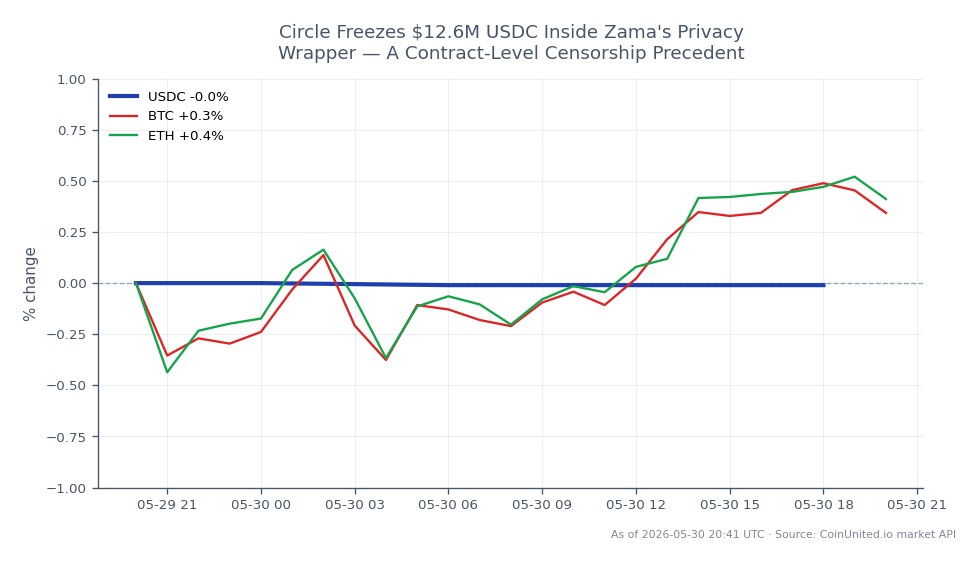
The direct market impact on USDC price is negligible — according to live market data, USDC is trading at $1.00 with a -0.02% 24-hour change. The real impact is reputational and structural. This freeze reinforces USDC's censorship risk profile, particularly for DeFi protocols that route treasury operations through privacy wrappers. Traders should monitor whether this accelerates rotation into decentralized stablecoins (DAI, LUSD, crvUSD) or competing centralized options. The institutional stablecoins guide provides useful context on how stablecoin choice affects on-chain yield strategies.
For the DeFi structural reset theme, this event adds meaningful pressure. DeFi yield protocols — especially those with opaque treasury operations — now face dual risk: governance-level disputes that attract legal attention, and the discovery that privacy wrappers using USDC as collateral offer no protection against issuer-level intervention. Any listed token associated with DeFi yield aggregators or privacy-layer infrastructure warrants elevated scrutiny. Traders positioned in Ethereum should note that Ethereum-based DeFi TVL carries this censorship risk dimension, which may widen risk premiums across USDC-collateralized protocols.
Volatility signals here are moderate but directionally bearish for privacy-infrastructure tokens and USDC-dependent DeFi strategies. The persistence of this narrative depends on whether Overnight Finance's legal situation escalates and whether Zama can recover protocol trust — both uncertain in the near term.
Trade USDC on CoinUnited.io
Trade USDC with up to 2000xx leverage → | Create Free Account
Frequently Asked Questions
Not without Circle lifting the blacklist. The freeze disables all transfers and redemptions from the contract, meaning recovery requires Circle to reverse the action — which typically requires resolution of the underlying legal/civil matter.
Continue Exploring
Disclaimer: This brief is for educational purposes only and is not investment advice.