Quick Links
U.S. Section 301 Probe Targets Vietnam: VND Under Pressure as Tariff Tail Risk Grows
Data Snapshot
Key Takeaways
- •USTR formally launched a Section 301 investigation into Vietnam (among 15 others) on March 11, 2026, with tariff authority identical to that used in the 2018–2020 U.S.–China trade war.
- •USD/VND at 26,312.50 shows muted reaction now, but leveraged positions face liquidation risk around the April 15 comment deadline and May 5–8 public hearings — high-leverage traders (>50x) should size accordingly.
- •Vietnam-exposed U.S. sectors — electronics hardware, apparel, footwear, and furniture — face margin compression risk if tariffs materialize, mirroring 2018 China tariff dynamics.
- •Cross-market: Gold may benefit from inflation re-pricing; USD/CNY faces additional trade-war headline pressure as China is also named in the same probe.
- •No tariffs are in place yet — this is a probability event with a July 24, 2026 expected conclusion date, creating a multi-month window of path-dependent headline risk.
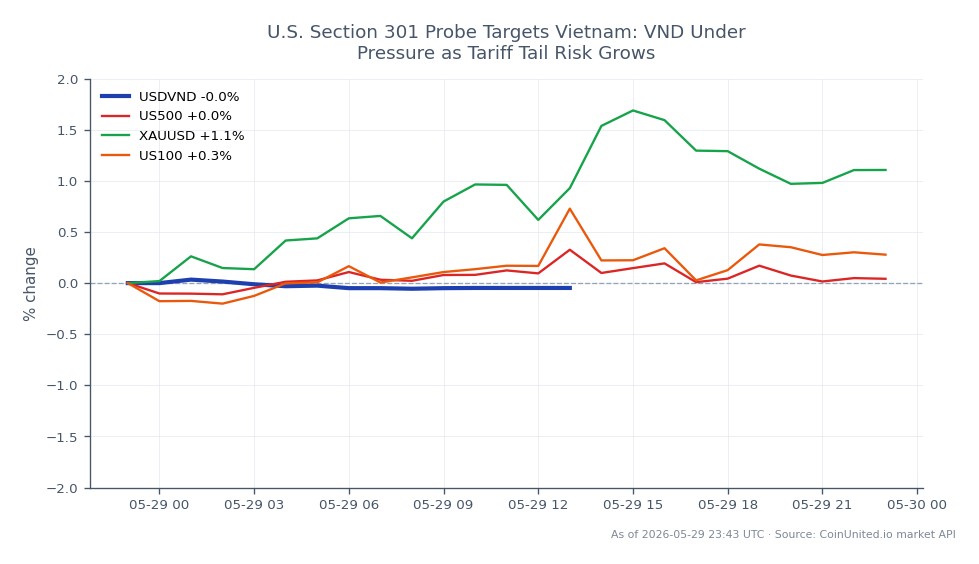
On March 11, 2026, the U.S. Trade Representative (USTR) formally initiated Section 301 investigations into 16 trading partners — including Vietnam — for alleged structural excess manufacturing capacit
Event Summary
On March 11, 2026, the U.S. Trade Representative (USTR) formally initiated Section 301 investigations into 16 trading partners — including Vietnam — for alleged structural excess manufacturing capacity. According to the USTR's official docket, the probe examines subsidies, state-owned enterprise behavior, suppressed wages, and currency practices that may unfairly burden U.S. commerce. Key procedural dates: dockets opened March 17, written comments due April 15, public hearings May 5–8, with USTR expected to conclude around July 24, 2026.
This marks an escalation in U.S. trade pressure on Vietnam, which has become a critical electronics assembly and apparel export hub — particularly after production shifted out of China during earlier Section 301 actions. No tariffs have been imposed yet, but the same legal instrument was used to trigger the U.S.–China trade war tariffs of 2018–2020.
Leverage Impact Analysis
USD/VND currently trades at 26,312.50 (24h range: 26,303.00–26,337.50, -0.05% on the day), reflecting muted immediate reaction — but leveraged traders should not mistake low realized volatility for low event risk.
The tail risk here is asymmetric: if USTR preliminary findings leak or proposed tariff schedules emerge around the May hearings, USD/VND could gap sharply. A trader holding a 100x long USD/VND CFD on CoinUnited.io at 26,312.50 would see approximately 1% adverse move = 100% margin loss — meaning a VND strengthening move to ~26,049 would trigger liquidation. Conversely, a tariff-shock scenario pushing USD/VND toward 26,600–26,800 (consistent with prior risk-off VND selloffs) would yield substantial gains on leveraged USD longs.
Given the macro inflation risk-off repricing dynamic this probe introduces, traders using leverage above 50x on VND pairs should treat April 15 (comment deadline) and May 5–8 (hearings) as high-volatility windows requiring tighter position sizing or pre-set stops. Monitor funding rates on CoinUnited.io for positioning signals ahead of these dates.
Cross-Market Impact
USD/CNY: The probe covers China alongside Vietnam — the USD/CNY pair faces renewed trade-war headline risk. Any escalation language from hearings could push CNY weaker, reinforcing dollar strength across Asia EM FX broadly.
Gold: A credible tariff threat resurrects inflation concerns — higher import prices on electronics, apparel, and furniture feed U.S. CPI. The gold/USD inverse relationship means gold may find renewed bid if markets reprice Fed patience. Watch the Gold/US Dollar CFD for safe-haven flows as hearing dates approach.
U.S. Indices: The S&P 500 and NASDAQ 100 face sector-specific headwinds. U.S. tech hardware names, apparel brands, and furniture retailers with heavy Vietnam sourcing (comparable to the 2018 China tariff shock) are most exposed. The APAC stagflation and currency stress theme is directly relevant here — stagflation risk from tariff-driven goods inflation could weigh on growth multiples in rate-sensitive tech names.
Trading Considerations
USD/VND's tight 34.5-pip 24h range signals the market is in a wait-and-see mode ahead of formal comment periods. Key levels to watch: resistance near the 24h high of 26,337.50; a sustained break above could signal early risk-off VND selling. On the downside, 26,303.00 is near-term support — a break would suggest dollar softness is dominating.
The critical catalyst cluster runs April 15 through May 8 — traders should monitor USTR statements, corporate guidance from major Vietnam-exposed U.S. importers, and any diplomatic signals between Washington and Hanoi for early resolution probability.
Trade US Dollar / Vietnamese Dong on CoinUnited.io
Trade USDVND with up to 1000xx leverage → | Create Free Account
Frequently Asked Questions
At 100x leverage, a ~0.26% adverse move in USD/VND (~68 pips) is sufficient to trigger liquidation — the May hearing dates and any interim USTR leaks are the highest-risk windows. Traders should pre-set stops and reduce position size ahead of April 15 and May 5–8.
Continue Exploring
Disclaimer: This brief is for educational purposes only and is not investment advice.