Quick Links
CPPIB and Founder Table $6.75/Share Buyout Proposal for ReNew Energy Global
Data Snapshot
Key Takeaways
- •The $6.75/share proposal from CPPIB and founder Sumant Sinha is non-binding and requires court, regulatory, and shareholder approvals — deal risk remains elevated.
- •A prior $8.00/share bid reference (per PV-Tech) signals room for price negotiation; the special committee's response is the next key catalyst.
- •CPPIB's involvement confirms that sovereign-scale capital continues to value India renewable infrastructure at a premium to current public-market prices.
- •RNW will trade as a merger-arb instrument; the spread to $6.75 reflects completion probability and timeline uncertainty.
- •Sector read-through is modestly bullish for comparable listed renewable developers where public valuations lag private-market comps.
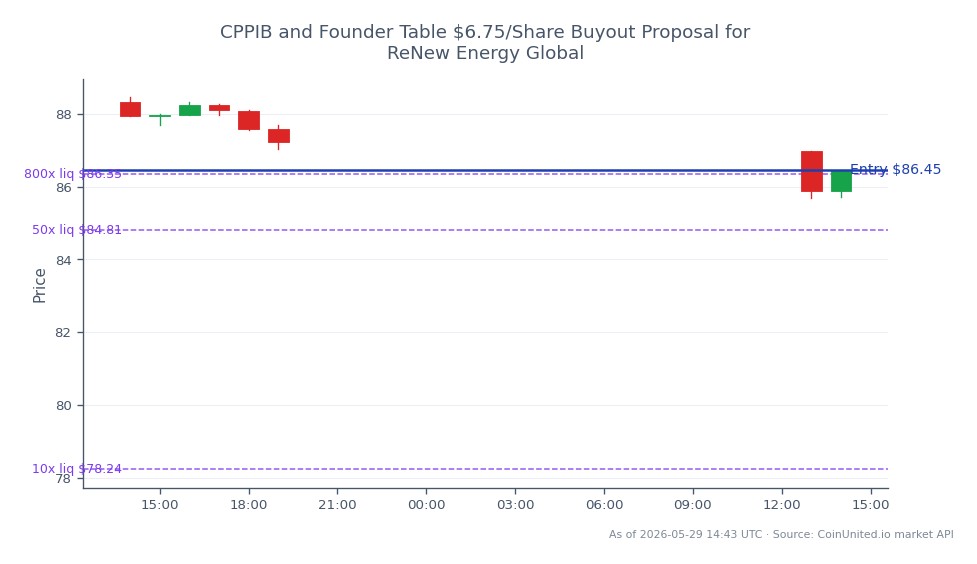
Canada Pension Plan Investment Board (CPPIB) and ReNew Energy Global founder Sumant Sinha have submitted a revised non-binding proposal to acquire all ReNew Energy Global plc (Nasdaq: RNW) shares they
Event Analysis
Canada Pension Plan Investment Board (CPPIB) and ReNew Energy Global founder Sumant Sinha have submitted a revised non-binding proposal to acquire all ReNew Energy Global plc (Nasdaq: RNW) shares they do not already own at $6.75 per share, according to an amended Schedule 13D filing reported by StockTitan. The consortium's combined stake may reach approximately 46.61% of voting rights on a fully diluted basis, with CPPIB alone holding 88,846,844 Class A shares (34.4% of voting rights). The proposed structure is a UK scheme of arrangement, which would require regulatory, court, and shareholder approvals before becoming binding.
This proposal is strategically significant for several reasons. CPPIB's involvement signals that large sovereign-adjacent capital is still willing to place long-duration bets on India's renewable energy infrastructure — even as rising interest rates have pressured valuations across the sector. The founder-led consortium structure reduces the risk of a competing hostile bid, but it also means minority shareholders are negotiating from a weaker position without an independent rival offer to establish a higher clearing price. The UK scheme mechanism also sets a higher procedural bar: a court sanction and shareholder vote are required, giving the special committee meaningful leverage to push for price improvements.
This deal fits squarely within the broader cross-sector acquisition repricing dynamic sweeping listed infrastructure and clean-energy names — where public market valuations have lagged private-market assessments of long-term cash flows. The M&A acquisition wave in energy infrastructure is being driven by the same logic: patient capital (pension funds, sovereign vehicles) is using public-market discounts as an entry point. For RNW specifically, the bid implicitly argues that India's utility-scale wind and solar pipeline carries more value than the current stock price reflects.
What This Means for Traders
The immediate trading dynamic for RNW is classic merger arbitrage. The stock will likely gravitate toward — but trade at a discount to — the $6.75 offer price, with the spread reflecting deal-completion risk, the non-binding status, and the multi-stage approval process required under the UK scheme. Traders should monitor whether RNW's special committee endorses the price or pushes back; any counter-demand above $6.75 would compress the arb spread and lift the stock. Notably, a separate Reuters/PV-Tech report referenced an $8.00/share figure from an earlier bid round, suggesting there is precedent for a higher number and the current proposal may not be the final word.
Beyond RNW itself, this proposal may provide a modest sentiment lift to comparable listed renewable developers — particularly those with significant India or emerging-market exposure such as NextEra Energy, Inc. and Brookfield Renewable Partners. The logic: if private markets are willing to pay a control premium for Indian renewable assets, publicly listed peers may be undervalued on similar metrics. Traders with positions in the broader energy, pharma & tech M&A acquisition wave theme should watch for sympathy moves in small- and mid-cap renewable names. Volatility on RNW itself is likely to be event-driven and news-dependent rather than broadly correlated with macro risk sentiment until a definitive agreement is reached.
For traders interested in acquisition arbitrage setups, this is a textbook situation: monitor the spread, watch for special committee announcements, and track whether any competing bid emerges. Given the non-binding status, position sizing should account for deal-break risk.
Start Trading on CoinUnited.io
Create Your Free Account → — Trade crypto, stocks, forex, indices, and commodities with up to 2000x leverage and zero fees.
Frequently Asked Questions
No — the proposal is explicitly non-binding. PV-Tech reported a prior bid at $8.00/share, suggesting the current figure could be a negotiating floor rather than a ceiling.
Continue Exploring
Disclaimer: This brief is for educational purposes only and is not investment advice.