Quick Links
Coinbase's CFTC-Cleared BTC Perps Go Live — The 5-Year Expiry Catch That Changes Everything for Leveraged Traders
Data Snapshot
Key Takeaways
- •Coinbase's BTC-PERP and ETH-PERP contracts went live July 21, 2025 after CFTC non-objection — the first regulated perpetual-style crypto futures available to U.S. traders.
- •Leverage is capped at 10x on Coinbase's venue; at BTC's current $73,471, a 10x long faces liquidation near $66,124 — far less cascade-prone than offshore 50–100x products.
- •The 5-year expiry (not true no-expiry) is the key structural catch: it removes monthly roll friction but won't capture the most aggressive offshore perp liquidity unless volumes prove otherwise.
- •Coinbase (COIN) is the primary equity beneficiary via incremental derivatives fee revenue; MARA and RIOT gain a better hedging tool for mining production.
- •Deeper U.S. perp markets will tighten BTC's reaction to macro events (FOMC, CPI) — watch for faster, larger BTC moves around U.S. data releases as institutional flow onboards.
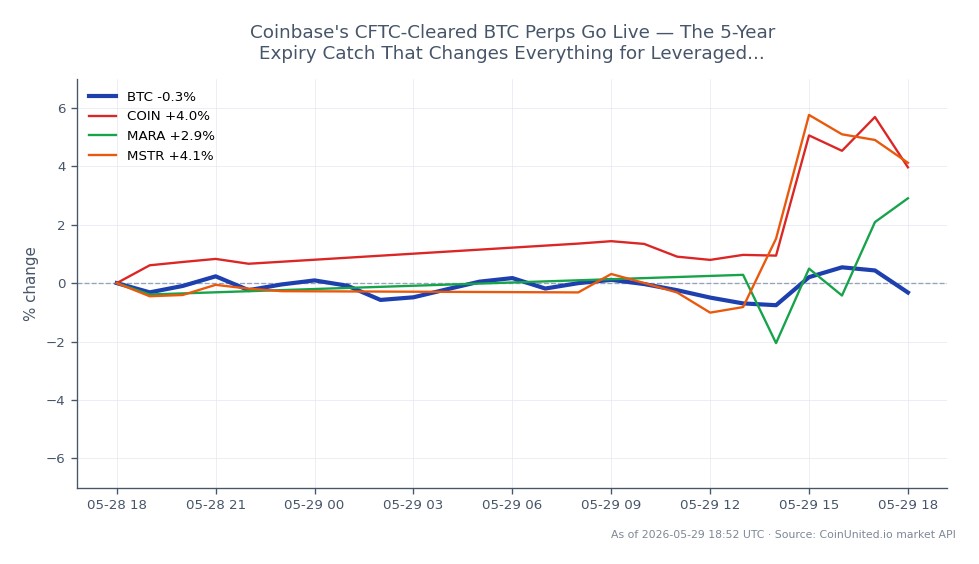
According to Coinbase's official announcement and legal client updates, Coinbase Derivatives — a CFTC-regulated U.S. futures exchange — listed the first-ever perpetual-style futures on Bitcoin and Eth
Event Summary
According to Coinbase's official announcement and legal client updates, Coinbase Derivatives — a CFTC-regulated U.S. futures exchange — listed the first-ever perpetual-style futures on Bitcoin and Ethereum for U.S. traders. On June 26, 2025, Coinbase filed self-certifications for nano Bitcoin Perpetual Futures (BTC-PERP) and nano Ether Perpetual Futures (ETH-PERP). The CFTC raised no objection, and both contracts went live on July 21, 2025. This CFTC non-objection is treated as a de facto green light under the Commodity Exchange Act, advancing the crypto banking and institutional integration narrative significantly.
The product offers up to 10x intraday leverage with fees as low as 0.02% per contract. The critical structural detail: these are not true never-expiring perpetuals — they carry 5-year expiration dates, distinguishing them from offshore perps on Binance or Bybit that use funding rates and remain open indefinitely.
Leverage Impact Analysis
With BTC currently trading at $73,471 (24h range: $72,438–$74,293), the 10x leverage cap on Coinbase's regulated perps creates a materially different risk profile versus offshore venues.
Worked example — Coinbase BTC-PERP vs. offshore: A trader entering a 10x long BTC-PERP at $73,471 faces liquidation around ~$66,124 (roughly a 10% adverse move). By contrast, a CoinUnited perpetual position at higher leverage — say 50x — at the same entry faces liquidation at approximately $72,002, requiring far tighter position sizing and active stop management.
Liquidation cascade risk: The 10x leverage ceiling on Coinbase's venue is unlikely to trigger the aggressive cascades common at offshore venues. However, as regulated U.S. perp open interest grows, large unwinds could transmit to spot BTC and CME futures via cross-exchange arbitrage — amplifying vol spikes around macro catalysts (FOMC, CPI). Monitor open interest on CoinUnited.io for confirmation signals as U.S. perp liquidity builds.
Funding rate dynamics: Coinbase's product relies on a long-dated structure rather than classic funding rates. This means the traditional funding-rate arbitrage (long spot / short perp when funding is elevated) may behave differently onshore. Traders running basis strategies should verify the precise settlement mechanics before sizing positions.
Cross-Market Impact
Coinbase (COIN) is the clearest structural equity winner. The ability to capture derivatives trading fees, clearing revenue, and ancillary services from a regulated U.S. perp market adds a new EPS growth vector and supports a multiple-expansion narrative around institutional crypto infrastructure — relevant to the broader crypto regulatory reckoning theme.
Miners & crypto proxies: Marathon Digital (MARA) and Riot Platforms (RIOT) benefit indirectly — a deeper regulated derivatives market improves their ability to hedge production systematically, potentially reducing earnings volatility. MicroStrategy (MSTR) is sensitive to any structural improvement in BTC's institutional infrastructure; see our MSTR NAV gap trading guide for positioning context.
Macro linkages: A robust onshore perp market accelerates BTC's role as a high-beta macro asset. U.S.-based macro funds can now express Fed/inflation views via regulated leveraged BTC exposure, likely tightening BTC's reaction to CPI and FOMC prints. This also fits the broader Bitcoin institutional adoption theme gaining momentum in 2025–2026.
Trading Considerations
BTC is trading near $73,471, just below the 24h high of $74,293. A sustained break above that level would open a retest of the $75,000+ zone seen in recent sessions. Key support sits at the 24h low of $72,439 — a close below this would signal near-term weakness and pressure leveraged longs.
The critical variable to watch is whether U.S. institutional flow actually migrates to Coinbase's 5-year perps or stays offshore. Low volume in the early weeks would limit price-discovery impact; high volume would compress basis spreads and increase BTC's sensitivity to U.S. session macro events. For context on the broader crypto derivatives landscape, the structural gap between true perpetuals and 5-year contracts remains the decisive factor.
Trade Bitcoin on CoinUnited.io
Trade BTC with up to 2000xx leverage → | Create Free Account
Frequently Asked Questions
At 10x, a $73,471 BTC entry is liquidated around $66,124 — a 10% buffer that is far wider than the ~2% buffer at 50x leverage available on offshore venues. Traders seeking higher leverage for BTC perpetual exposure should monitor platforms like CoinUnited.io, which offers up to 2000x on BTC perpetuals.
Continue Exploring
Disclaimer: This brief is for educational purposes only and is not investment advice.