Quick Links
CFTC Clears First Regulated Crypto Perps at Coinbase — What It Means for Leveraged BTC & ETH Traders
Data Snapshot
Key Takeaways
- •Coinbase Derivatives listed nano BTC-PERP and ETH-PERP contracts effective July 21, 2025 — the first CFTC-regulated perpetual-style crypto futures in the U.S.
- •Leverage traders on offshore perpetuals venues face potential liquidity thinning if U.S. volume migrates onshore — increasing slippage and funding rate volatility risk.
- •COIN is the primary equity beneficiary; MSTR and HOOD carry secondary exposure via BTC NAV and retail derivatives expansion respectively.
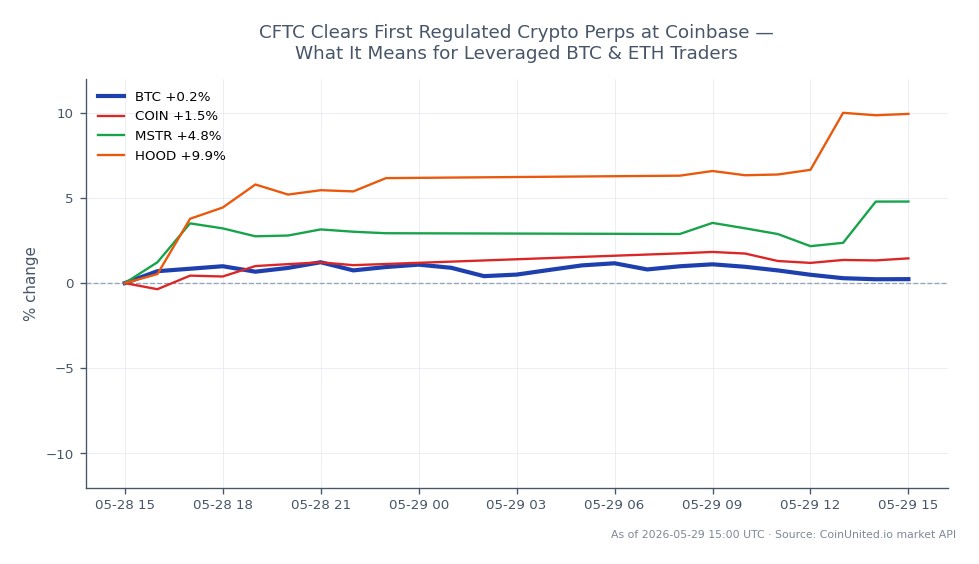
- •BTC is ranging $72,438–$73,908 with muted reaction, confirming this is a structural milestone rather than an immediate price catalyst.
- •The 10x intraday leverage cap on Coinbase's regulated perps vs. 100x+ offshore sets a regulatory benchmark that could reshape the global perps market structure.
According to Coinbase and legal analysis published by Pillsbury Law, Coinbase Derivatives became the first U.S. regulated firm to list perpetual-style crypto futures after filing self-certifications o
Event Summary
According to Coinbase and legal analysis published by Pillsbury Law, Coinbase Derivatives became the first U.S. regulated firm to list perpetual-style crypto futures after filing self-certifications on June 26, 2025. The contracts — nano Bitcoin Perpetual Futures (BTC-PERP) and nano Ether Perpetual Futures (ETH-PERP) — went effective July 21, 2025 with no CFTC objection. A February 2026 CFTC statement further reinforced that perpetual-style products are now treated as a legitimate part of the U.S. derivatives framework.
These are CFTC-regulated instruments with no monthly expiration and up to 10x intraday leverage on the Coinbase platform — a sharp structural contrast to the 100x+ leverage available on offshore perpetuals venues that have historically dominated this market segment.
Leverage Impact Analysis
This is a market-structure event, not a price shock — but it carries real leverage implications. The key dynamic is liquidity migration risk: if U.S.-based traders shift perpetuals activity to regulated onshore venues, offshore platforms may see reduced open interest, which can widen funding rates and thin liquidity during volatile sessions.
For traders currently running high-leverage BTC perpetual positions on offshore venues, reduced liquidity depth increases the probability of slippage on stop-loss fills and amplifies liquidation cascade risk. At BTC's current price of $73,083, a trader holding a 100x long perpetual position entered at $73,000 carries a liquidation threshold within roughly $730 of entry — any funding rate spike from reduced offshore liquidity compresses that buffer further.
On CoinUnited.io, where BTC perpetuals trade with up to 2000x leverage, this regulatory development is a structural tailwind: it validates the perpetual futures product category within the U.S. regulatory perimeter, reducing long-term political risk for the asset class globally. Traders should monitor crypto derivatives trading dynamics closely as volume redistributes across venues.
Cross-Market Impact
The clearest equity beneficiary is Coinbase Global (COIN), which now holds a first-mover advantage in regulated U.S. crypto perpetuals — a product category that generates significant fee revenue at offshore venues. Improved derivatives optionality and expanded product breadth directly support COIN's revenue thesis under the crypto-clarity-act regulatory pivot.
MicroStrategy (MSTR) and Robinhood (HOOD) carry secondary exposure: MSTR as a BTC NAV proxy benefits if regulated perps attract institutional hedging flows that improve BTC price discovery; HOOD benefits from any downstream retail derivatives expansion. For broader context, this development reinforces the crypto banking institutional integration thesis.
BTC spot at $73,083 (+0.12% 24h) shows muted immediate reaction, consistent with the research report's assessment that this is a structural milestone rather than a near-term price catalyst. ETH trades in sympathy. No significant DXY or commodities spillover is expected from this crypto-specific event.
Trading Considerations
BTC is consolidating between $72,438 (24h low) and $73,908 (24h high). The narrow range suggests the market is not yet pricing a material liquidity shift from this regulatory change. Key confirmation signals to watch: COIN stock volume expansion, any CFTC follow-on statements on leverage limits for regulated perps, and open interest data on offshore venues for signs of migration.
Risk factor: the 10x leverage cap on Coinbase's regulated perps is dramatically lower than offshore alternatives. If U.S. regulators use this as a template to pressure offshore platforms, it could trigger broader derivatives market repricing. Monitor the crypto regulatory landscape for downstream rule-making.
Trade Bitcoin on CoinUnited.io
Trade BTC with up to 2000xx leverage → | Create Free Account
Frequently Asked Questions
If U.S. traders migrate to Coinbase's regulated venue, offshore open interest may decline, potentially widening funding rates and reducing liquidity depth — both of which increase liquidation risk for high-leverage positions during volatile sessions.
Continue Exploring
Disclaimer: This brief is for educational purposes only and is not investment advice.