Quick Links
First Federal Insider Trading Case Hits Polymarket — What It Means for Prediction Markets and Crypto
Data Snapshot
Key Takeaways
- •SDNY and CFTC have established the first federal template for prosecuting insider trading in crypto prediction markets using existing commodities fraud and wire fraud statutes.
- •The legal doctrine is NOT limited to classified government intel — corporate employees trading event contracts on M&A, earnings, or product launches face equivalent exposure.
- •Prediction-market-adjacent tokens (REP, GNO) and DeFi derivatives protocols face elevated U.S. regulatory risk premium in the near term.
- •Compliance costs will rise across Big Tech, financial services, and advisory firms as personal-trading policies are updated to cover event contracts.
- •Medium-term, forced compliance upgrades (KYC, geofencing) could paradoxically legitimize prediction markets for institutional participation — a structural inflection point.
On April 23, 2026, the U.S. Attorney's Office for the Southern District of New York (SDNY) unsealed a landmark indictment charging a U.S. Army Special Forces Master Sergeant, Gannon Ken Van Dyke, with
Event Analysis
On April 23, 2026, the U.S. Attorney's Office for the Southern District of New York (SDNY) unsealed a landmark indictment charging a U.S. Army Special Forces Master Sergeant, Gannon Ken Van Dyke, with using classified military intelligence to place profitable wagers on Polymarket, a crypto-based prediction market platform. According to reporting by Crypto Briefing and legal analysis from Debevoise & Plimpton, Van Dyke allegedly leveraged nonpublic information about "Operation Absolute Resolve" — a classified U.S. military operation targeting Venezuelan President Nicolás Maduro — to generate approximately $400,000 in profits from event contracts on the platform. The CFTC filed parallel civil charges citing commodities fraud and unlawful use of nonpublic government information under the Commodity Exchange Act.
This is the first U.S. federal insider trading case explicitly involving a crypto prediction market, and its significance lies in the legal doctrine being established. As noted by Debevoise, SDNY and the CFTC are applying traditional misappropriation and commodities fraud theories directly to event contracts — confirming that Polymarket-style instruments fall squarely within existing federal financial crime statutes. Critically, legal analysts emphasize these theories are not confined to classified government intelligence: confidential corporate information about product launches, M&A deals, regulatory decisions, or litigation outcomes could equally expose corporate employees, consultants, and bankers to prosecution for trading related event contracts. This is part of the broader crypto regulatory & tax reckoning reshaping how U.S. authorities treat on-chain financial products.
What distinguishes this from prior crypto enforcement is the cross-disciplinary reach: it implicates not just crypto-native platforms but any professional with access to material nonpublic information who participates in prediction markets. Law firms are already advising clients to update insider-trading and personal-trading compliance policies to explicitly cover event contracts — a compliance cost rippling across Big Tech, financial services, and advisory firms. This sits firmly within the global regulatory enforcement wave that has defined 2026's regulatory landscape.
What This Means for Traders
The immediate market implication is bearish sentiment for prediction-market-adjacent crypto tokens — projects like Augur (REP) and Gnosis (GNO) that operate in the on-chain event contract space face a higher perceived U.S. regulatory risk premium in the short term. Traders should monitor these assets for headline-driven volatility, particularly if follow-on enforcement actions involve corporate insiders rather than military personnel. The prediction market regulatory & growth surge theme now carries a dual dynamic: near-term enforcement overhang versus longer-term institutional legitimacy if platforms formalize KYC and compliance frameworks.
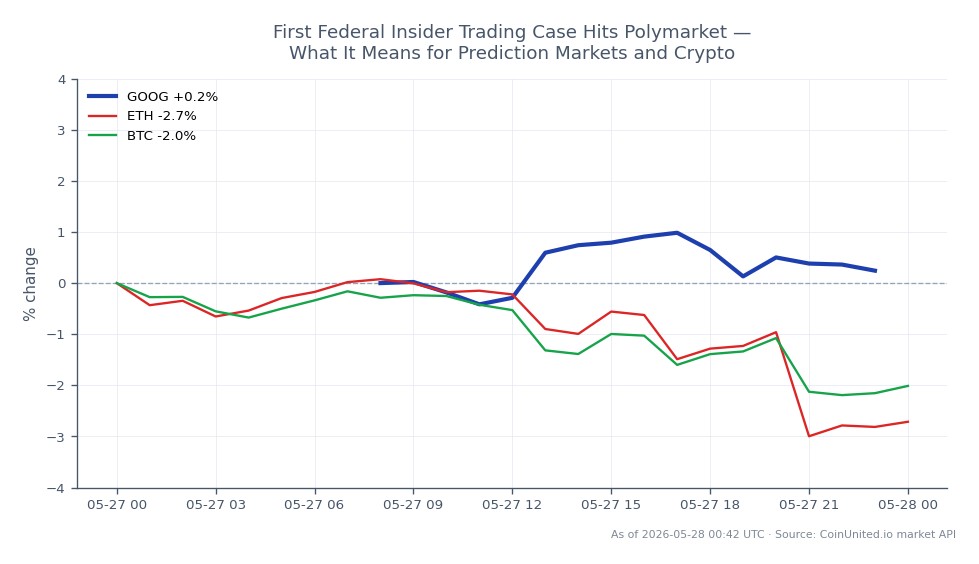
For broader crypto markets, this case reinforces the trend of DOJ and CFTC asserting jurisdiction over DeFi-adjacent products, which contributes incrementally to the regulatory risk premium on Ethereum and Bitcoin — particularly assets tied to U.S.-centric teams or regulated venues. Stablecoin oversight is also a secondary consideration, as Polymarket settles in USD-pegged stablecoins; increased enforcement scrutiny of on-chain financial crime feeds directly into the ongoing policy debate around stablecoin regulation, relevant to our institutional stablecoins guide. GOOG itself, trading at $385.19 with negligible 24h movement (+0.19%), shows no direct price impact — the event's corporate compliance angle is second-order for Alphabet's earnings trajectory.
Trade Alphabet Inc (Google) Class C on CoinUnited.io
Trade GOOG with up to 1000xx leverage → | Create Free Account
Frequently Asked Questions
No direct earnings or operational impact is present — GOOG is trading flat at $385.19. The indirect angle is compliance cost exposure for large tech firms whose employees hold material nonpublic information and may participate in prediction markets.
Continue Exploring
Disclaimer: This brief is for educational purposes only and is not investment advice.