Quick Links
Dollar Firms on US-Iran Escalation: How Leveraged FX Traders Should Navigate the PCE Minefield
Data Snapshot
Key Takeaways
- •Leveraged USD long positions (e.g., 100x short EUR/USD) are exposed to rapid reversal risk — Iran-era dollar safe-haven rallies historically average only 2–4% before fading, creating two-sided liquidation risk at high leverage.
- •PCE is the macro binary: hot print = higher yields + stronger USD + pressure on risk assets; soft print = USD selloff + gold/crypto relief rally, potentially compounding with any Iran de-escalation.
- •WTI crude oil is the cleanest geopolitical trade — Strait of Hormuz supply risk is directly bullish for energy prices regardless of PCE outcome.
- •CHF historically outperforms USD in sustained geopolitical conflicts (100% of analyzed episodes, ~0.85% avg monthly gain) — USD/CHF shorts may offer better risk-adjusted expression than straight DXY longs.
- •Bitcoin shows limited safe-haven characteristics (~3% gain in prior Iran-war episode) and faces headwinds if PCE triggers tighter financial conditions — treat BTC as a risk asset, not a hedge, in this environment.
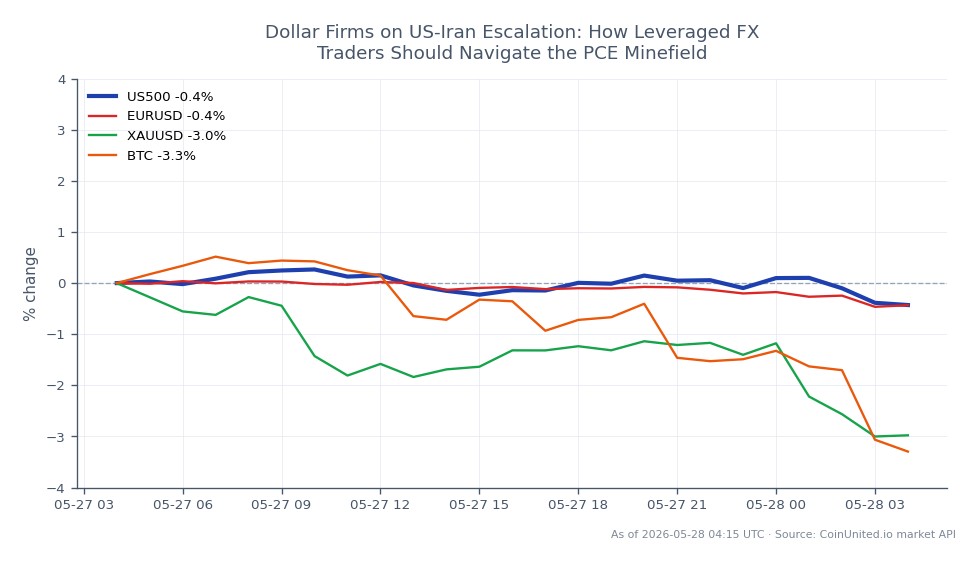
The US dollar has strengthened following renewed US–Iran military action, with safe-haven demand supporting DXY across major FX pairs. According to strategists cited across major sell-side commentary,
Event Summary
The US dollar has strengthened following renewed US–Iran military action, with safe-haven demand supporting DXY across major FX pairs. According to strategists cited across major sell-side commentary, dollar rallies during Iran-related escalations tend to be sharp but historically short-lived compared to prior geopolitical crises. Compounding the geopolitical driver, markets are awaiting the US PCE price index — the Federal Reserve's preferred inflation gauge — which represents a second, independent catalyst for significant FX volatility. The dual-driver setup (geopolitical risk + macro data release) places this squarely within the macro inflation risk-off repricing playbook.
Analysis from FX strategists notes that the oil geopolitical risk-off dynamic is particularly relevant here: any credible threat to the Strait of Hormuz raises oil supply risk premiums, which feeds into inflation expectations and forces central banks — including the Fed — to maintain a more hawkish stance. This keeps Fed macro policy tightly linked to the military situation.
Leverage Impact Analysis
This dual-catalyst environment creates outsized risk for leveraged FX positions in either direction.
Long USD scenario (e.g., short EUR/USD): A trader running a 100x short EUR/USD CFD at 1.0850 controls a $108,500 notional position with ~$1,085 margin. A hot PCE print combined with Iran escalation headlines could push EUR/USD down 80–120 pips rapidly — generating $800–$1,200 profit on that position. However, a surprise PCE miss or de-escalation statement could reverse the move equally fast, generating liquidation risk within minutes.
Fade-the-dollar scenario (long EUR/USD): Research confirms that dollar safe-haven rallies during Iran-related events average only ~2–4% before partially reversing. A 200x long EUR/USD position has extremely thin margin tolerance — a 50-pip adverse move at 200x on a standard lot wipes the position. Traders should check funding rates on CoinUnited.io and monitor open interest for confirmation signals before entering counter-trend positions.
USD/JPY consideration: Historical data shows CHF appreciates against USD in 100% of analyzed conflict scenarios, averaging ~0.85% monthly gains. USD/JPY is vulnerable to safe-haven yen demand layered on top of any dovish PCE surprise — a compounding bearish setup for highly leveraged USD/JPY longs.
For forex leverage strategies around inflation data, position sizing down to 10–20x is advisable ahead of binary data events like PCE.
Cross-Market Impact
WTI crude oil is the most direct beneficiary — US–Iran conflict that threatens Strait of Hormuz passage is structurally bullish for energy prices, with prior Iran-war episodes pushing oil above $100/bbl. Higher crude reinforces headline inflation, which then delays Fed rate cuts and supports USD — a self-reinforcing loop tracked in the Hormuz Strait energy supply shock theme.
Gold is historically inconsistent during rapid escalations but benefits from the inflation hedge angle if PCE prints hot — monitor the gold vs. US dollar inverse relationship for confirmation. Bitcoin tracked geopolitical episodes with only ~3% gains per research, suggesting limited safe-haven status; hot PCE tightening financial conditions is a net headwind. The S&P 500 faces pressure from both higher yields (hot PCE) and risk-off sentiment (Iran), though US energy sector components may outperform given domestic production exposure.
Trading Considerations
The PCE release is the binary pivot: an upside surprise compounds the dollar bid from geopolitical flows, while a downside miss could trigger sharp reversal as safe-haven trades unwind simultaneously. Watch core PCE m/m (consensus ~0.2–0.3%) and services ex-housing for Fed reaction function signals. EUR/USD key levels and USD/JPY resistance are the primary FX battlegrounds; oil's response to any Hormuz-related headlines is the leading indicator for broader risk sentiment.
Monitor for de-escalation statements from US or Iranian leadership — historical analysis shows these trigger partial reversal of both oil and dollar safe-haven premia, creating mean-reversion opportunities for disciplined traders.
Start Trading on CoinUnited.io
Create Your Free Account → — Trade crypto, stocks, forex, indices, and commodities with up to 2000x leverage and zero fees.
Frequently Asked Questions
A hot PCE print strengthens the dollar, pushing EUR/USD lower — beneficial for short positions but a rapid liquidation risk for leveraged longs. At 100x leverage, a 100-pip adverse move equals roughly 10% of notional, so size down ahead of the release.
Continue Exploring
Disclaimer: This brief is for educational purposes only and is not investment advice.