Quick Links
Ørsted Q1 Net Profit Crashes 46% on U.S. Rate-Driven Impairments — But Operating Performance Tells a Different Story
Data Snapshot
Key Takeaways
- •Ørsted Q1 2026 net profit fell 46% YoY to DKr 2.62bn (~$412m), driven by a £158m U.S. impairment and higher tax charges tied to elevated long-dated U.S. interest rates — not operational weakness.
- •EBITDA rose 8–11% YoY to DKr 9.54bn, revealing a quality-of-earnings divergence that may cause the market to overreact to the headline figure.
- •The results are sector-wide evidence that higher-for-longer U.S. rates materially impair long-duration renewable infrastructure valuations — peers like RWE, Iberdrola, and EDP Renováveis carry similar exposure.
- •European project delays (including Hornsea 3) add execution risk on top of the rate-driven impairment story, compounding cash flow timing uncertainty.
- •Traders should distinguish between structural de-rating risk (if U.S. rates stay elevated) and a potential mispricing opportunity if the market over-penalizes non-cash items against a growing operating base.
Danish offshore wind giant Ørsted reported Q1 2026 net profit of DKr 2.62bn (~$412m), a 46% year-on-year collapse from DKr 4.88bn in Q1 2025, according to Power Technology and Windpower Monthly. The c
Event Analysis
Danish offshore wind giant Ørsted reported Q1 2026 net profit of DKr 2.62bn (~$412m), a 46% year-on-year collapse from DKr 4.88bn in Q1 2025, according to Power Technology and Windpower Monthly. The culprit is not a failing business — it's a balance sheet casualty of elevated U.S. long-term interest rates. Inspiratia quantifies the hit as a £158m U.S. impairment tied directly to higher discount rates compressing the present value of Ørsted's American renewable project portfolio.
The critical distinction traders must internalize: EBITDA grew 8–11% YoY to DKr 9.54bn, demonstrating that Ørsted's operational engine is running well. The headline impairment is non-cash and rate-driven — not a demand collapse or project failure. This is a classic earnings miss revenue shock where surface numbers mask underlying business health, creating potential mispricing. For a guide on navigating these situations, see how to trade earnings misses.
This result also carries broader sector-wide signaling. Ørsted is effectively a living stress-test for what sustained higher-for-longer U.S. rates do to long-duration infrastructure assets. As reported by Windpower Monthly, impairments are explicitly linked to rising long-term U.S. interest rates — the same macro force documented in our Fed Policy & Markets guide. Peers including Vestas, RWE, Iberdrola, and EDP Renováveis carry similar long-duration exposure and may face analogous valuation pressure in upcoming reports.
Adding to execution risk, Inspiratia reports delays on Hornsea 3 and other European projects, meaning cash flow timing is slipping on multiple fronts simultaneously — a compounding concern even if individual impairments remain non-cash.
What This Means for Traders
The immediate directional bias for Ørsted equity (ORSTED.CO) is bearish on headline reaction, but the magnitude depends on how much was pre-priced and whether guidance provides reassurance. Traders focused on the earnings miss deep dive playbook should watch for an overreaction to the net profit figure — the EBITDA growth story could attract dip-buyers if management commentary is constructive. The S&P 500 Index and clean-energy ETFs with Ørsted exposure may see modest sympathy pressure, particularly names holding offshore wind developers.
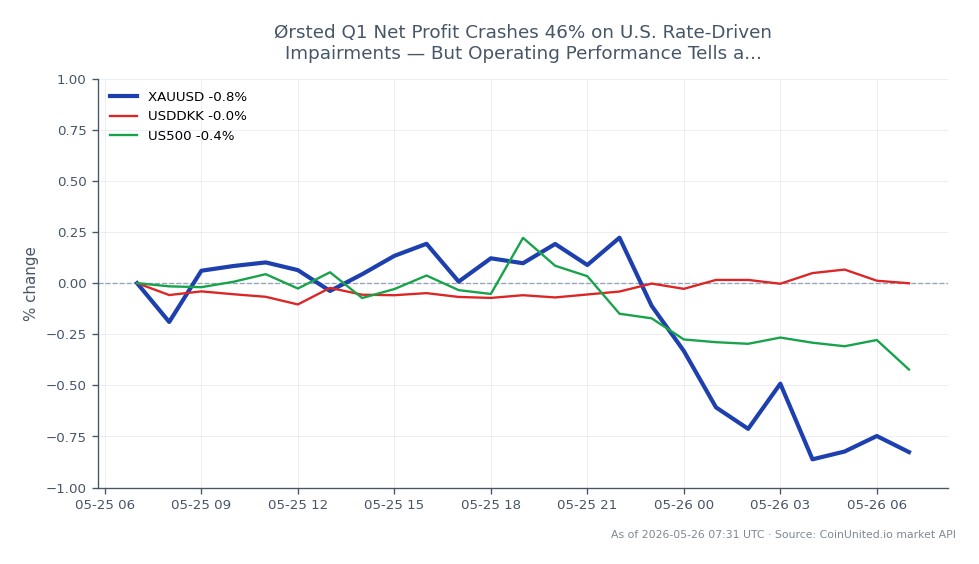
The macro read-through matters more than the single-stock move. This result is concrete, sector-specific evidence that U.S. long-end yields are materially impairing real-asset valuations — reinforcing a structural rate-sensitivity theme across European utilities and global infrastructure. Traders positioned in USD/DKK should note that DKK direct FX impact is likely contained given Denmark's ECB-peg framework, but the result adds to the narrative of rate pressure on European capital-intensive sectors. The gold vs. US dollar dynamic remains a parallel watch — if this data point reinforces higher-for-longer rate expectations, gold as an inflation hedge faces a mixed signal environment.
Offshore wind supply chain names — turbine OEMs, subsea cable manufacturers, marine contractors — face secondary pressure if markets infer slower U.S. and European build-out rates. Monitor whether Ørsted's FID pipeline commentary shows any deferrals, as that would be the more structurally damaging signal for the sector.
Start Trading on CoinUnited.io
Create Your Free Account → — Trade crypto, stocks, forex, indices, and commodities with up to 2000x leverage and zero fees.
Frequently Asked Questions
It depends on your rate outlook — EBITDA growth is healthy, so if U.S. long rates stabilize or fall, the impairment cycle could reverse and the stock would be mispriced to the downside. If rates stay elevated, repeated quarterly impairments could justify a persistent valuation discount.
Continue Exploring
Disclaimer: This brief is for educational purposes only and is not investment advice.