Quick Links
Warsh's Hawkish Fed + Iran War Risk: How Rising Yields and a Stronger Dollar Squeeze Leveraged Traders
Data Snapshot
Key Takeaways
- •Leveraged longs in EUR/USD, BTC, and Nasdaq 100 CFDs face the highest liquidation risk — hawkish Fed repricing with >97% hold probability and rising hike pricing narrows margin buffers at 50x+ leverage.
- •The Iran/Hormuz risk layer reinforces inflation expectations, making oil longs (WTI/Brent) the relative cross-market beneficiary in this environment.
- •Gold faces a genuine tug-of-war: geopolitical safe-haven demand vs. real yield headwinds from a hawkish Fed — directional conviction is lower than in other assets.
- •USD strength is the clearest expression of this theme — USD/JPY long and EUR/USD short are the most direct forex trades if yields continue to reprice higher.
- •Any Iran de-escalation or dovish Fed communication would sharply reverse this setup — treat this as a high-persistence but binary-risk trade requiring defined stops.
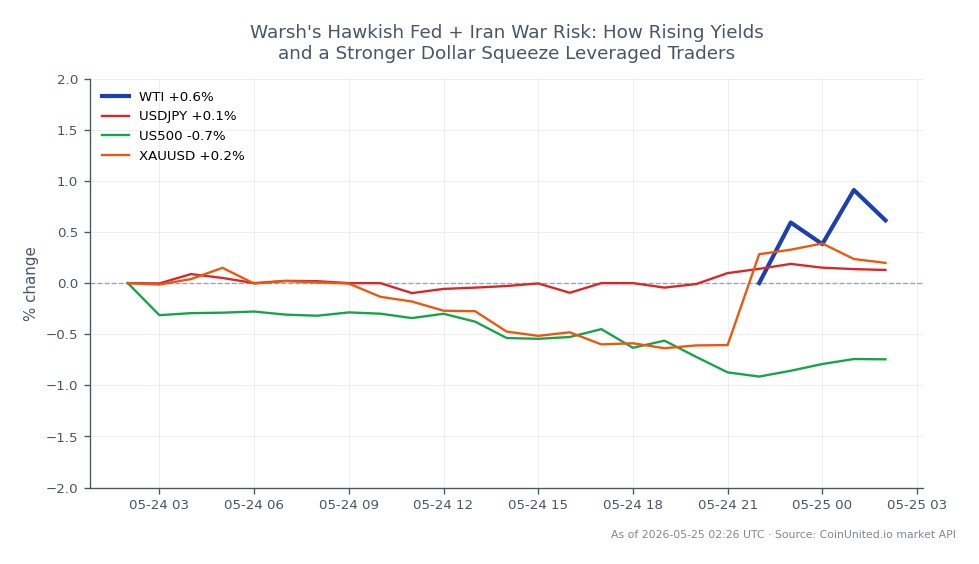
According to CBS News and Fortune, Kevin Warsh has been sworn in as Federal Reserve Chair, replacing Jerome Powell. Warsh is widely perceived as hawkish, and market pricing has rapidly shifted: per re
Event Summary
According to CBS News and Fortune, Kevin Warsh has been sworn in as Federal Reserve Chair, replacing Jerome Powell. Warsh is widely perceived as hawkish, and market pricing has rapidly shifted: per reporting from KATV, there is a 97.2% probability of a hold at the first FOMC meeting under Warsh, with rate cuts described as "pretty much off the table" for June and July. Bond traders are reportedly beginning to price in a potential rate hike later this year.
Layered on top of the leadership change is the Iran conflict, which raises Strait of Hormuz supply-disruption risk. As reported by Fortune, this geopolitical overlay threatens to push oil higher, reinforce inflation expectations, and further reduce the probability of any near-term easing. The combined signal — a hawkish new chair plus an oil-driven inflation shock — is a meaningful macro inflation risk-off repricing event across asset classes.
Leverage Impact Analysis
This is a high-leverage-relevance event (0.91 score). The Fed macro policy crossroads dynamic — hold probability above 97%, hike pricing creeping in — creates asymmetric risk for leveraged longs in rate-sensitive assets.
Forex example: A 100x long EUR/USD position opened at 1.0850 faces roughly $108.50 of margin exposure per standard lot at 100x. A 100-pip USD rally (USD strengthening on hawkish repricing) produces a $1,000 loss per lot — enough to wipe approximately 9.2x margin at that leverage level. Traders in EUR/USD, GBP/USD, or AUD/USD long positions should monitor stop placement carefully as yield-spread dynamics favor further USD strength.
Crypto example: Bitcoin and ETH perpetual longs face a dual headwind: higher real yields raise the opportunity cost of holding non-yielding assets, and a stronger USD historically weighs on crypto sentiment. A 50x long BTC position has a liquidation band that tightens materially with any 2%+ BTC move lower — check funding rates on CoinUnited.io for real-time cost-of-carry signals before sizing positions.
Equity index example: A 50x long Nasdaq 100 CFD is especially exposed — growth and long-duration tech are the highest-beta names to Fed repricing. Even a 1% index decline translates to a 50% margin drawdown at 50x. Monitor the stagflation risk and geopolitical inflation shock dynamic before adding long equity exposure.
Cross-Market Impact
The transmission chain is clear: Iran oil risk → higher inflation expectations → fewer cuts / possible hike → higher yields + stronger USD → pressure on equities and crypto.
- -Forex: USD broadly supported. USD/JPY likely moves higher as US-Japan yield spreads widen; EUR/USD faces downside. See the Fed chair leadership change market impact guide for historical precedent.
- -Commodities: WTI crude and Brent are potential beneficiaries if Hormuz risk escalates — see the Hormuz Strait energy markets trader's guide. Gold faces a tug-of-war: safe-haven demand is bullish, but rising real yields and a stronger dollar are structurally bearish — the gold vs. US dollar inverse relationship guide details this dynamic.
- -Equities/Indices: The Nasdaq 100 is most vulnerable; the S&P 500 sees broader pressure. Energy equities are a relative beneficiary. REITs and high-duration growth names are the most exposed laggards.
- -Crypto: Hawkish repricing is a medium-term headwind. Bitcoin's correlation to macro risk-off episodes is well-documented in the oil geopolitical crypto risk-off theme.
Trading Considerations
Key levels to watch: front-end US Treasury yields (2Y is the most sensitive to FOMC repricing), the DXY for USD momentum confirmation, and WTI for any Hormuz escalation signals. If bond traders are genuinely pricing a hike, the 2Y yield breaking materially higher would be the clearest confirmation of the hawkish repricing thesis.
Risk factors include any Iran de-escalation (which would remove the oil/inflation overlay) and any dovish Fed communication that pushes back against hike pricing. Given CoinUnited's 24/7 trading, positions in forex, commodities, and indices CFDs can be adjusted immediately as geopolitical headlines develop — no waiting for the NYSE open or FX session gaps.
Start Trading on CoinUnited.io
Create Your Free Account → — Trade crypto, stocks, forex, indices, and commodities with up to 2000x leverage and zero fees.
Frequently Asked Questions
Higher US yields raise the opportunity cost of non-yielding assets like BTC and ETH, while a stronger USD historically weighs on crypto sentiment — both headwinds compress upside and tighten liquidation bands for leveraged longs. Check live funding rates on CoinUnited.io before sizing positions.
Continue Exploring
Disclaimer: This brief is for educational purposes only and is not investment advice.