Quick Links
Goldman Sachs Downgrades Futu Holdings on Regulatory Concerns — What It Means for China ADR Traders
Data Snapshot
Key Takeaways
- •Goldman Sachs downgraded Futu Holdings citing China regulatory enforcement — proposed fines of ~RMB 1.85B (~USD 250–270M) and personal penalties on the CEO represent material business risk.
- •FUTU had already fallen nearly 28% on the initial regulatory headline; the Goldman downgrade adds institutional sell pressure and can cap relief rallies.
- •This is a structural, not transitory, risk — Chinese regulators are targeting Futu's core cross-border securities business model.
- •Peer Chinese online brokers and fintech platforms with cross-border exposure face sympathy re-pricing as the enforcement narrative persists.
- •Watch for cascading sell-side downgrades and earnings estimate cuts as the analyst consensus catches up to the regulatory reality.
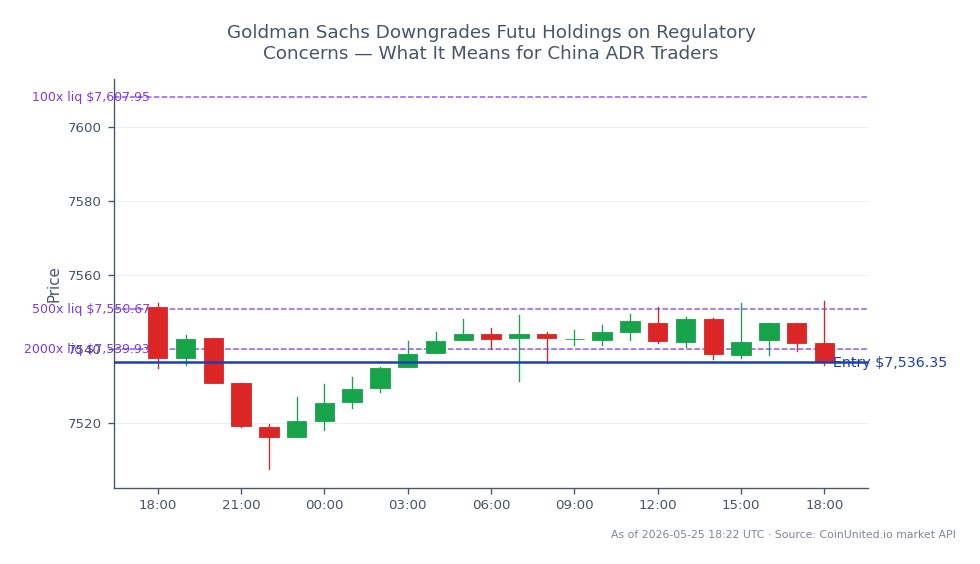
Goldman Sachs has downgraded Futu Holdings Limited (NASDAQ: FUTU), the Chinese online brokerage and wealth-management platform, citing mounting regulatory concerns. The downgrade comes against a backd
Event Analysis
Goldman Sachs has downgraded Futu Holdings Limited (NASDAQ: FUTU), the Chinese online brokerage and wealth-management platform, citing mounting regulatory concerns. The downgrade comes against a backdrop of verified, material enforcement action: Futu disclosed receipt of a Notice of Investigation and Administrative Penalty Pre-Notification Letter from Chinese regulators targeting its cross-border securities business. As reported by market coverage of the regulatory filings, Chinese authorities proposed rectification orders plus confiscation of alleged illegal gains and fines totaling approximately RMB 1.85 billion (roughly USD 250–270 million), alongside personal penalties against Futu's founder and CEO. The stock had already plunged nearly 28% on the initial regulatory headline.
What makes this Goldman downgrade strategically significant is the *timing and source*. When a top-tier sell-side house like Goldman Sachs formally revises its rating — not on valuation grounds, but explicitly on regulatory risk — it sends a structural signal to institutional allocators. Long-only funds with internal rating-distribution rules are compelled to reduce or exit positions. Quant and systematic strategies that incorporate broker sentiment momentum will register a negative signal. This is institutional validation of what retail traders already feared.
This event also fits squarely within the broader global regulatory enforcement wave targeting China's private financial platforms. The proposed penalties, the personal fine on the CEO, and the cross-border nature of the enforcement all suggest this isn't a routine compliance matter — it's a structural business-model challenge. Futu's ability to serve clients outside mainland China sits at the heart of its growth thesis, and that is precisely what regulators appear to be targeting. The cross-border enforcement repricing dynamic here parallels patterns seen across multiple Chinese platform companies since 2021.
What This Means for Traders
The primary directional bias is bearish for FUTU in the near-to-medium term. Goldman's downgrade reduces the aggregate bullish rating share in the analyst consensus, which mechanically depresses institutional demand. Beyond price, traders should watch for further earnings estimate cuts as analysts revise revenue forecasts downward to account for potential business curtailment of cross-border operations and elevated compliance costs. Any relief rally should be treated with caution — the Goldman downgrade can cap recoveries by keeping institutional re-entry demand suppressed.
For broader China ADR and fintech exposure, this event reinforces that regulatory risk remains a persistent structural discount, not a one-off event. Peer names with similar cross-border brokerage or wealth-management models may see sympathy pressure as investors reprice the sector. Traders watching the NASDAQ 100 or S&P 500 Index for broader tech/China ADR spillover should note that FUTU's index weighting limits macro contagion, but sentiment toward the China fintech sub-sector can weigh on related ETF flows. Monitor short interest trends and whether additional sell-side analysts follow Goldman's lead — a cascade of downgrades would materially extend the bearish setup.
Start Trading on CoinUnited.io
Create Your Free Account → — Trade crypto, stocks, forex, indices, and commodities with up to 2000x leverage and zero fees.
Frequently Asked Questions
Goldman Sachs downgraded its rating on FUTU, explicitly citing escalating regulatory concerns from Chinese authorities. The precise rating tier (e.g., Buy to Neutral) and revised price target require the official research note, but the directional signal is negative.
Continue Exploring
Disclaimer: This brief is for educational purposes only and is not investment advice.