Quick Links
FDA Approves Gilead's HDV Treatment — GILD Rises 2.6% on Rare Disease Milestone
Data Snapshot
Key Takeaways
- •FDA approved Gilead's HDV (Hepatitis Delta Virus) treatment, addressing a rare but severe disease with historically limited options.
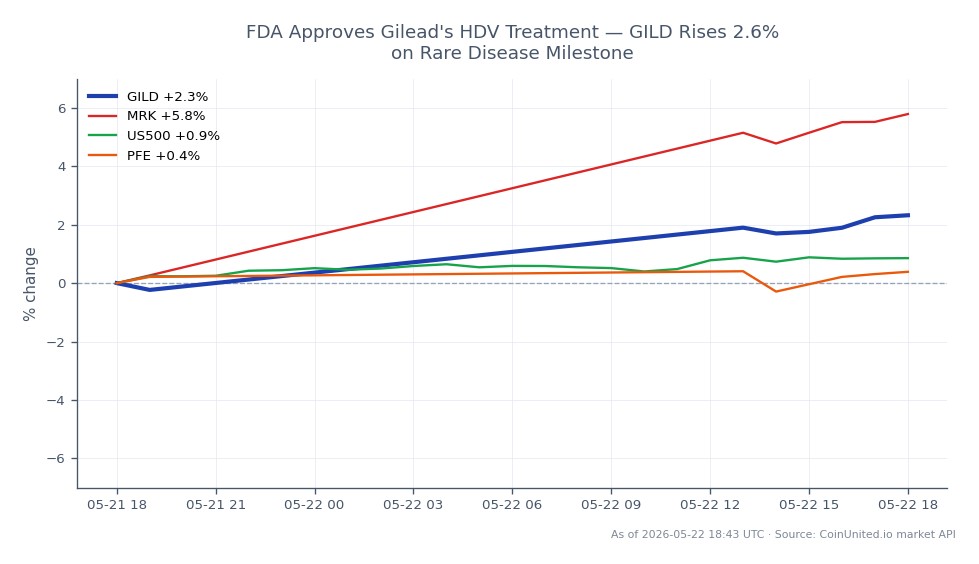
- •GILD trades at $133.93, up +2.59%, with the move reflecting measured optimism rather than a full re-rating — suggesting room for further upside if commercial execution is strong.
- •Rare disease approvals carry premium pricing power; HDV adds a new high-margin revenue stream to Gilead's antiviral franchise.
- •This approval fits the broader pipeline re-rating thesis for Gilead, supported by recent moves including the $5B Tubulis acquisition and the Tempus AI oncology partnership.
- •Direct competitive impact on Merck and Pfizer is minimal — this is a Gilead-specific catalyst in an underserved antiviral niche.
Gilead Sciences has received U.S. Food and Drug Administration (FDA) approval for its treatment targeting Hepatitis Delta Virus (HDV) — a rare but severe form of viral hepatitis that affects an estima
Event Analysis
Gilead Sciences has received U.S. Food and Drug Administration (FDA) approval for its treatment targeting Hepatitis Delta Virus (HDV) — a rare but severe form of viral hepatitis that affects an estimated 15–20 million people globally, primarily those already infected with Hepatitis B. HDV is widely regarded as the most aggressive form of chronic viral hepatitis, with limited treatment options historically available, making this approval a clinically significant milestone.
This approval adds meaningful breadth to Gilead's antiviral portfolio, a franchise built on transformative HIV and Hepatitis C therapies. Unlike incremental label expansions, an HDV-specific approval opens an entirely new rare disease revenue stream. Rare disease designations typically carry premium pricing power and favorable reimbursement dynamics, which has important implications for Gilead's long-term margin profile. The approval also reflects a broader product launch market catalyst dynamic in pharma — where FDA decisions on rare or underserved diseases tend to generate outsized investor reactions relative to the immediate addressable market.
This comes at a strategically active period for Gilead, which recently acquired ADC biotech Tubulis for $5B and expanded its oncology AI collaboration with Tempus. The HDV approval reinforces the narrative that Gilead is building a diversified, pipeline-rich portfolio beyond its legacy HIV business — a key concern among analysts who had flagged revenue concentration risk.
Competitors including Merck & Co., Inc. and Pfizer, Inc. have limited direct exposure to HDV, meaning this approval does not immediately threaten their pipelines but does raise the competitive bar for antiviral rare disease positioning.
What This Means for Traders
According to live market data, GILD is trading at $133.93, up +2.59% on the session, with an intraday high of $134.25 and a low of $131.56. The move is measured rather than euphoric, suggesting the market is pricing this as a positive but not transformational near-term revenue event — consistent with HDV's relatively contained patient population. Momentum traders should watch whether GILD can sustain above the $133–134 range, as a close above $134.25 would confirm bullish continuation.
For sector watchers, this is a stock-specific catalyst rather than a broad pharma re-rating event. The S&P 500 Index and healthcare sector broadly are unlikely to move materially on this news alone. However, traders monitoring the pharma & fintech acquisition repricing theme may note that Gilead's pipeline execution — approvals, acquisitions, and partnerships — is steadily reducing the discount the market had applied to its post-HCV era growth story. Longer-duration investors may view today's approval as incremental confirmation of that re-rating thesis, with the next catalysts being commercial ramp data and HDV pricing announcements.
Trade Gilead Sciences Inc on CoinUnited.io
Trade GILD with up to 1000xx leverage → | Create Free Account
Frequently Asked Questions
HDV affects an estimated 15–20 million people globally but is considered a rare disease in the U.S., so near-term revenue will be modest. However, rare disease pricing premiums can make even small patient populations financially meaningful over time.
Continue Exploring
Disclaimer: This brief is for educational purposes only and is not investment advice.