Quick Links
EUR/USD Rejected at 100-Hour MA — Sellers Push to New Low as Short-Term Bias Flips Bearish
Data Snapshot
Key Takeaways
- •EUR/USD failed to hold above the 100-hour MA at ~1.1540, confirming sellers remain in control intraday and flipping short-term bias bearish.
- •Leverage traders who bought the breakout above 1.1540 face immediate stop-out risk; the MA/swing zone at 1.1539–1.1546 now acts as overhead resistance.
- •At 100x leverage, a 50-pip adverse move from 1.1600 to 1.1540 represents a ~4.5% notional loss — position sizing relative to margin is critical in this environment.
- •USD strength from EUR/USD downside carries cross-market implications: headwinds for Gold, Bitcoin, and NASDAQ 100 CFDs if the move extends.
- •GBP/USD, AUD/USD, and NZD/USD should be monitored for correlated USD-bid confirmation — divergence would suggest EUR-specific rather than broad USD flows.
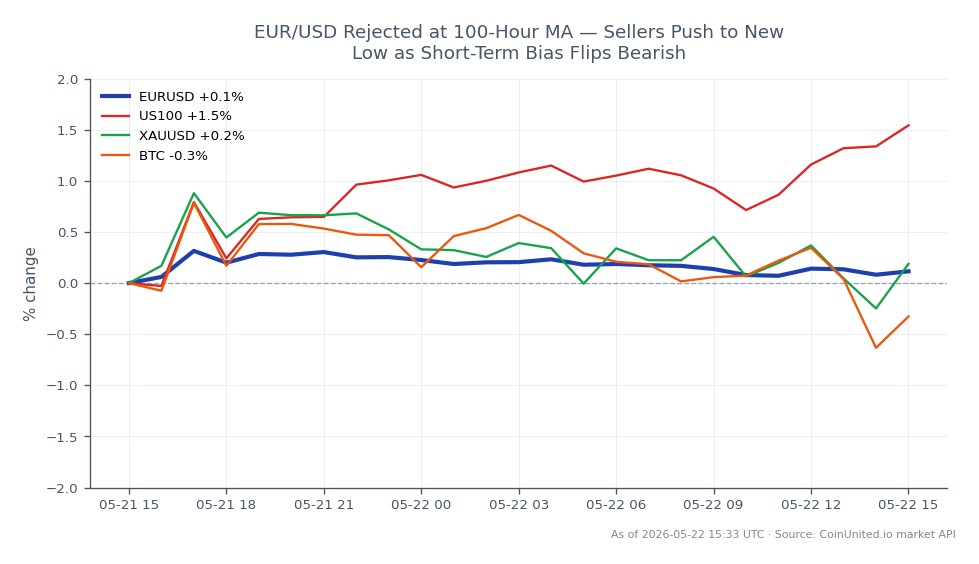
According to reporting by KuCoin/Bpaynews and Forexlive, EUR/USD staged an intraday rally that failed to sustain a break above the 100-hour moving average near 1.1539–1.1540 and the accompanying swing
Event Summary
According to reporting by KuCoin/Bpaynews and Forexlive, EUR/USD staged an intraday rally that failed to sustain a break above the 100-hour moving average near 1.1539–1.1540 and the accompanying swing resistance zone at 1.1541–1.1546. Sellers re-engaged at that technical ceiling, driving the pair to a fresh session low. As of the live market snapshot, EUR/USD trades at $1.1600 (down 0.19% on the day), with the failed MA test reinforcing short-term bearish momentum.
The 200-hour MA near 1.1543 formed a tight confluence with the 100-hour MA, creating a well-defined resistance cluster. Per Forexlive coverage, price briefly traded between the two moving averages before sellers reasserted control — a textbook failed breakout sequence that systematic and momentum strategies will interpret as a continuation signal lower.
Leverage Impact Analysis
This rejection sets up asymmetric risk for leveraged positions on EUR/USD at current levels:
Long squeeze scenario: A trader holding a 100x long EUR/USD CFD entered at 1.1600 faces approximately $0.0060 of adverse move (roughly 60 pips) to the swing zone at 1.1540 before the position reaches a meaningful support test. At 100x leverage, that 52-pip gap represents a ~4.5% notional move — enough to erode margin buffers on tightly sized positions. Traders who bought the attempted breakout above 1.1540 are already underwater.
Short entry framework: The failed 100-hour MA test provides a defined risk anchor. Short entries near the 1.1539–1.1546 resistance zone carry stops just above 1.1550, limiting exposure to roughly 10–11 pips. At 200x leverage, even a 10-pip adverse move equals a ~1.7% notional swing, so position sizing is critical. Our macro inflation trading strategy guide covers structuring FX leverage around technical rejection levels in detail.
Volatility note: Clustered stop-loss orders near the broken MA often produce brief counter-spikes. Traders short from the rejection should watch for a re-test of 1.1540–1.1546 (now acting as resistance) before the next leg lower rather than assuming uninterrupted downside.
Cross-Market Impact
EUR carries the largest weight in the DXY basket, so EUR/USD weakness directly translates to USD strength. This has near-term ripple effects across multiple asset classes:
Gold (XAUUSD): A firmer USD typically pressures Gold in the short term. The gold vs. US dollar inverse relationship is well-documented — sustained EUR/USD downside would add headwinds to spot gold, though macro safe-haven demand can decouple the correlation during risk-off episodes.
Crypto (BTC): Bitcoin has historically struggled during periods of broad USD strength. This intraday technical signal is too granular to be a standalone BTC driver, but reinforces the macro inflation pressure backdrop that has weighed on risk assets.
NASDAQ 100: A stronger USD can compress earnings expectations for multinational US tech — a secondary headwind for US100 CFD longs if the USD bid extends.
FX Contagion: USD majors including GBP/USD, AUD/USD, and NZD/USD typically see correlated selling pressure when EUR/USD breaks to new session lows. Watch USD/JPY and USD/CHF for confirmation of broad USD strength.
Trading Considerations
The key resistance zone to monitor is 1.1539–1.1546 (100-hour MA confluence with the swing high). Any bounce that fails to reclaim this band on an hourly close maintains the bearish bias. The nearest downside reference is the previously cited support area at 1.1484–1.1491 per Forexlive data. Volume confirmation and whether other USD majors echo the move will determine if this is a broad USD bid or EUR-specific weakness. Monitor Fed-ECB policy divergence signals as the macro backdrop — intraday technical signals carry more weight when aligned with the macro trend.
Trade Euro / US Dollar on CoinUnited.io
Trade EURUSD with up to 2000xx leverage → | Create Free Account
Frequently Asked Questions
Longs entered above 1.1540 on the attempted breakout are already below their entry with resistance now overhead at 1.1539–1.1546. At 100x leverage, even a 30-40 pip adverse move materially erodes margin — traders should reassess stop placement or reduce size.
Continue Exploring
Disclaimer: This brief is for educational purposes only and is not investment advice.