Quick Links
ARMA Bill Would Lock 1M BTC Into U.S. Law: Leverage Map for Bitcoin Traders at $77K
Data Snapshot
Key Takeaways
- •ARMA would codify the Strategic Bitcoin Reserve in law, reducing reversal risk from future administrations and adding institutional legitimacy beyond the current executive order.
- •The proposed accumulation program targets 1,000,000 BTC over five years at 200,000 BTC/year — a sovereign demand signal that markets will price probabilistically before any enactment.
- •Leveraged BTC longs at 50x face liquidation near $75,800 — within striking distance of today's $76,699 low — requiring confirmation of upside momentum before scaling.
- •MSTR, MARA, and COIN are the highest-beta cross-market plays; the gold-certificate funding mechanism ties BTC and gold narratively as co-reserve assets.
- •Bill passage is not confirmed; if purchase language is diluted or legislation stalls, any speculative premium built into BTC becomes a fade-the-rally risk.
As reported by Bitcoin Magazine and Bitfinex Blog, Rep. Nick Begich plans to reintroduce the BITCOIN Act under the new name American Reserves Modernization Act (ARMA), designed to codify the existing
Event Summary
As reported by Bitcoin Magazine and Bitfinex Blog, Rep. Nick Begich plans to reintroduce the BITCOIN Act under the new name American Reserves Modernization Act (ARMA), designed to codify the existing executive-order-based Strategic Bitcoin Reserve into permanent law. The White House already holds approximately 328,372 BTC under the reserve framework — assets from civil/criminal forfeitures that cannot be sold.
The legislative framework, anchored in Sen. Cynthia Lummis's BITCOIN Act of 2025 text, proposes Treasury purchase 200,000 BTC per year for five years, targeting a 1,000,000 BTC sovereign stockpile with a mandatory 20-year lockup. Funding would come from up to $6 billion per year in Federal Reserve remittances and gold-certificate revaluation mechanisms. This is a forward-looking proposal — not yet law — and enactment remains speculative pending committee traction and bipartisan support.
Leverage Impact Analysis
With Bitcoin trading at $77,330 (24h range: $76,699–$78,179), this is a policy-narrative catalyst rather than an immediate fundamental shock. Leverage traders must price the gap between headline excitement and legislative reality.
Long scenario — 50x BTC perpetual opened at $77,330:
- -A move to $79,000 (+2.2%) returns +110% on margin.
- -Liquidation sits near $75,800 (assuming ~2% margin buffer at 50x) — well within the current day's range.
- -Traders should note BTC is down -0.26% on the day, suggesting the headline hasn't delivered an immediate breakout; momentum confirmation is required before scaling size.
High-leverage risk — 200x long:
- -Liquidation distance compresses to ~0.5%. At current prices, any dip toward $76,946 triggers forced closure.
- -Given the 24h low of $76,699, this level was nearly tested already — extreme leverage is ill-suited to a legislative catalyst with uncertain timing.
Funding rate and open interest data are unavailable — monitor both on CoinUnited.io before sizing positions. The bitcoin-municipal-institutional-adoption theme is the core driver here: markets price sovereign demand probability, not enacted law. Position sizing should reflect that probability discount.
CoinUnited offers BTC perpetuals with up to 2000x leverage and zero trading fees — but this event rewards measured sizing over maximum exposure until legislative momentum firms.
Cross-Market Impact
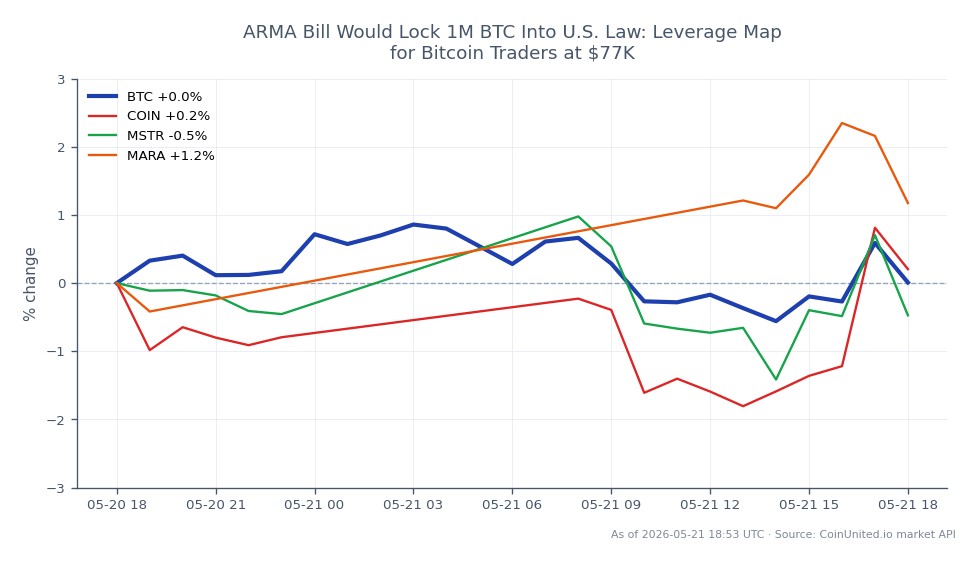
Crypto equities (CFDs): MicroStrategy (MSTR) and Marathon Digital Holdings (MARA) are the highest-beta proxies. MSTR's BTC treasury strategy means any sovereign accumulation narrative directly reinforces its NAV premium thesis — see our MSTR Bitcoin Premium trading guide. Coinbase (COIN) benefits if reserve custody requirements expand institutional storage demand.
Gold: The bill's gold-certificate revaluation mechanism creates a direct conceptual link — BTC as a modern reserve complement. This reinforces the bitcoin-geopolitical-payment-rails thesis and could apply mild narrative pressure on gold's symbolic reserve role, though near-term price impact is limited.
USD/Macro: Use of Fed remittances as funding may trigger debate around fiscal accounting, but is not a conventional near-term inflation driver. DXY impact is second-order.
Trading Considerations
BTC holds the $76,699 intraday low as near-term support, with resistance at the $78,179 24h high. A sustained break above $78,200 would signal market belief in legislative momentum; failure to hold $76,700 would suggest the headline is being faded. Watch for committee scheduling, bipartisan co-sponsorship announcements, and whether the 200,000 BTC/year purchase language survives intact — any dilution removes the core supply-shock narrative.
The 2026 Crypto Market Outlook provides broader context for sovereign adoption as a multi-quarter catalyst.
Trade Bitcoin on CoinUnited.io
Trade BTC with up to 2000xx leverage → | Create Free Account
Frequently Asked Questions
At $77,330, a 50x long faces liquidation near $75,800 — only ~2% below current price and close to today's $76,699 low. Until BTC breaks above the $78,179 resistance with conviction, high-leverage longs carry meaningful intraday liquidation exposure.
Continue Exploring
Disclaimer: This brief is for educational purposes only and is not investment advice.