Quick Links
CytoSorbents Q1 2026: Going-Concern Warning and Sub-$1 Share Price Signal Deep Distress
Data Snapshot
Key Takeaways
- •Q1 2026 revenue of $8.9M (+2% YoY) and net loss of $5.1M reflect anemic growth and deteriorating GAAP profitability driven by FX losses and debt costs.
- •The company's 10-Q explicitly flags 'substantial doubt' about going-concern status, with only ~$6.3M cash against $18.4M debt due 2027.
- •Sub-$1 share price (~$0.479) creates active NASDAQ delisting risk and elevates probability of a dilutive equity raise or reverse split.
- •Germany market restructuring remains unresolved, removing a key revenue catalyst in the near term.
- •Event has no material cross-market impact on broader indices but reinforces bearish sentiment toward leveraged micro-cap medtech.
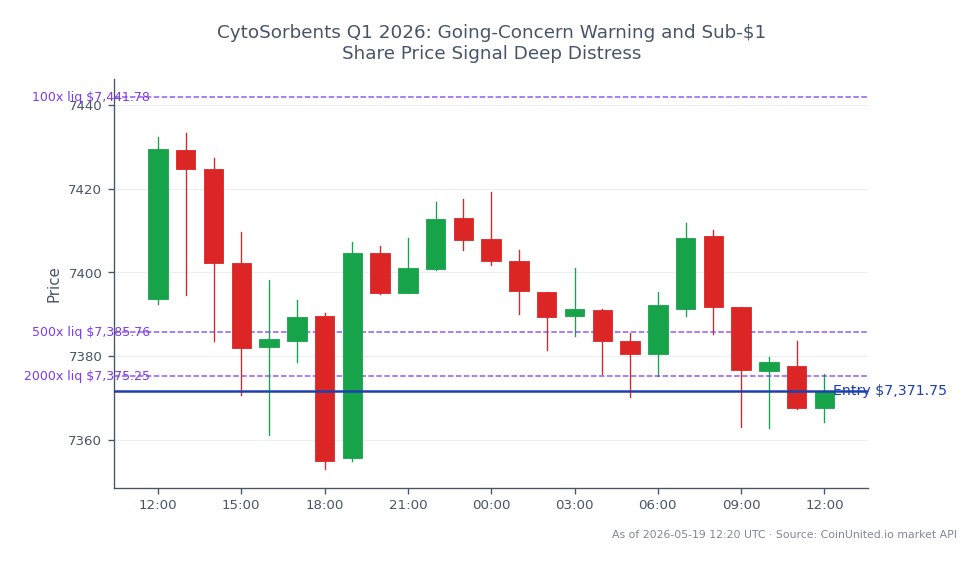
CytoSorbents Corporation (NASDAQ: CTSO), a micro-cap medical device company specializing in extracorporeal blood purification, reported Q1 2026 financial results that fell short of expectations on mul
Event Analysis
CytoSorbents Corporation (NASDAQ: CTSO), a micro-cap medical device company specializing in extracorporeal blood purification, reported Q1 2026 financial results that fell short of expectations on multiple dimensions. According to the company's investor relations press release and SEC-referenced 10-Q filing, revenue came in at $8.9M — up just 2% year-over-year — while net loss widened dramatically to $5.1M ($0.08/share) versus $1.5M ($0.02/share) in Q1 2025. The widening loss was driven by approximately $1.2M in foreign exchange losses and higher interest expense on the company's $18.4M Avenue Capital debt facility due in 2027.
What separates this from a routine earnings miss is the explicit going-concern language in the 10-Q filing. With only ~$6.3–6.4M in cash and restricted cash against $18.4M in long-term debt, the company's financial runway is critically short. Cash burn of ~$1.1M per quarter (excluding restructuring) implies fewer than six quarters of runway at current rates — before accounting for debt service. This is not a temporary shortfall; it reflects a structural capital adequacy problem.
The Germany headwind compounds the concern. Germany has historically been a core market for CytoSorbents' CytoSorb therapy, but ongoing sales and reimbursement restructuring has created a notable gap in revenue that low-teens growth in other direct international markets has not yet offset. The operational picture — improved operating loss of $3.0M versus $3.9M, and a respectable 69% gross margin — shows execution capability, but balance sheet stress is dominating the investment thesis. This is a pattern consistent with what our earnings miss revenue shock theme identifies as the most damaging scenario: when a miss exposes underlying solvency risk rather than just a temporary demand shortfall.
What This Means for Traders
For traders, CTSO's situation is a textbook earnings miss recovery plays challenge with a severe balance sheet overlay. According to the research data, CTSO was trading around $0.479 (-3.82%) around the coverage window — a sub-$1 share price that triggers NASDAQ minimum bid price compliance risk. A sustained sub-$1 price typically leads to a formal deficiency notice, followed by a 180-day cure period. The most common outcomes — reverse stock splits or heavily dilutive equity raises — are historically negative price catalysts. Traders eyeing a speculative long should treat any bounce as structurally fragile until a credible recapitalization is announced.
The broader market impact is minimal. CTSO is far too small to move the S&P 500 Index or NASDAQ 100 Index, and there is no meaningful read-through to the wider healthcare sector. However, this event reinforces the ongoing thematic pressure on leveraged, pre-profit micro-cap medtech names — a pocket of the market facing compounding stress from tight credit conditions and higher-for-longer interest rates. Understanding how to trade earnings misses in this context requires distinguishing between cyclical misses and structural distress; CTSO clearly falls into the latter category.
Start Trading on CoinUnited.io
Create Your Free Account → — Trade crypto, stocks, forex, indices, and commodities with up to 2000x leverage and zero fees.
Frequently Asked Questions
It means the auditors or management have flagged material doubt about the company's ability to continue operations without additional capital. For equity holders, it significantly raises the risk of forced dilution, debt restructuring, or in a worst case, bankruptcy.
Continue Exploring
Disclaimer: This brief is for educational purposes only and is not investment advice.