Quick Links
Venture Global Locks in Greece's First U.S. LNG Deal: What It Means for Energy CFD Traders
Data Snapshot
Key Takeaways
- •VG equity CFD is the highest-leverage expression of this trade — a 50x long position amplifies any post-announcement move 50:1, but the 2030 start date limits fundamental urgency.
- •At 0.5 MTPA, this deal is too small to reprice WTI, Henry Hub, or TTF spot — do not size commodity CFDs on this headline alone.
- •Greece's first-ever long-term U.S. LNG deal signals sustained European diversification demand, a mild positive for U.S. LNG exporter peers (Cheniere, New Fortress Energy).
- •USDCAD warrants monitoring as a macro proxy — sustained U.S. LNG contract wins in Europe are a slow-burn structural headwind for Canadian LNG market share and CAD sentiment.
- •The expansion clause in the SPA represents optional volume upside that markets may begin pricing in if Venture Global's project execution milestones are met before 2030.
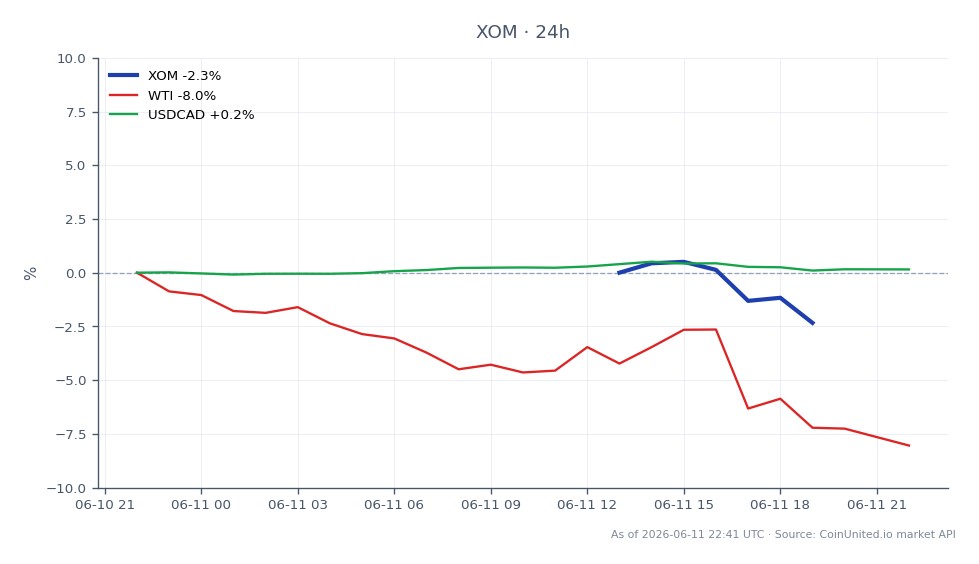
According to Venture Global's investor-relations release, Venture Global, Inc. (NYSE: VG) and Atlantic-See LNG Trade S.A. — a Greek joint venture involving AKTOR and DEPA Commercial — have executed a
Event Summary
According to Venture Global's investor-relations release, Venture Global, Inc. (NYSE: VG) and Atlantic-See LNG Trade S.A. — a Greek joint venture involving AKTOR and DEPA Commercial — have executed a 20-year Sales and Purchase Agreement for a minimum 0.5 million tonnes per annum (MTPA) of U.S. LNG, commencing in 2030. As confirmed by GIIGNL and LNG Industry, this is Greece's first-ever long-term LNG supply agreement with a U.S. exporter, framed explicitly as a contribution to Central and Eastern European energy security.
The deal includes an expansion clause offering optional volume upside. While 0.5 MTPA is modest in global LNG terms, the 20-year tenor locks in offtake revenue visibility for Venture Global and signals sustained European appetite for long-dated U.S. supply contracts — a meaningful data point for the broader cross-sector partnership catalyst theme playing out across energy markets.
Leverage Impact Analysis
This is a contract-backlog event, not a spot-price shock — meaning the leverage impact is concentrated in equity CFDs on LNG exporters rather than in commodity perpetuals. VG stock is the most direct instrument.
Consider a trader with a 50x long VG CFD position: a 3% move in VG shares (a modest reaction to a contract announcement of this size) would generate a 150% return on margin — but equally, a 2% adverse drift on a crowded long would consume the entire margin buffer at that leverage level. Position sizing discipline is critical when trading equity CFDs on news-driven catalysts with 2030 delivery timelines, since the market may front-run and then fade.
For WTI crude oil and natural gas commodity CFDs, the leverage calculus is different: this deal is not large enough to move spot LNG or TTF prices materially, so leveraged commodity positions should not be sized on this headline alone. Monitor open interest on energy CFDs for any confirmation signal before adding exposure.
For Exxon Mobil and Chevron CFD traders, any sympathy move is likely shallow — treat it as sector sentiment lift rather than a fundamental re-rating catalyst.
Cross-Market Impact
The clearest read-through is in U.S. LNG exporter equities. VG is the direct beneficiary; peers with contracted European exposure (Cheniere, New Fortress Energy) may see modest sympathy buying. This fits the broader cross-sector liquidity alliance wave where long-dated energy partnerships are re-rating contract-heavy names.
European gas markets (TTF) may see a marginal directional signal — diversification away from pipeline dependence is incrementally bearish for spot volatility premiums, but one 0.5 MTPA deal won't reprice the curve. USDCAD is worth watching: Canada is a competing LNG export nation, and sustained U.S. contract wins in Europe structurally pressure Canadian LNG market share, providing a mild fundamental headwind for CAD over time. The FX impact from this single deal is negligible in isolation, but it adds to a directional narrative. For a deeper macro framework, see our energy sector acquisitions and deal flow guide.
Trading Considerations
The most actionable level to watch is VG's post-announcement price reaction relative to its recent range — a sustained hold above pre-announcement levels would confirm the market is pricing in contract backlog expansion, while a fade back would signal the 2030 start date is too distant to move near-term valuation. For commodity CFD traders, WTI and Henry Hub levels are unaffected by this deal in isolation; geopolitical factors (Hormuz, OPEC) remain the dominant drivers per our Hormuz Strait energy markets guide.
Key risk: the deal starts in 2030, meaning any near-term equity re-rating is purely sentiment-driven and vulnerable to reversal if broader risk appetite deteriorates.
Start Trading on CoinUnited.io
Create Your Free Account → — Trade crypto, stocks, forex, indices, and commodities with up to 2000x leverage and zero fees.
Frequently Asked Questions
At 50x leverage, even a 2% adverse move wipes margin — the 2030 delivery date means this is a sentiment-driven re-rating, not a near-term cash flow event, so tighter position sizing and stop levels are warranted. Monitor whether VG holds post-announcement gains as a confirmation signal before adding.
Continue Exploring
Disclaimer: This brief is for educational purposes only and is not investment advice.