Quick Links
Gold Plunges to $4,045 as U.S. Inflation Heats Up — Leveraged XAUUSD Longs Face Liquidation Cascade Risk
Data Snapshot
Key Takeaways
- •XAUUSD is trading at $4,045.28 after an intraday decline exceeding 8%, one of the sharpest single-session drops since March, driven by U.S. CPI rising 0.9% in March per Kitco.
- •Leveraged long positions above 20x opened near $4,200 have likely already been liquidated — the $4,036–$4,000 zone is the next critical support band to monitor.
- •Higher real yields and a stronger dollar are the dual transmission channels; the gold-dollar inverse relationship is the primary framework for this move.
- •Cross-market spillover is real: silver, EUR/USD, and Bitcoin are all facing correlated selling pressure in this risk-off repricing environment.
- •Short-sellers should note that 8%+ single-day moves in gold historically carry elevated mean-reversion risk — position sizing and funding costs matter critically at high leverage.
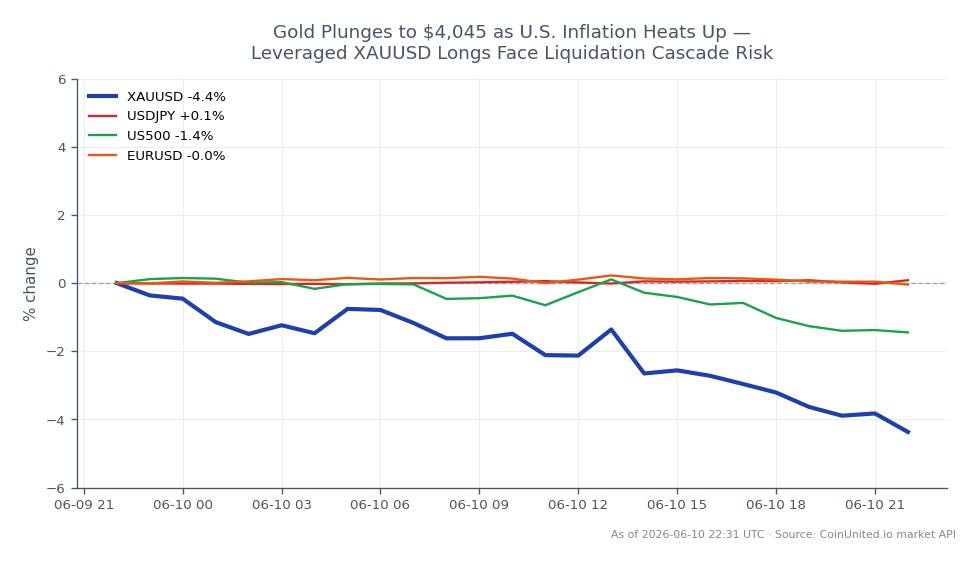
Gold (XAUUSD) has suffered one of its sharpest drawdowns since March, with multiple market reports documenting an intraday decline of more than 8% and a drawdown exceeding $1,000 from recent highs, ac
Event Summary
Gold (XAUUSD) has suffered one of its sharpest drawdowns since March, with multiple market reports documenting an intraday decline of more than 8% and a drawdown exceeding $1,000 from recent highs, according to TradingKey. As reported by Reuters, spot gold dived to a four-month low as inflation fears drove rate-hike bets. The macro catalyst is a hotter-than-expected U.S. inflation print — Kitco documented U.S. CPI rising 0.9% in March — which has repriced Fed policy expectations toward a tighter-for-longer stance, lifting real yields and the U.S. Dollar Index simultaneously.
According to Live Market Data, XAUUSD is currently trading at $4,045.28, with a 24h range of $4,036.25–$4,057.33 and a 24h change of -0.39% — suggesting the bulk of the sell-off has already repriced but downside pressure persists. This macro inflation risk-off repricing dynamic is characteristic of environments where gold temporarily loses its safe-haven bid as real yields spike.
Leverage Impact Analysis
The ~8% intraday plunge creates severe liquidation exposure for leveraged long positions. On CoinUnited.io's Gold CFD (up to 2000x leverage), consider these scenarios using the live price of $4,045.28:
- -50x long opened at $4,400 (pre-sell-off): The ~8% move ($355) against a 2% margin requirement means this position is deeply underwater, with effective losses of ~400% of initial margin — liquidated well before current levels.
- -20x long opened at $4,200: A $155 adverse move (~3.7%) exceeds the 5% margin buffer — liquidation triggered approximately at $4,095, already breached.
- -10x long opened at $4,200: Requires a 10% adverse move to liquidate (~$4,000 level) — still at risk given the 24h low of $4,036.25 approaching this zone.
For short-side traders, the macro inflation pressure narrative supports continuation — but mean-reversion risk is high after an 8%+ single-session move. Check funding rates on CoinUnited.io for carry cost before holding shorts overnight. The gold vs. U.S. dollar inverse relationship is the core mechanic here: dollar strength is directly compressing gold.
Cross-Market Impact
The inflation shock ripples broadly across asset classes:
- -EUR/USD: Dollar strength driven by rate-hike repricing pressures EUR/USD lower. A 100x long EUR/USD position faces accelerating pip losses in a stronger-dollar regime.
- -USD/JPY: Higher U.S. yields widen the rate differential, supporting USD/JPY upside — a continuation of the carry dynamic that has weighed on yen.
- -S&P 500: Tighter-for-longer Fed expectations are a valuation headwind for equities, particularly rate-sensitive growth stocks. Monitor whether the index can hold key support.
- -Bitcoin: BTC has been partially correlating with gold as a macro hedge. A gold breakdown under macro inflation pressure historically spills into crypto risk-off positioning — monitor BTC open interest for confirmation.
- -Silver: TradingKey explicitly notes silver also fell sharply alongside gold, making silver/euro and related pairs vulnerable to further selling.
Trading Considerations
With XAUUSD at $4,045.28 and the 24h low at $4,036.25, a close below $4,036 on volume would confirm bearish continuation with the next structural reference near the $4,000 psychological level. The CPI and inflation data trading guide highlights that post-CPI volatility often compresses within 48–72 hours — meaning the immediate window carries outsized risk for both directions. Key watches: subsequent Fed communication, Treasury real yield trajectory, and whether DXY sustains above recent resistance. Any dovish Fed pivot signal could trigger a violent short squeeze given the speed of the decline.
Trade Gold / US Dollar on CoinUnited.io
Trade XAUUSD with up to 2000xx leverage → | Create Free Account
Frequently Asked Questions
At 20x leverage, a position opened near $4,200 would face liquidation around $4,095 — already breached. At 10x, the liquidation zone falls near $4,000, which is close to the current 24h low of $4,036.25.
Continue Exploring
Disclaimer: This brief is for educational purposes only and is not investment advice.