Quick Links
Oracle Tumbles 11% on $150B Debt Load and AI Capex Surge — Leverage Scenarios & Cross-Market Impact
Data Snapshot
Key Takeaways
- •Oracle fell ~11% in one session, erasing ~$100B in market cap, driven by a ~$150B debt load and AI capex guidance of up to ~$95B in future years (per BNN Bloomberg/ABC News).
- •Leveraged long ORCL CFD positions opened near the $189 session high face ~273% margin erosion at 50x leverage by current price ($178.69) — liquidation thresholds are actively in play.
- •The NASDAQ 100 and S&P 500 face modest index drag given Oracle's large-cap weight; cloud peers Microsoft and Amazon are at risk of read-across multiple compression.
- •The event is a live stress-test of AI capex sustainability — markets are beginning to penalize debt-funded AI spending without near-term monetization visibility.
- •Key levels: support at $175.28 (24h low), resistance at $189.17 (24h high); watch analyst revisions and peer hyperscaler guidance for directional follow-through.
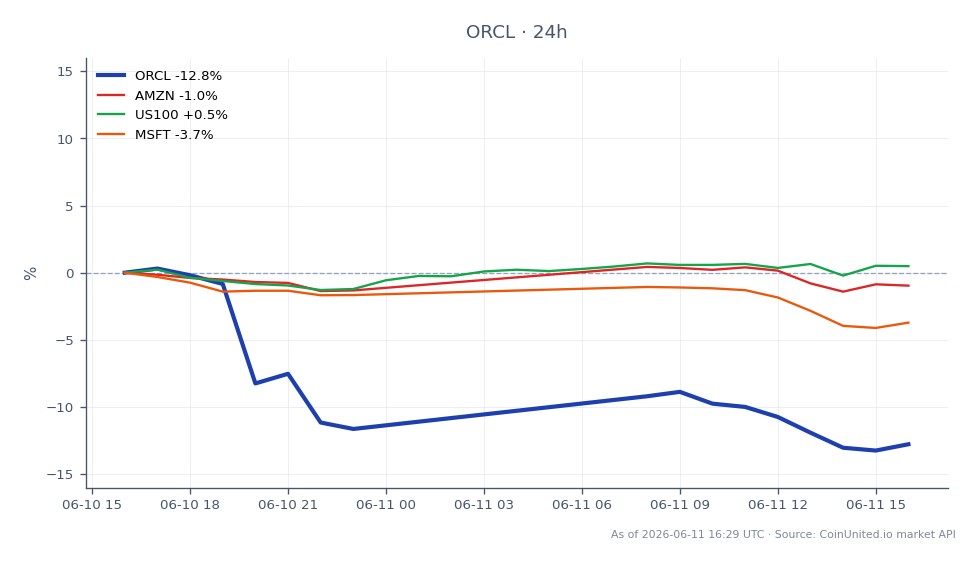
According to BNN Bloomberg and ABC News, Oracle Corporation (ORCL) shares fell approximately 11% in a single session, wiping roughly $100 billion from the company's market capitalization. The sell-off
Event Summary
According to BNN Bloomberg and ABC News, Oracle Corporation (ORCL) shares fell approximately 11% in a single session, wiping roughly $100 billion from the company's market capitalization. The sell-off was triggered by Oracle's disclosure of sharply higher AI infrastructure capital expenditures — with capex reportedly reaching ~$56 billion in the current fiscal year and potentially ballooning to ~$95 billion in a future year — funded in large part by debt that has surged to approximately $150 billion. Investors reacted negatively to the combination of heavy financing needs, elevated cash burn, and unclear near-term AI monetization timelines.
Commentators explicitly framed the drop within the broader AI infrastructure capital reallocation debate, with Oracle's move serving as a live stress-test of market tolerance for debt-funded AI spending. The event is consistent with the emerging convertible notes capital raise wave across the tech sector, where large-scale AI ambitions are increasingly colliding with balance-sheet limits.
Leverage Impact Analysis
With ORCL trading at $178.69 (24h low: $175.28, 24h high: $189.17), leveraged CFD traders face significant margin dynamics following an ~11% single-session drawdown.
Long-side scenario: A trader holding a 50x long ORCL CFD opened near $189 (pre-drop high) would face a notional loss of ~$10.31 per share on a move to $178.69 — representing a ~5.5% adverse move against a position leveraged 50x, meaning ~273% of margin is at risk. Positions opened above $180 with 50x leverage are likely already at or past liquidation thresholds.
Short-side scenario: Traders who entered short positions ahead of the announcement near $189.17 and held to current price ($178.69) captured roughly 5.5% in spot terms — multiplied by leverage, a 20x short position would yield ~110% return on margin. However, short squeeze risk remains elevated if Oracle issues stabilizing guidance.
Volatility consideration: The wide 24h range ($175.28–$189.17, a $13.89 spread or ~7.3%) signals elevated implied volatility. High-leverage positions (50x+) require position sizing that accounts for multi-percent intraday swings. Monitor open interest on CoinUnited.io for directional confirmation before adding exposure.
Cross-Market Impact
Tech indices: Oracle's weight in large-cap benchmarks creates a modest drag on the NASDAQ 100 and S&P 500. Concentrated tech indices with AI infrastructure exposure face the highest spillover risk.
Cloud hyperscalers: Microsoft Corp. and Amazon.com carry comparable AI capex narratives. Markets may re-examine their own spending trajectories — Microsoft's Azure and Amazon AWS are both deep in multi-year AI infrastructure cycles. Any read-across guidance weakness could pressure these names.
AI hardware supply chain: If Oracle's capex concerns signal broader spending deceleration, GPU and accelerator demand expectations could soften at the margin — a headwind for AI monetization and chip demand theses.
Risk sentiment / FX: The effect on forex is second-order; however, a sustained tech risk-off episode could marginally support defensive currencies and weigh on pro-risk FX pairs. No direct commodity impulse is expected.
Trading Considerations
Key levels for ORCL CFDs: immediate support sits near the 24h low of $175.28; a breach opens the path toward the prior earnings-gap zone. Resistance is now established at $189.17 (24h high). The $100B market-cap wipe-out represents a significant valuation reset — watch for analyst price target revisions and any follow-up commentary on AI ROI timelines as the next catalyst.
Risk factor to monitor: Oracle's ~$150B debt load makes the stock increasingly sensitive to credit spread widening and rate expectations. Traders should also track whether peer hyperscalers (Alphabet Inc.) issue similar capex guidance updates, which could amplify or reverse the sector-wide repricing.
Trade Oracle Corporation on CoinUnited.io
Trade ORCL with up to 1000xx leverage → | Create Free Account
Frequently Asked Questions
A 50x long ORCL CFD opened near the $189.17 session high faces a ~5.5% adverse move to current price ($178.69), consuming roughly 273% of the initial margin — well past liquidation for most leverage configurations above 20x.
Continue Exploring
Disclaimer: This brief is for educational purposes only and is not investment advice.