Quick Links
Japan May PPI Surges to 6.3% y/y — BOJ Repricing Risk Mounts for Leveraged USD/JPY Longs
Data Snapshot
Key Takeaways
- •May PPI of 6.3% y/y vs 5.5% expected is a significant upside surprise, nearly doubling the month-on-month pace and reinforcing BoJ rate hike expectations toward 1.00% as early as June 2026.
- •Leveraged USD/JPY longs face acute squeeze risk: at 100x leverage, a 0.5% JPY appreciation from 160.39 produces a ~50% margin drawdown; at 200x, full liquidation.
- •Broad-based producer price pressure (364/515 items rising) signals cost-push inflation will feed into CPI, reducing BoJ's pause window and validating the hawkish policy repricing thesis.
- •Cross-market: Nikkei 225 faces headwinds from JPY strength hitting exporters; Gold and inflation-hedge assets benefit from the global cost-push inflation confirmation; JPY carry trades face compression.
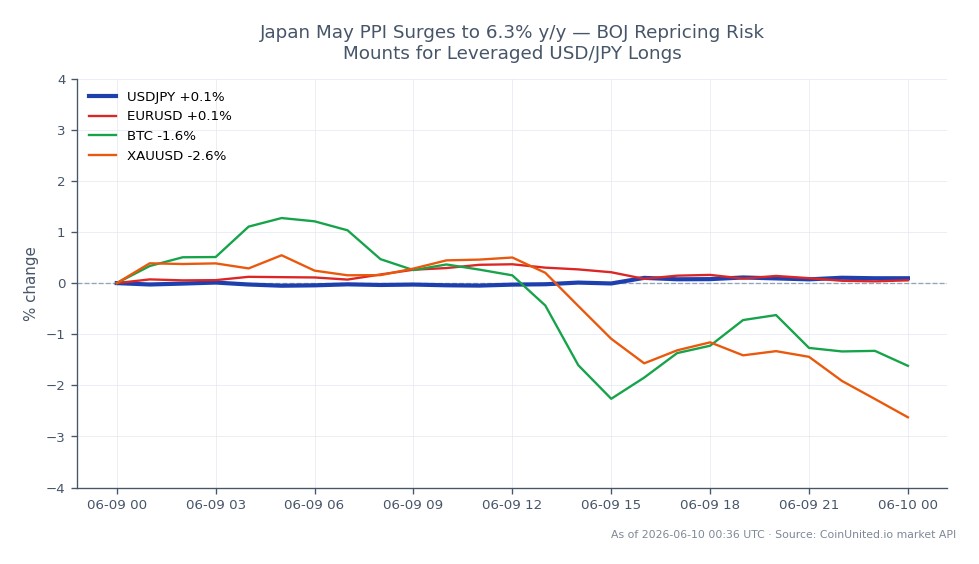
- •USD/JPY's unusually tight 24h range (160.36–160.42) suggests the market has not fully repriced — watch for a directional break below 159.50 as the key confirmation level.
Japan's May Producer Price Index (Corporate Goods Price Index) printed at 6.3% y/y versus the 5.5% consensus estimate — an +0.8 percentage point upside surprise. The month-on-month reading also double
Event Summary
Japan's May Producer Price Index (Corporate Goods Price Index) printed at 6.3% y/y versus the 5.5% consensus estimate — an +0.8 percentage point upside surprise. The month-on-month reading also doubled expectations at 0.9% m/m vs 0.5% forecast. This follows an already-elevated April print of 4.9% y/y (itself a beat), marking the fastest sequential acceleration in producer inflation in over a decade. According to Daiwa Institute research, energy cost shocks linked to Middle East tensions and persistent yen weakness are the primary drivers, with 364 of 515 tracked items rising — signalling broad-based, not energy-only, price pressure. This is a direct input into the CPI shock & central bank repricing thesis that has been building across APAC markets.
The Daiwa Institute projects BoJ short-term rates rising to 1.00% as early as June 2026, followed by ~25 bps hikes every six months. BNP Paribas similarly forecasts the policy rate reaching ~2% over time, with core CPI averaging 2.7% in 2026. A PPI print this far above expectations materially pulls forward those projections and reduces the BoJ's room to pause — directly feeding the macro inflation pressure that has dominated Japan macro trading in 2026.
Leverage Impact Analysis
According to live market data, USD/JPY is currently trading at 160.39 (24h range: 160.36–160.42) — an unusually tight band that suggests the market has not yet fully repriced the PPI shock, or is awaiting BoJ confirmation signals.
Leveraged long USD/JPY positions are directly exposed. Consider a trader holding a 100x long USD/JPY CFD opened at 160.39 on CoinUnited. A 0.5% JPY appreciation move — modest given a +0.8pp PPI surprise — would push USD/JPY to ~159.59, generating a 50% drawdown on margin for that position. At 200x leverage, the same 0.5% move wipes the position entirely. Traders running high-leverage longs near current levels face asymmetric risk: the PPI print removes a key justification for BoJ patience.
For short USD/JPY positions, this event is a tailwind. A 100x short opened at 160.39 targeting 158.50 — a level consistent with prior intervention-zone reactions per recent USD/JPY analysis — would yield a ~119% return on margin if reached. However, position sizing discipline is critical: USD/JPY has shown sharp intraday reversals above 160 when MOF intervention speculation peaks. Monitor funding rates and open interest on CoinUnited.io for directional confirmation before sizing up.
Cross-Market Impact
Nikkei 225 (JP225): A stronger yen following this PPI beat is net negative for Japanese export-heavy names (autos, electronics). However, financials and banks stand to benefit from higher rate expectations — expect sector divergence within the index. Net index impact leans modestly bearish near-term.
Gold (XAU/USD): The inflation hedge thesis is reinforced. Persistent producer inflation in Japan — a major energy importer — validates the global cost-push inflation narrative. Gold typically benefits from this backdrop, particularly if JPY strength triggers carry trade unwinding and broader risk-off flows. Watch the gold vs. USD dynamic closely if DXY softens on yen strength.
EUR/USD & FX Crosses: A EUR/USD reaction depends on whether JPY strength is read as risk-off (EUR positive vs USD) or triggers broader carry unwind. JPY crosses — EURJPY, AUDJPY — face the most direct pressure as yen appreciation compresses carry returns. The APAC hawkish pivot theme adds further pressure on high-yielding EM currencies funded in JPY.
Bitcoin (BTC): Indirect exposure only. If JPY appreciation accelerates carry trade unwinding, risk-beta assets including crypto may face short-term pressure. The medium-term fiat debasement narrative, however, remains structurally supportive for BTC.
Trading Considerations
USD/JPY at 160.39 sits just below the psychologically sensitive 160.50 zone that has previously triggered MOF verbal intervention warnings. The tight 24h range (160.36–160.42) suggests either pre-positioning caution or a liquidity void waiting to be filled. Key support is 159.50–159.60 (prior intervention reaction zone); resistance at 160.80–161.00. A clean break below 159.50 on volume would confirm the PPI-driven BoJ repricing trade.
The primary risk to the JPY-bullish thesis: if BoJ officials walk back urgency at upcoming speeches, or if US macro data reinforces USD strength. Watch for BoJ Governor Ueda commentary and any MOF statements as the next catalysts. Traders seeking a macro inflation trading framework should review position sizing given the elevated volatility regime.
Trade US Dollar / Japanese Yen on CoinUnited.io
Trade USDJPY with up to 2000xx leverage → | Create Free Account
Frequently Asked Questions
With USD/JPY at 160.39, a PPI-driven 0.5% JPY appreciation move to ~159.59 generates a 50% margin loss on a 100x position — at 200x, that same move is a full liquidation. Reduce position size or place tight stops above 160.80 if holding longs.
Continue Exploring
Disclaimer: This brief is for educational purposes only and is not investment advice.