Quick Links
USD/INR at 95.58 — Hawkish Fed and Hormuz Stalemate Keep Rupee Bearish Bias Locked In
Data Snapshot
Key Takeaways
- •USD/INR is at 95.58 with the bearish INR trend structurally intact; year-end consensus points to 97.50 as long as Hormuz remains constrained and the Fed stays hawkish.
- •Leverage risk is asymmetric: at 100x long USD/INR, a move to recent record highs (~96.52) yields ~98% return on margin, but a 1% reversal approaches liquidation — size accordingly.
- •Brent crude near $100–102/bbl is the primary INR transmission mechanism; India's net oil importer status means every $10/bbl increase widens the current account deficit and adds structural INR depreciation pressure.
- •Cross-market: Gold benefits from geopolitical and inflation hedge flows; high-beta crypto faces dual pressure from risk-off sentiment, though USD-stablecoin demand in India may provide incremental BTC/ETH support.
- •The single biggest tail risk for short-INR positions is a sudden US–Iran deal or Hormuz reopening headline — this would trigger a sharp INR short squeeze and potential oil price collapse, reversing all current positioning.
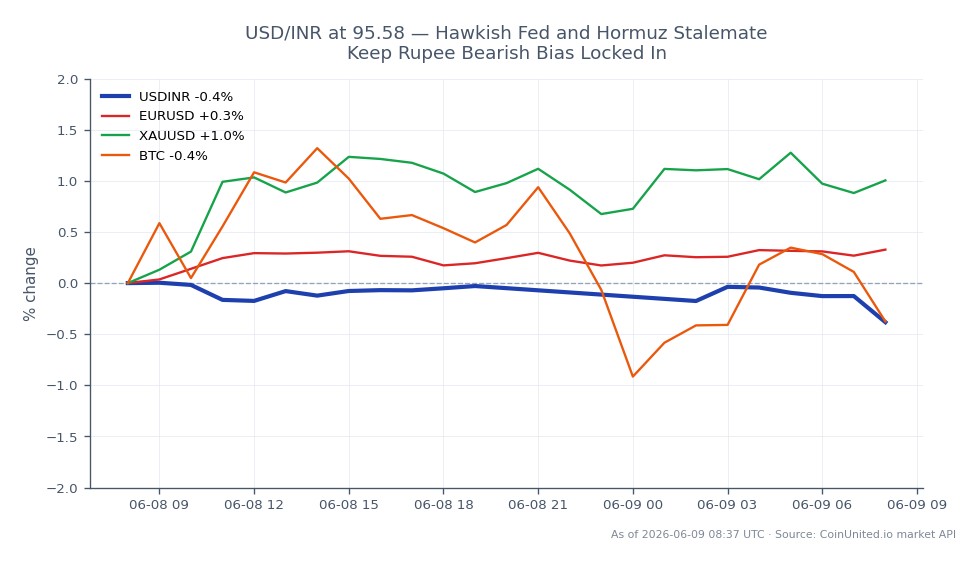
The Indian Rupee continues to trade under significant pressure, with USD/INR at 95.58 (24h range: 95.55–95.92) as multiple macro headwinds converge simultaneously. According to current FX market analy
Event Summary
The Indian Rupee continues to trade under significant pressure, with USD/INR at 95.58 (24h range: 95.55–95.92) as multiple macro headwinds converge simultaneously. According to current FX market analysis, the pair has already breached prior all-time lows near 96.52–96.96 in recent sessions, with year-end consensus forecasts clustering around 97.50.
Two structural forces are driving the bearish INR bias: the Hormuz Strait energy supply shock keeping Brent crude near $100–102/bbl, and the Fed's macro policy crossroads — where policymakers are actively floating rate hike possibilities after above-forecast US inflation prints. As reported in recent FX notes, the Reserve Bank of India (RBI) is intervening only to smooth volatility, not to reverse the trend, leaving the depreciation trajectory structurally intact.
Leverage Impact Analysis
With USD/INR at 95.58, leveraged traders face an asymmetric volatility environment. The pair is range-bound intraday (95.55–95.92) but carries a clear directional bias toward new highs.
Long USD/INR scenario (high conviction): A trader opening a 100x long USD/INR CFD at 95.58 controls a notional position worth 100x the margin deployed. A move to the recent record high near 96.52 represents a ~0.98% gain on notional — translating to approximately 98% return on margin at 100x. However, the inverse is critical: a 1% adverse move (USD/INR falling to ~94.63, e.g., on a credible Iran peace framework headline) would approach full margin liquidation at 100x leverage.
Short INR squeeze risk: Traders short INR must respect the scenario where a sudden Hormuz reopening or dovish Fed pivot triggers a sharp INR relief rally. This is the primary tail risk — the APAC stagflation and currency stress backdrop means any détente headline could generate violent short-covering. Monitor position sizing carefully; check funding rates on CoinUnited.io for current carry costs on USD/INR perpetual positions.
Intraday structure: Key support sits at 95.55 (24h low); resistance clusters near 95.92 (24h high) and then the 96.20 zone noted in FX analysis. Breaks above 95.92 on volume would signal fresh momentum toward record highs.
Cross-Market Impact
The USD/INR bearish INR theme radiates across multiple asset classes. WTI crude oil and Brent remain the primary transmission mechanism — the oil geopolitical risk-off dynamic ties elevated crude directly to India's widening current account deficit. The World Bank projects energy prices up ~24% year-on-year under even an optimistic Hormuz resolution timeline, per the research report.
Gold benefits from the dual tailwinds of geopolitical uncertainty and inflation hedging demand — the currency depreciation narrative in India adds incremental local gold demand pressure. For Bitcoin and Ethereum, the macro environment is mixed: INR depreciation and EM capital controls can spur incremental crypto adoption as a USD-stablecoin hedge, but a broad risk-off hawkish Fed episode pressures high-beta crypto assets simultaneously.
On forex crosses, EUR/USD faces its own headwinds from USD strength, while USD/JPY may see further yen weakness if the hawkish Fed narrative intensifies — compounding APAC currency stress broadly. Indian equities (Nifty 50, Sensex) face sector-specific pressure: aviation and oil marketing companies bear the double hit of higher crude costs plus FX translation losses, while export-oriented IT and pharma sectors partially offset via INR revenue tailwinds.
Trading Considerations
The directional bias in USD/INR remains bullish USD while the US–Iran stalemate persists and Brent stays elevated above $100. Key upside levels to watch: 95.92 (intraday resistance), 96.20 (noted technical resistance), and 96.52/96.96 (recent record highs). Downside support: 95.55 (current 24h low); a break below 95.00 would require a material macro catalyst such as a credible peace framework or unexpected Fed dovish pivot.
The primary regime-change risk is a sudden Hormuz resolution — traders should monitor US–Iran negotiation headlines closely as this is the single highest-impact binary event. US Retail Sales and Jobless Claims data also represent near-term event risk that can shift Fed expectations and USD momentum rapidly.
Trade US Dollar / Indian Rupee on CoinUnited.io
Trade USDINR with up to 1000xx leverage → | Create Free Account
Frequently Asked Questions
A hawkish Fed surprise (e.g., rate hike signal) would likely push USD/INR higher, benefiting long USD/INR positions — at 100x leverage, even a 0.5% move to ~96.05 delivers ~50% margin return. Conversely, a dovish pivot or weak US data print could trigger rapid USD/INR pullbacks that liquidate over-leveraged longs near the 95.55 support zone.
Continue Exploring
Disclaimer: This brief is for educational purposes only and is not investment advice.