Quick Links
Chainalysis Flags $36.7M DeFi Blind Spot: Unverified Contracts Are a Liquidation Risk Factor
Data Snapshot
Key Takeaways
- •Chainalysis confirmed ~$36.7M in losses across four exploits targeting unverified DeFi smart contracts, framing this as a systemic 'security blind spot'.
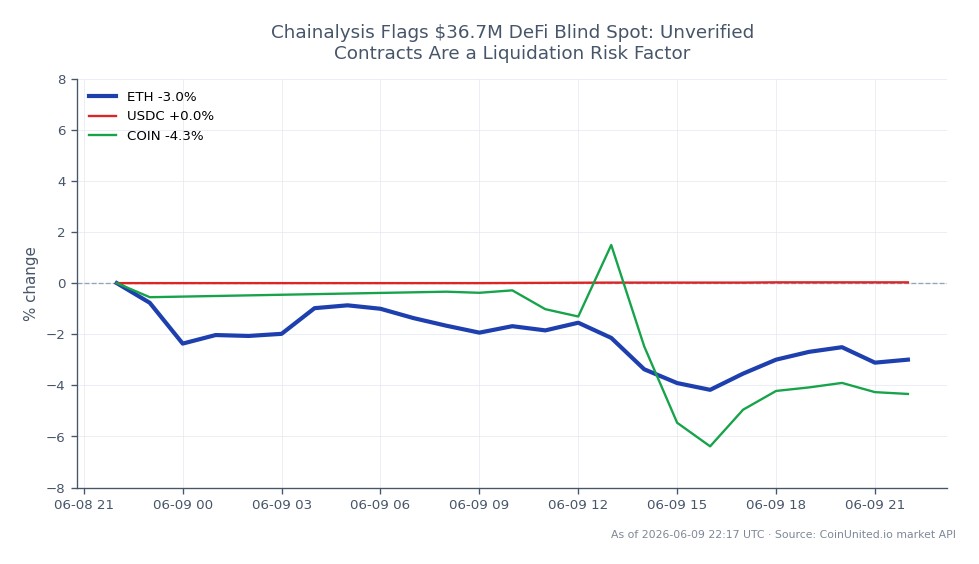
- •ETH is at $1,652.30 (-2.96% 24h); a 50x ETH long opened at $1,700 is already deep in margin danger — risk management on leveraged DeFi-adjacent positions is critical.
- •Liquidity is likely to rotate from unverified/opaque DeFi protocols toward audited blue-chip platforms — creating relative value divergence within DeFi tokens.
- •Coinbase (COIN) may see short-term CeFi volume benefit but faces longer-term headwind if repeated security incidents erode retail crypto confidence.
- •The Chainalysis report carries regulatory weight — watch for DeFi disclosure guidance that could raise compliance costs for unverified or anonymous protocol developers.
According to Chainalysis, a leading on-chain analytics firm, four major DeFi exploits targeting smart contracts with unverified source code resulted in combined losses of approximately $36.7 million.
Event Summary
According to Chainalysis, a leading on-chain analytics firm, four major DeFi exploits targeting smart contracts with unverified source code resulted in combined losses of approximately $36.7 million. The firm characterizes unverified contracts as a systemic "DeFi security blind spot" — their opaque logic limits the ability of auditors, monitoring tools, and institutional desks to detect vulnerabilities before they are exploited.
The finding is data-driven, not speculative. Chainalysis serves as a primary data provider to regulators and law enforcement, meaning this report carries potential policy weight beyond the immediate market impact. As reported by CryptoTimes, the scale is notable but contained — $36.7M is insufficient to shock total DeFi TVL, but it reinforces a persistent risk-off bias in long-tail DeFi.
Leverage Impact Analysis
Ethereum (ETH) is trading at $1,652.30, down 2.96% over 24 hours (24h range: $1,645.51–$1,652.49). In this environment, leveraged DeFi-adjacent positions face compounding risk from both price weakness and sentiment deterioration.
Worked example — leveraged ETH long: A trader holding a 50x ETH perpetual long opened at $1,700 would now be sitting on approximately a 3% adverse move. At 50x, that represents ~150% of margin consumed — already past liquidation for most configurations. Even at 20x, a move from $1,700 to $1,645 (the 24h low) would erase ~32% of margin, placing undercapitalized longs at serious risk.
This event also has indirect leverage implications for Aave (AAVE) and Uniswap (UNI) perpetuals. If the market reprices protocol-level security risk, tokens of DeFi protocols perceived as opaque or under-audited could see sudden liquidity withdrawal — widening spreads and increasing slippage costs at the exact moment leveraged traders need to exit. Monitor open interest on DeFi token perps for signs of forced unwind; check funding rates on CoinUnited.io for directional skew.
The DeFi Structural Reset theme is directly in play here. Cascading TVL outflows from unverified protocols can trigger secondary liquidations in lending platforms that use DeFi LP tokens as collateral.
Cross-Market Impact
This is primarily a DeFi-layer event with limited macro spillover, but two cross-market channels are worth monitoring:
Crypto-proxy equities: Coinbase Global (COIN) faces a mild indirect headwind. Persistent DeFi exploit news historically accelerates retail migration to centralized exchanges short-term, which can boost CeFi volumes — but prolonged security incidents erode overall retail confidence in crypto as an asset class. The net effect on COIN is likely muted unless exploit frequency accelerates.
USDC and stablecoin flows: USDC flows are worth watching as a leading indicator. When DeFi users exit unverified protocols, stablecoins typically concentrate in blue-chip venues. For broader context on institutional stablecoin dynamics, see the Institutional Stablecoins 2026 guide.
BTC, equities indices, FX, and commodities are effectively unaffected at this loss scale.
Trading Considerations
ETH is trading near the bottom of its 24h range ($1,645.51 support), with the broader DeFi reset risk landscape adding overhead pressure. Key level to watch: a sustained break below $1,645 on volume could open a move toward the recent 13-month low at $1,569. Resistance sits at the 24h high of $1,652.49, then the $1,700 psychological level.
For DeFi token positions (AAVE, UNI, COMP), the actionable screen is contract verification status — protocols with fully verified, multi-audited contracts are likely to outperform peers on any further risk-off repricing. Regulatory commentary citing "unverified contracts" is the key macro catalyst to monitor; it would structurally widen the risk premium for opaque DeFi.
Trade Ethereum on CoinUnited.io
Trade ETH with up to 2000xx leverage → | Create Free Account
Frequently Asked Questions
ETH is already down 2.96% to $1,652.30 — at 50x leverage, that move from $1,700 represents a ~150% margin drawdown, past liquidation for most configs. Traders should verify margin buffers and consider tightening stops near the $1,645 24h low.
Continue Exploring
Disclaimer: This brief is for educational purposes only and is not investment advice.