Quick Links
The $900B Treasury Cash Rebuild That Could Quietly Pull the Liquidity Floor From Under Bitcoin
Data Snapshot
Key Takeaways
- •A large TGA rebuild pulls hundreds of billions from bank reserves and money markets, tightening the dollar liquidity that fuels BTC's high-beta risk appetite.
- •50x BTC longs opened near $62,641 face liquidation near $61,388 — already tested within this session's $60,393 low, making leverage sizing critical right now.
- •Bitcoin historically follows a 'sell-off first, re-risk later' pattern during TGA drain phases — respect the first leg before fading it.
- •EUR/USD faces USD headwinds, NASDAQ growth multiples compress under rising real yields, and MSTR/COIN act as amplified BTC proxies in a risk-off move.
- •Monitor weekly TGA balances, Fed RRP usage, and Treasury auction sizes as leading indicators — these move before crypto prices react.
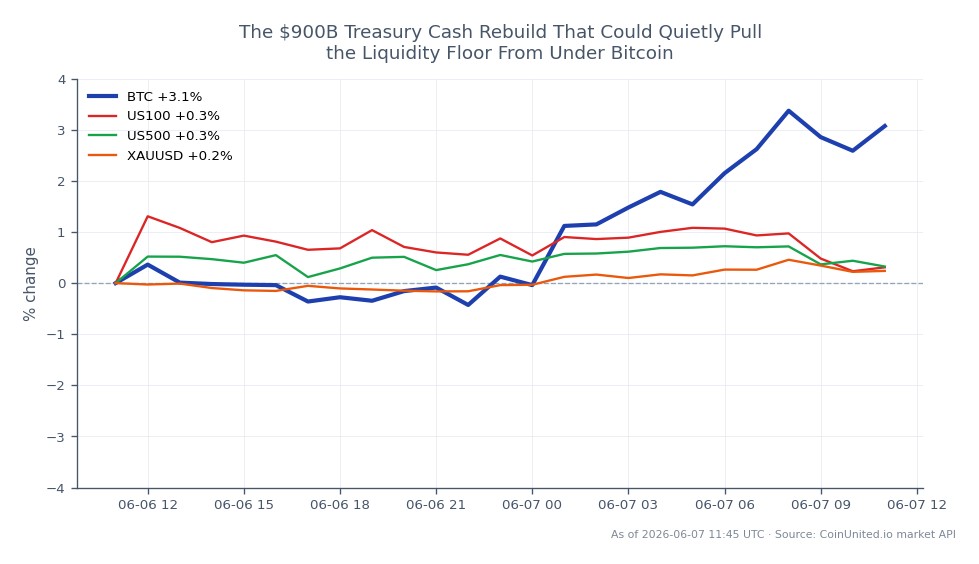
As analyzed through macro liquidity research and Treasury market dynamics, the U.S. Treasury is expected to rebuild its Treasury General Account (TGA) — the government's cash balance held at the Feder
Event Summary
As analyzed through macro liquidity research and Treasury market dynamics, the U.S. Treasury is expected to rebuild its Treasury General Account (TGA) — the government's cash balance held at the Federal Reserve — by an estimated $600–900B following a debt-ceiling drawdown period. According to the research, this rebuild occurs via heavy T-bill and short-term coupon issuance, pulling cash from bank reserves and money market funds back into government coffers.
This mechanism is structural, not headline-driven. The Fed macro policy crossroads it creates is silent but historically potent: when large TGA rebuilds coincide with elevated real yields and a Fed on hold, cross-sector liquidity and capital flows tighten systemically — and Bitcoin, as one of the most liquidity-sensitive high-beta assets, tends to be among the first casualties.
Leverage Impact Analysis
At BTC's current price of $62,641, leveraged long positions face asymmetric risk during an active TGA rebuild phase. Consider: a trader holding a 50x long BTC perpetual opened at $62,641 has a liquidation threshold roughly 2% below entry (~$61,388). The 24h low already printed at $60,393 — meaning that level was nearly reached in a single session. A liquidity-drain-driven move toward the $59,000–60,000 zone would liquidate all 50x longs opened anywhere above ~$61,200.
At 100x leverage, the liquidation band tightens to ~$62,015 — effectively within the current 24h range. During a fast, front-loaded TGA rebuild (e.g., $600B+ over 60–90 days), realized volatility spikes as institutional desks reduce high-beta exposure simultaneously. This compresses funding windows and can trigger cascading liquidations in BTC perpetuals. Monitor open interest on CoinUnited.io for confirmation of crowded long positioning before adding size.
The research notes that prior TGA rebuild episodes produced a "risk-off first, re-risk later" pattern — BTC sells off during the drain, then rebounds when policy pivots dovish. Traders should respect the first phase before positioning for the second.
Cross-Market Impact
The transmission runs across every major asset class. A USD-supportive TGA rebuild pressures EUR/USD lower as front-end U.S. yields rise and dollar funding tightens globally. Gold faces a contradictory pull: safe-haven demand supports it, but higher real yields cap upside — making the gold vs. U.S. dollar inverse relationship critical to watch.
For equities, the NASDAQ 100 and S&P 500 face multiple de-rating risk as real yields climb. Crypto-proxy stocks — MSTR, COIN, MARA — act as leveraged beta on BTC and would amplify any BTC drawdown. The MSTR NAV gap dynamic is particularly vulnerable: if BTC drops 10–15%, MSTR's premium can collapse faster than spot.
The Fed & ECB rate patience macro repricing theme reinforces that no near-term policy pivot offsets the drain — central banks holding rates while Treasury supply floods the market is the most toxic combination for risk assets.
Trading Considerations
Key levels to watch: BTC support at $60,393 (24h low) and $59,000 (prior consolidation zone). A break below $60,000 on elevated volume with rising T-bill auction sizes would confirm the liquidity drain is accelerating. Resistance sits at $62,942 (24h high) — bulls need a clean reclaim to invalidate short-term bearish momentum.
Track weekly TGA balance updates from the U.S. Treasury, Fed RRP usage data, and 2Y/10Y Treasury auction bid-to-cover ratios as leading indicators. Tightening funding spreads (SOFR, FRA-OIS) and falling bank reserves are the earliest warning signals before crypto feels the full impact.
Trade Bitcoin on CoinUnited.io
Trade BTC with up to 2000xx leverage → | Create Free Account
Frequently Asked Questions
It tightens system-wide dollar liquidity, reducing risk appetite and increasing the probability of sharp BTC drawdowns that trigger cascading liquidations — at 50x from $62,641, you're liquidated near $61,388, a level already approached in today's session.
Continue Exploring
Disclaimer: This brief is for educational purposes only and is not investment advice.