Quick Links
Anthropic AI Uncovers Zcash Counterfeit Flaw: ZEC Crashes 44% — Leverage Liquidation Map
Data Snapshot
Key Takeaways
- •ZEC dropped 43.77% to $338.80 (24h high: $473.97), one of its sharpest single-session declines, triggered by a counterfeit-minting vulnerability disclosure.
- •Leverage wipeout risk is extreme: 50x longs opened near $473.97 are fully liquidated; even 10x positions opened above $380 are beyond margin thresholds at current prices.
- •Electric Coin Co. confirmed the flaw was real and patched, but unconfirmed exploitation status means supply-integrity uncertainty persists — a key bearish overhang.
- •Cross-market spillover is most acute in privacy coins (XMR sentiment risk) and indirectly in COIN stock via exchange volume and reputational optics.
- •Key levels: $323.05 immediate support, $473.97 overhead resistance — a confirmed exploit pre-patch would likely break support; a clean 'zero exploitation' confirmation could trigger a partial bounce.
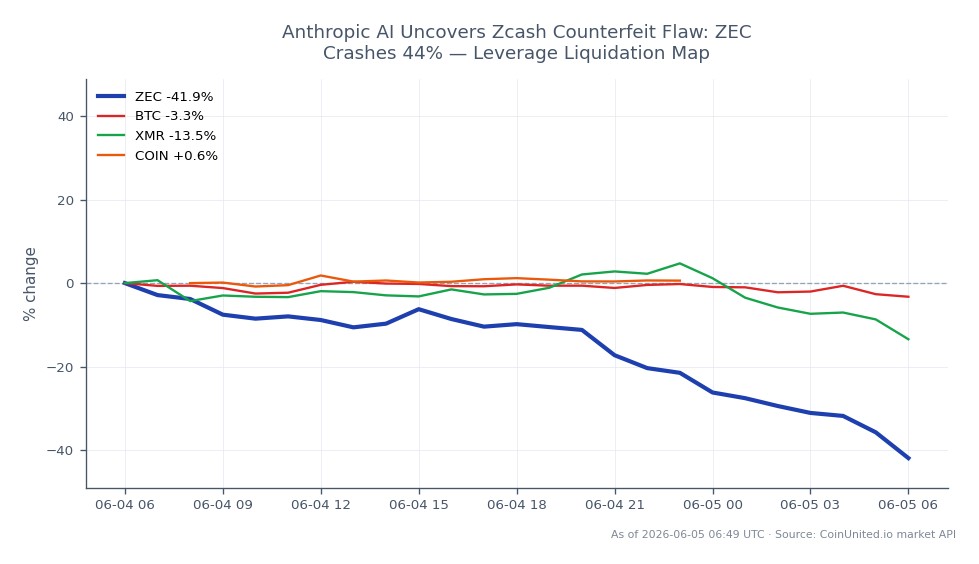
Zcash (ZEC) has suffered one of its sharpest single-session declines on record, falling 43.77% to $338.80 from a 24-hour high of $473.97, after disclosure of a counterfeit-minting vulnerability in the
Event Summary
Zcash (ZEC) has suffered one of its sharpest single-session declines on record, falling 43.77% to $338.80 from a 24-hour high of $473.97, after disclosure of a counterfeit-minting vulnerability in the protocol. According to multiple market feeds and Electric Coin Co.'s own remediation blog, the flaw could theoretically allow unauthorized creation of shielded ZEC — a direct attack on the fixed-supply integrity that underpins the coin's valuation. The vulnerability has since been patched, per Electric Coin Co., but whether any counterfeit issuance occurred before remediation remains unconfirmed.
The discovery has been attributed to white-hat research using AI tools with references to Anthropic AI — though sourced attribution details remain partially unverified. What is confirmed is the technical credibility of the flaw: Zcash's own remediation post validates the issue was real, not rumor. This follows a period of strong ZEC outperformance, making the trust-shock impact on leveraged longs especially severe.
Leverage Impact Analysis
The 43.77% drawdown is an extreme deleveraging event. Consider a trader holding a 50x long ZEC perpetual opened at the session high of $473.97 on CoinUnited.io:
- -Initial margin required (at 50x): ~2% of notional — a $2,000 margin controls $100,000 notional
- -Liquidation threshold: typically hit at ~1.5–2% adverse move at 50x — meaning positions opened above ~$481 were liquidated before the move accelerated
- -At current price $338.80: that position sits at a -28.6% loss on notional — a full wipeout of margin and more if not stopped out
For 20x long positions opened at $400 (mid-session): the drawdown to $338.80 represents a -15.3% move on notional — exceeding 100% margin loss on a 20x position. Even 10x longs opened above $380 are deeply underwater.
Short traders who entered before the disclosure and held through the spike to $473.97 faced severe squeeze risk — shorts at 20x opened at $350 would have seen unrealized losses exceeding margin at the intraday high. Post-disclosure, those shorts are now profitable but face volatile funding conditions. Monitor crypto derivatives positioning for funding rate normalization signals.
Security-driven crashes like this are classified as DeFi exploit contagion events — recovery timelines are uncertain and protocol-trust shocks can persist for weeks.
Cross-Market Impact
Privacy coins: Monero (XMR) faces the strongest spillover risk. A cryptographic vulnerability in Zcash raises questions about zero-knowledge proof integrity across the privacy-coin sector, even though XMR uses a different cryptographic system. Expect sentiment-driven selling pressure rather than fundamental contagion.
Bitcoin: Bitcoin is largely insulated — it uses transparent UTXO accounting, not zero-knowledge proofs. However, a broad altcoin risk-off wave can modestly compress BTC as traders rotate to safety or deleverage portfolios.
Crypto-proxy equities: Coinbase (COIN) carries indirect exposure via ZEC trading volume spikes and potential custody/operational risk optics. Elevated ZEC volatility typically boosts exchange revenue short-term, but protocol-integrity headlines introduce reputational noise.
Macro: No meaningful macro link. This is crypto-specific with limited spillover to forex or commodities.
Trading Considerations
ZEC's 24-hour low of $323.05 represents the immediate structural support to watch — a breach opens a retest of pre-rally levels. The $473.97 high now acts as strong overhead resistance and a reference for any dead-cat-bounce short entries. The critical unknown is whether confirmed counterfeit issuance occurred pre-patch; if Electric Coin Co. confirms zero exploitation, a partial recovery is plausible. If exploitation is confirmed, further supply-integrity repricing is likely.
Given extreme intraday volatility (high-to-low range of $150.92, or ~31.8%), position sizing must account for continued wide spreads. Check live funding rates on CoinUnited.io before entering any ZEC perpetual position.
Trade Zcash on CoinUnited.io
Trade ZEC with up to 2000xx leverage → | Create Free Account
Frequently Asked Questions
At current volatility with a $150 intraday range, positions above 5x carry significant liquidation risk on any further leg down toward or below the $323.05 low. Monitor live funding rates on CoinUnited.io and size accordingly.
Continue Exploring
Disclaimer: This brief is for educational purposes only and is not investment advice.