Quick Links
South Korea's First DEX Rug-Pull Arrest: What the CATFI Solana Memecoin Case Means for SOL and Crypto Traders
Data Snapshot
Key Takeaways
- •Seoul prosecutors charged five individuals behind the CATFI Solana memecoin in South Korea's first-ever DEX rug-pull criminal case under the new virtual asset law.
- •The $260,000 scheme is small, but the legal precedent is high-impact — rug-pull conduct on DEXs is now explicitly criminal in a major Asian market.
- •Solidus Labs data shows 98.6–98.7% of Pump.fun tokens display rug-pull characteristics, giving regulators ample justification for broader Solana DEX scrutiny.
- •Near-term headwind for Solana memecoins and thin-liquidity DEX tokens, particularly those marketed to Korean or Asian retail users.
- •Capital rotation thesis favors BTC and ETH over speculative memecoins as enforcement risk premium rises across the sector.
As reported by Crypto.news and BeInCrypto, Seoul prosecutors arrested and charged five individuals behind CATFI, a Solana-based memecoin, in what authorities describe as South Korea's first criminal a
Event Analysis
As reported by Crypto.news and BeInCrypto, Seoul prosecutors arrested and charged five individuals behind CATFI, a Solana-based memecoin, in what authorities describe as South Korea's first criminal action against a DEX rug pull under the country's new virtual asset law. The scheme involved a central suspect posing as the crypto influencer "Eth Father" to promote the token before withdrawing liquidity, generating approximately $260,000 in alleged illicit gains. While that figure is modest by global crypto standards, the legal novelty is the real story.
What distinguishes this from prior regulatory actions is the enforcement mechanism: South Korea is not debating whether CATFI constitutes a security — it is criminalizing the deceptive rug-pull conduct itself under a purpose-built virtual asset statute. This fits squarely within the broader crypto enforcement accountability wave, and it signals that rug pulls on DEXs are no longer a legal grey area in a major Asian market.
The structural backdrop is damning for Solana memecoins specifically. According to a Solidus Labs compliance report, approximately 98.6–98.7% of tokens on Pump.fun exhibit pump-and-dump or rug-pull characteristics, while around 93% of liquidity pools on Raydium show soft rug-pull traits. South Korean regulators are now aware of and apparently responsive to this data — the CATFI case is unlikely to be the last. This represents a meaningful escalation in the global regulatory enforcement wave targeting retail-facing speculative crypto products.
What This Means for Traders
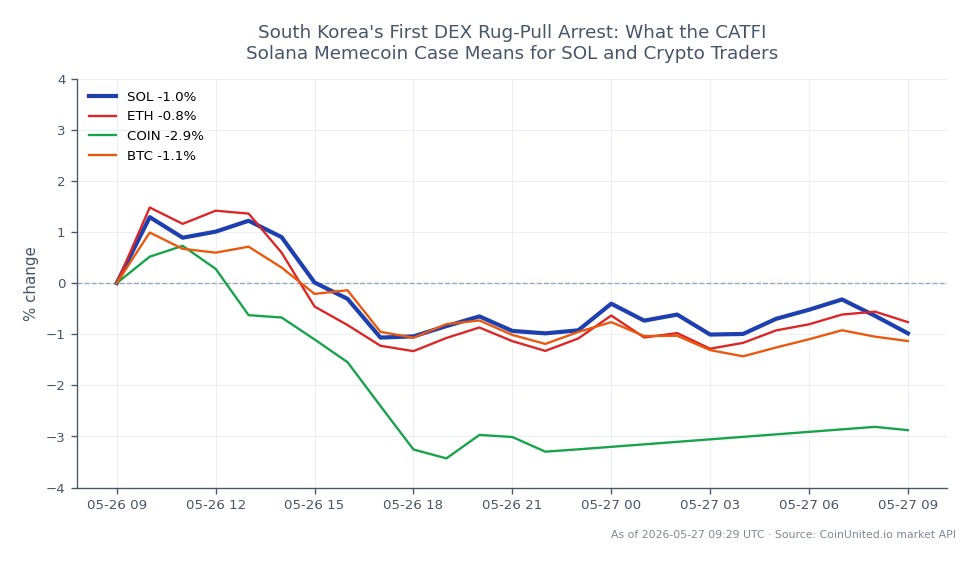
For SOL holders, the direct price impact from a $260,000 scheme is negligible — SOL was trading at $83.60 (down 0.95% over 24 hours) at the time of writing, per live market data. However, the reputational and regulatory risk premium is the real concern. If Korean regulators extend scrutiny to on-ramps, marketing channels, and CEX listings of Solana-based DEX tokens, Korean retail participation in the Solana memecoin segment could contract materially. This is a slow-burn headwind, not an immediate shock.
The more actionable implication lies in capital rotation. Enforcement pressure on speculative memecoin segments historically nudges flows toward larger-cap, more regulated exposures. Traders watching this cross-border enforcement repricing dynamic may find relative value in Bitcoin and Ethereum over illiquid Solana memecoins — the compliance-driven rotation thesis favors blue-chip L1s. For crypto-equity exposure, Coinbase and similar regulated exchange operators face a nuanced narrative: short-term, tighter enforcement dampens speculative volume; longer-term, it benefits compliant platforms. Consult our 2026 crypto market outlook and the crypto enforcement & accountability trader's guide for deeper context on how similar events have historically repriced sector risk.
Trade Solana on CoinUnited.io
Trade SOL with up to 2000xx leverage → | Create Free Account
Frequently Asked Questions
Not materially in the short term — SOL sits at $83.60 with a modest -0.95% 24h move. The risk is medium-term reputational and regulatory overhang on the Solana memecoin ecosystem, not an immediate price shock.
Continue Exploring
Disclaimer: This brief is for educational purposes only and is not investment advice.