Quick Links
RBNZ Hawkish Hold on Deck: NZD/USD Leverage Traders Eye OCR Track Deviation as the Real Trade
Data Snapshot
Key Takeaways
- •RBNZ is universally expected to hold at 2.25% — the market-moving variable is the published OCR track vs. ~78 bps of tightening already priced over the next 12 months.
- •Leverage risk is acute: NZD/USD's 19-pip pre-event range can expand to 60–100 pips on release, making high-leverage positions (50x+) vulnerable to liquidation on whipsaw moves.
- •AUD/NZD is the highest-conviction cross-market expression: a hawkish RBNZ that outpaces RBA guidance compresses this pair, offering a cleaner relative-value trade than outright NZD/USD longs.
- •A dovish-vs-expectations outcome (shallower or later hikes than priced) is the asymmetric tail risk — it would unwind crowded hawkish NZD positioning rapidly.
- •ING's base case targets NZD/USD at 0.62 by year-end if the hawkish path is confirmed — a 640-pip swing from current $0.5847 levels and a multi-month carry/momentum thesis.
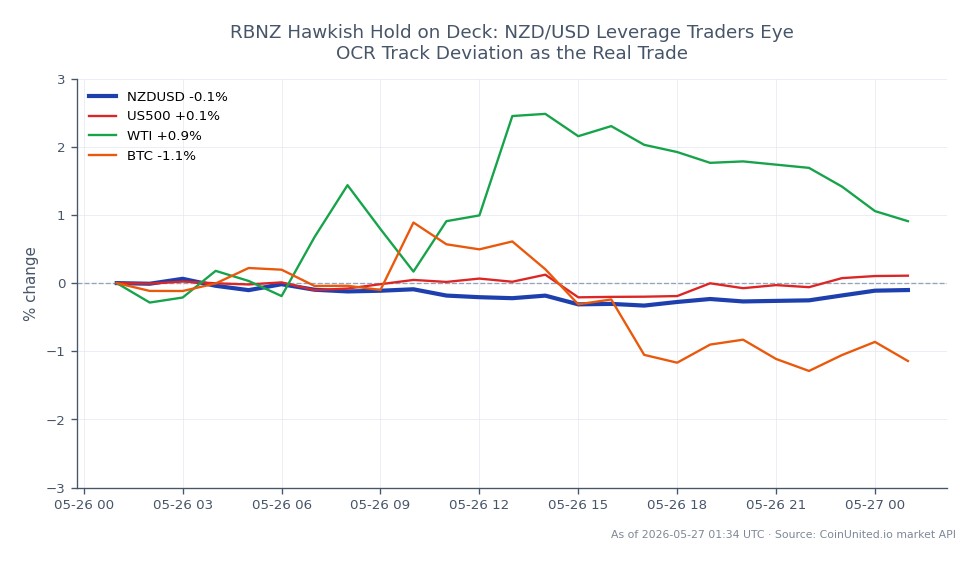
The Reserve Bank of New Zealand (RBNZ) is expected to keep its Official Cash Rate (OCR) at 2.25% at its 27 May 2026 Monetary Policy Statement — but the decision itself is not the trade. According to I
Event Summary
The Reserve Bank of New Zealand (RBNZ) is expected to keep its Official Cash Rate (OCR) at 2.25% at its 27 May 2026 Monetary Policy Statement — but the decision itself is not the trade. According to ING analysis, the RBNZ is anticipated to revise inflation forecasts higher and shift its projected OCR path upward, signaling two hikes beginning in Q3 2026 and targeting ~2.75% by year-end. Local market commentary cited by research sources notes that ~78 bps of tightening is already priced over the remainder of 2026, with ~120 bps over 12 months implying an OCR of 3.25–3.50% by mid-2027.
The RBNZ's own prior guidance pointed to holding the OCR "fairly steady in 2026" before a slow transition back toward its estimated neutral rate of ~3%. The gap between this guidance and current market pricing is the core tradeable tension heading into the decision.
Leverage Impact Analysis
NZD/USD is trading at $0.5847 (24h range: $0.5836–$0.5855) heading into the decision — a tight 19-pip band that understates post-announcement volatility risk.
Hawkish scenario (OCR track validates ~75–120 bps of hikes): A 100x long NZD/USD perpetual opened at $0.5847 requires only an 18-pip adverse move (~0.31%) to hit a 30% margin drawdown at that leverage. RBNZ decisions routinely generate 50–100 pip moves in NZD pairs within minutes of release.
Worked example — hawkish surprise:
- -50x long NZD/USD at $0.5847, notional $29,235 per standard lot
- -A 60-pip rally to $0.5907 = +$300 profit per lot at 50x; a 40-pip reversal to $0.5807 = –$200 per lot, approaching liquidation thresholds for undercapitalized positions
Dovish vs. expectations scenario (RBNZ projects shallower/later hikes than the ~78 bps priced): This is the asymmetric risk. If the OCR track shows only one hike or pushes timing past Q3, NZD/USD faces a sharp unwind of positioning — a 50x short AUD/NZD or long NZD/USD position built on hawkish expectations could see rapid liquidation.
Traders should check live funding rates on CoinUnited.io and size positions to withstand at minimum a 60–80 pip initial spike before direction confirms.
Cross-Market Impact
The RBNZ outcome feeds directly into the broader macro inflation risk-off repricing narrative. A confirmed hawkish pivot from a small open economy reinforces the thesis that global disinflation is stalling — relevant context for stagflation risk watchers.
AUD/USD: The most sensitive cross. A hawkish RBNZ that outpaces RBA guidance compresses AUD/NZD, effectively making AUD/USD a relative underperformer. Watch this pair as a confirmation signal.
USD/JPY: Higher NZ yields widen DM rate differentials, modestly supportive of carry trades funded in JPY — but BOJ policy divergence remains the dominant driver here.
Gold: A hawkish hold that strengthens the USD-bloc generally (via risk appetite and yield signals) creates marginal headwinds for gold as a risk-off refuge, though geopolitical factors dominate the inflation hedge thesis near-term.
Crypto (BTC/ETH): Impact is second-order. A broader hawkish DM signal slightly reduces global risk appetite, but RBNZ alone is insufficient to drive meaningful crypto repositioning. Monitor open interest for confirmation signals.
Trading Considerations
NZD/USD key levels: $0.5836 (24h low / near-term support), $0.5855 (24h high / immediate resistance). ING sees upside toward $0.62 by year-end if the hawkish path is validated — a 640-pip move from current levels that represents a multi-month swing trade thesis, not an intraday play.
The binary risk is real: if the RBNZ's published OCR track falls short of the ~78 bps priced by markets, NZD/USD faces an immediate flushing of hawkish positioning. Traders should define risk to the 24h low and avoid overleveraging ahead of the statement release. The APAC currency and inflation theme adds a secondary layer — any dovish surprise compounds regional risk-off flows.
Trade New Zealand Dollar / US Dollar on CoinUnited.io
Trade NZDUSD with up to 2000xx leverage → | Create Free Account
Frequently Asked Questions
RBNZ decisions typically generate 50–100 pip moves in NZD pairs within minutes of release. At 100x leverage, a 50-pip adverse move on NZD/USD (~0.85%) can wipe out most of the margin on a standard position — size accordingly and use hard stops.
Continue Exploring
Disclaimer: This brief is for educational purposes only and is not investment advice.