Quick Links
Slate Grocery REIT Jumps on Unsolicited Takeover Bid — What Traders Need to Know
Key Takeaways
- •Slate Grocery REIT received an unsolicited takeover offer, causing an immediate share price rally — the stock is now pricing in a deal probability premium.
- •Unsolicited bids often trigger peer repricing; grocery-anchored REIT peers may see sympathy moves as the market reassesses portfolio valuations.
- •This fits the active 2026 M&A acquisition wave targeting real asset and income-generating sectors.
- •Acquisition arbitrage traders should monitor management's formal response — rejection without a counter-bid risks a sharp retracement.
- •Broad index impact (S&P 500, Nasdaq 100) is likely minimal; the trade is primarily stock-specific and sector-level.
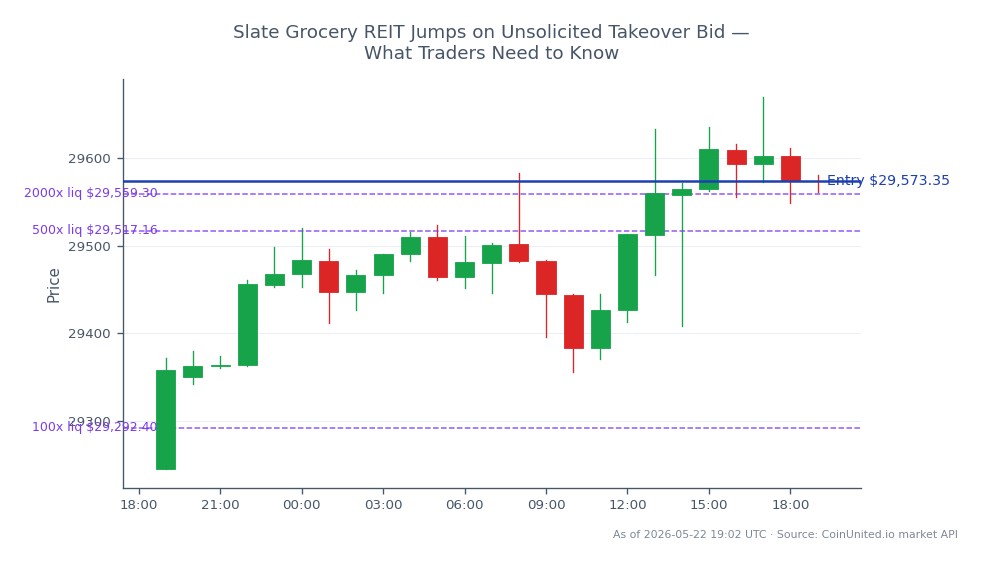
Slate Grocery REIT (SRG) has received an unsolicited takeover offer, triggering an immediate share price rally. Unsolicited bids — sometimes called hostile or opportunistic offers — are significant pr
Event Analysis
Slate Grocery REIT (SRG) has received an unsolicited takeover offer, triggering an immediate share price rally. Unsolicited bids — sometimes called hostile or opportunistic offers — are significant precisely because they signal that an external party believes the target is undervalued relative to its intrinsic or strategic worth. In the grocery-anchored REIT space, where assets provide stable, necessity-driven cash flows, this type of approach typically reflects a bidder's conviction that the portfolio is mispriced by the public market.
This event fits squarely into the broader M&A acquisition wave reshaping real asset sectors in 2026. REITs have been a recurring target class as institutional capital seeks inflation-resilient, income-generating portfolios — and grocery-anchored properties carry particular appeal given their defensive tenant base. The unsolicited nature of this bid adds a layer of complexity: management may resist, a bidding war could emerge, or a negotiated deal at a higher premium could follow. Each scenario carries distinct price implications.
The cross-sector acquisition repricing dynamic is also at play here. When a REIT receives a takeover bid, the market often re-rates peer REITs upward as investors anticipate that similar portfolio discounts may attract additional acquirers. Traders should watch for sympathetic moves across grocery-anchored and broader retail REIT peers. According to the news signal, this event requires immediate market confirmation — meaning the initial price pop needs to hold on volume before momentum can be considered credible.
For a deeper framework on how acquisition events create tradeable setups, the acquisition arbitrage guide and the M&A trading guide offer structured approaches to navigating deal uncertainty.
What This Means for Traders
The immediate trade setup in SRG is classic acquisition arbitrage: the stock prices in a probability-weighted premium, and traders must assess whether the final deal price (if any) justifies holding through the uncertainty. Key variables include whether the bid is binding, the premium offered versus the pre-announcement price, and management's response. If management rejects and no white knight emerges, the stock typically retraces toward pre-bid levels. If a bidding war develops, further upside is possible.
Broadly, this event is modestly risk-on for REIT and real asset sectors. The S&P 500 Index and NASDAQ 100 Index are listed as cross-market assets, though the direct impact on broad indices is likely limited given SRG's market cap. The more meaningful read-through is sector-level: grocery REIT peers and real estate income names may see sympathy bids as the market reassesses portfolio valuations. Volatility in SRG itself is likely to remain elevated until deal terms or a rejection is formally communicated.
Start Trading on CoinUnited.io
Create Your Free Account → — Trade crypto, stocks, forex, indices, and commodities with up to 2000x leverage and zero fees.
Frequently Asked Questions
If rejected without a counter-bid or competing offer, the stock typically retraces toward pre-announcement levels as the deal premium unwinds. Traders holding long positions should define their exit around this scenario.
Continue Exploring
Disclaimer: This brief is for educational purposes only and is not investment advice.