Quick Links
BITCOIN Act of 2025: How a 1M BTC Federal Reserve Program Reshapes Leverage Risk at $77K
Data Snapshot
Key Takeaways
- •The BITCOIN Act proposes purchasing 200,000 BTC/year for 5 years (1M BTC total) with a 20-year mandatory hold — converting government sell pressure into a permanent supply sink.
- •Leverage risk: At $77,604, a 50x long BTC perpetual liquidates near $76,830 — inside today's session low of $76,699. Position sizing must account for pre-passage volatility.
- •An Executive Order is already in force halting future USMS BTC auctions; the Act would codify and expand this in statute, making reversal significantly harder.
- •Crypto-proxy equities (MSTR, MARA, RIOT, COIN) face direct re-rating as U.S. sovereign endorsement of BTC lowers institutional adoption friction.
- •Gold faces marginal substitution pressure: the Act explicitly uses gold certificate revaluations to fund BTC purchases, formally linking the two reserve assets.
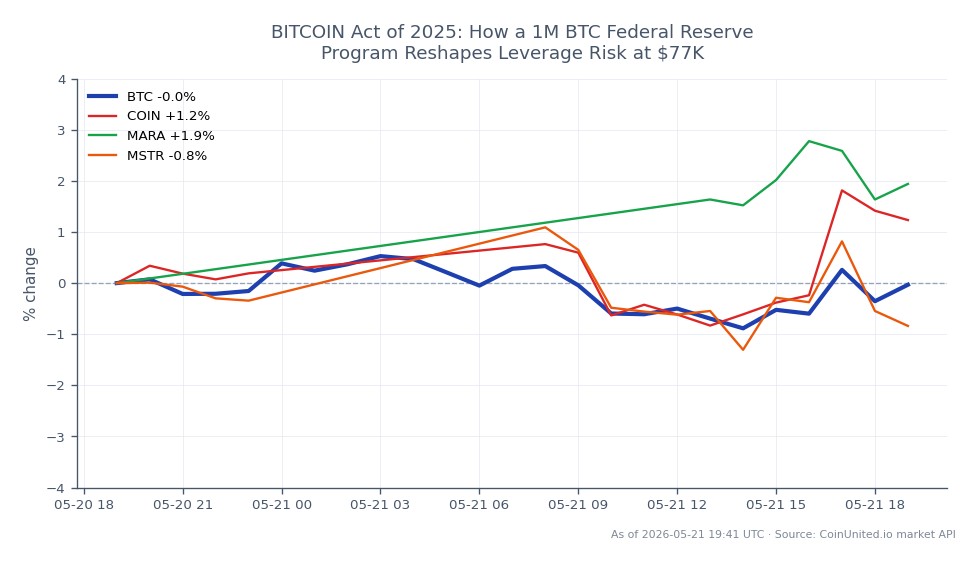
U.S. Senator Cynthia Lummis and Representative Nick Begich have introduced the BITCOIN Act of 2025, legislation that would direct the U.S. Treasury to purchase 200,000 BTC per year for five years — ac
Event Summary
U.S. Senator Cynthia Lummis and Representative Nick Begich have introduced the BITCOIN Act of 2025, legislation that would direct the U.S. Treasury to purchase 200,000 BTC per year for five years — accumulating 1,000,000 BTC (~5% of total supply) — and lock holdings for a mandatory 20-year minimum period. Purchases would be funded via $6B/year in Federal Reserve remittances and gold certificate revaluations, framing the program as budget-neutral. The bill builds on an existing Executive Order already in force, which consolidates all federally forfeited BTC into a Strategic Bitcoin Reserve (SBR) and prohibits future sales. The oft-cited "$25 billion federal stash" is an estimated market-value figure based on seized/forfeited BTC; it does not appear in the statutory or Executive Order text. The Act is introduced legislation, not yet law, per the official bill text reviewed by this desk.
Critically, the BITCOIN Act also prohibits federal interference with self-custody rights — a structural de-risking for the broader Bitcoin municipal & institutional adoption thesis and an accelerant for the crypto clarity act regulatory pivot narrative.
Leverage Impact Analysis
With BTC trading at $77,604 (24h range: $76,699–$78,179), leveraged longs face a classic policy-catalyst setup: strong narrative tailwind, but confirmation still pending Congressional passage.
Long scenario — 50x BTC perpetual opened at $77,604:
- -A 1% move to ~$78,380 returns +50% on margin.
- -Liquidation threshold (assuming ~1% maintenance margin) sits near $76,830 — inside today's low of $76,699.
- -The 24h range of ~$1,480 (~1.9%) means even moderate leverage faces intra-day liquidation risk on retracements.
Short squeeze risk: The 20-year lock-up eliminates the historical USMS auction supply channel. Any trader short BTC on "government will sell seized coins" logic faces structural invalidation. High-leverage shorts (>20x) opened below $78,000 are exposed if the Act gains committee momentum.
Funding rate watch: Sustained bullish narrative from a sovereign accumulation mandate typically drives perpetual funding rates positive. Monitor funding on CoinUnited.io — elevated positive funding increases the carry cost of long positions, compressing net returns at 50x–100x leverage.
For context on how corporate and sovereign BTC treasury strategies affect leveraged positioning, see Bitcoin Treasury Strategy: Corporate BTC Balance Sheets.
Cross-Market Impact
Crypto-proxy equities face direct re-rating. MicroStrategy (MSTR) benefits via NAV expansion if BTC reprices higher — its leveraged BTC-per-share model amplifies every dollar of BTC appreciation. Marathon Digital Holdings and Riot Platforms gain from improved long-term mining economics and the U.S. onshore mining narrative embedded in the SBR's domestic cold-storage mandate. Coinbase benefits from institutional flow acceleration as U.S. policy formally endorses BTC as a strategic asset.
Gold: The bill's explicit use of gold certificate revaluations to finance BTC purchases is a conceptual bridge linking BTC to hard-reserve asset frameworks — reinforcing the inflation hedge asset rotation trade. Gold may see modest selling pressure at the margin if sovereign allocators treat BTC as a partial substitute.
USD/macro: Near-term FX impact is muted. Longer-term, the bitcoin geopolitical payment rails dynamic strengthens if other nations mirror the SBR model, which could incrementally pressure dollar reserve dominance over a multi-year horizon.
Trading Considerations
BTC at $77,604 sits near the midpoint of its 24h range with only +0.30% daily change — the market has not yet fully priced the Act's passage probability. Key levels: $76,699 (session low / leveraged-long liquidation zone), $78,179 (session high / short-term resistance). A close above $78,200 on volume would signal institutional front-running of the legislative narrative.
The primary risk is legislative delay or failure — the purchase program requires Congressional appropriation, and the current political calendar is uncertain. Traders should size positions to survive BTC retracing to the $74,000–$75,000 range (prior structural support) before any bill markup catalyst materializes. For deeper analysis of the regulatory trajectory, see the Crypto Clarity Act & SEC Rules Trader's Guide.
Trade Bitcoin on CoinUnited.io
Trade BTC with up to 2000xx leverage → | Create Free Account
Frequently Asked Questions
At $77,604, a 50x long liquidates near $76,830 — inside today's low. Traders expecting pre-passage volatility should consider 10x–20x leverage with stops below $76,500, sizing to survive a retest of $74,000–$75,000 structural support before any bill markup catalyst.
Continue Exploring
Disclaimer: This brief is for educational purposes only and is not investment advice.